
CVS Stock Price Prediction 2025: Surprising Turnaround or Risky Bet?
Introduction
If you have been watching CVS Health stock over the past year, you already know how wild the ride has been. The stock plunged to multi-year lows in late 2024, scared off investors, and then staged one of the most dramatic recoveries in the large-cap healthcare space. So what happens next?
The CVS Stock Price Prediction 2025 is one of the most debated topics among retail investors and Wall Street analysts right now. Some see a deeply undervalued healthcare giant finding its footing. Others warn the turnaround is still fragile. In this article, you will get a full breakdown of where CVS stands today, what the analysts are saying, the key risks you need to watch, and what the numbers actually tell us about the road ahead.
Whether you already hold CVS shares or you are thinking about buying in, this guide gives you everything you need to make a smarter, more informed decision.
What Is CVS Health and Why Does It Matter to Investors?
CVS Health is one of the largest healthcare companies in the United States. It is not just a drugstore chain. It operates across four major business segments that touch almost every part of American healthcare.
The four core segments are:
- Health Care Benefits (Aetna): Health insurance plans including Medicare Advantage, Medicaid, and commercial plans.
- Health Services (Caremark): Pharmacy benefit management, negotiating drug prices for roughly 90 million plan members.
- Pharmacy and Consumer Wellness: More than 9,000 retail pharmacy locations and infusion services.
- Corporate and Other: Centralized functions and strategic investments.
This integrated model is what makes CVS unique. It controls the insurance side, the pharmacy benefit manager side, and the retail dispensing side all at once. That gives it enormous leverage in the healthcare value chain. But it also means that when one piece breaks, the damage can ripple fast. That is exactly what happened with Aetna in 2023 and 2024.
CVS Stock Performance: What Happened in 2024 and 2025?
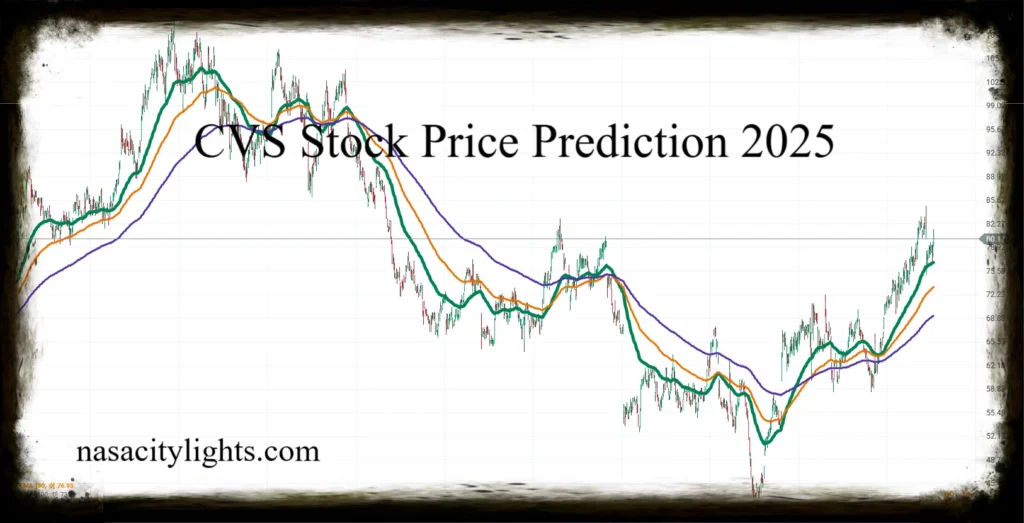
Image Description 2: A financial chart showing CVS Health stock price movement from 2024 to 2025, with a sharp decline in late 2024 followed by a recovery trend through 2025, representing the stock’s volatile journey.
To understand the CVS stock price prediction for 2025, you need to understand the context. The stock entered 2025 at around $44.89 per share, a painful low point after falling nearly 44% in 2024. That collapse was driven by surging medical costs in the Aetna Medicare Advantage business, which caught the entire insurance industry off guard.
But then something changed. Under new CEO David Joyner, who took over in late 2024, CVS launched an aggressive restructuring plan. The company cut costs, reshuffled leadership, exited unprofitable Medicare Advantage markets, and tightened its operational discipline.
The results were striking. By the end of 2025, CVS stock had climbed roughly 74% from its January starting point, trading around the $78 level. Full-year 2025 revenue reached $402 billion, up 7.85% year over year. The fourth quarter alone came in at $105.69 billion in revenue, beating Wall Street’s estimate of $103.59 billion.
The Pharmacy and Consumer Wellness segment delivered strong prescription volume growth. The Health Services segment grew 9% in Q4 2025. Even the troubled Aetna business showed signs of life, with improved Medicare Advantage star ratings and a medical benefit ratio trending in the right direction.
As CFO Brian Newman put it after the Q4 2025 results: 2024 was a tough year, but 2025 righted the ship.
CVS Stock Price Prediction 2025: What Do the Analysts Say?
Here is where things get interesting. Wall Street has turned noticeably bullish on CVS heading into 2025 and beyond.
Analyst consensus snapshot:
- Average 12-month price target: $94 to $97 (across multiple sources)
- High estimate: $105
- Low estimate: $80 to $83
- Consensus rating: Strong Buy (across 15 to 30 analysts depending on the platform)
- Upside potential from current levels: Approximately 25% to 29%
According to TipRanks data, 15 Wall Street analysts have issued price targets averaging $97 over the next 12 months, with the high end sitting at $105 and the low end at $93. TradingView’s aggregated forecast from 30 analysts puts the average target at $94.96, also with a max of $105.
One optimistic scenario from 24/7 Wall Street projects CVS could reach $125.70 over a 12-month period if strong earnings growth, positive market sentiment, and successful execution of the turnaround all come together. That would represent a 71.5% gain from 2025 price levels.
Even the conservative scenario from the same model puts CVS around $93.77, suggesting limited downside from current levels.
The broader message from the analyst community is clear: the risk-reward balance at current prices looks favorable.
Key Drivers That Could Push CVS Higher in 2025 and 2026
Image Description 3: A healthcare professional consulting with a patient inside a CVS MinuteClinic, representing the company’s growing healthcare delivery ambitions beyond traditional retail pharmacy.
Several concrete catalysts could drive CVS stock toward and beyond analyst targets. Here is what you should watch.
1. Aetna’s Medicare Advantage Recovery
This is the single biggest variable in the CVS story. The Aetna business has been the primary source of pain for the last two years, with a medical benefit ratio that ran far too high. But the 2025 numbers are showing improvement. The medical benefit ratio for the Healthcare Benefits segment came in at 87.3% in Q1 2025, down 310 basis points year over year. That is a meaningful move in the right direction.
CVS has set a target of 3% to 4% margins in its Medicare Advantage business by 2028. Hitting that target would be a powerful earnings catalyst.
2. Pharmacy Volume Growth
Same-store prescription volume grew 5.9% and 6.8% on a 30-day equivalent basis in Q4 2024, and the trend continued into 2025. The company also acquired Rite Aid prescription files during the restructuring, adding incremental volume. Pharmacy revenue remains the most stable and predictable part of the CVS business.
3. Biosimilar Leadership Through Cordavis
CVS successfully converted over 90% of eligible HUMIRA patients to lower-cost biosimilars through its Cordavis subsidiary, delivering nearly $1 billion in net savings for clients. This positions CVS as a major force in the fast-growing biosimilar market, which is projected to expand significantly as more blockbuster biologics face patent expiration.
4. PBM Business Strength
The Caremark pharmacy benefit management business serves approximately 90 million plan members. The TrueCost model, which passes drug rebates directly to plan members at the pharmacy counter, has gained strong traction. Over 75% of CVS Caremark commercial lives now use two or more elements of this model. That stickiness creates durable, recurring revenue.
5. 2026 Guidance Signals Confidence
CVS guided for full-year 2026 profit of $7 to $7.20 per share and total revenues of at least $400 billion. That kind of forward guidance from management signals genuine operational confidence, not just hope.
Risks That Could Hold CVS Back
No stock prediction is complete without an honest look at what could go wrong. CVS carries real risks that you should factor into your thinking.
Medical cost inflation in Medicare Advantage: This is still the biggest wildcard. If medical costs spike again, the Aetna business could slip back into losses. The industry is still navigating post-pandemic utilization patterns that have been hard to predict.
PBM regulatory pressure: Pharmacy benefit managers face growing political scrutiny in Washington. New regulations or pricing transparency requirements could squeeze Caremark’s margins.
Retail pharmacy headwinds: CVS has been closing underperforming retail stores as part of its restructuring plan. While this improves efficiency, it creates near-term disruption and revenue loss during the transition period.
Leverage levels: Interest expense rose significantly in 2025, up 5.4% for the full year due to long-term debt issuances. The company’s leverage ratio remains above its long-term targets, which limits financial flexibility.
IRA impact on Part D: The Inflation Reduction Act has changed the economics of Medicare Part D substantially. CVS has acknowledged uncertainty about the long-term Part D outlook and is monitoring the situation carefully.
Goodwill impairment charges: The company recorded goodwill impairment charges in 2025, which weighed on reported GAAP earnings even as adjusted earnings improved. This signals that some past acquisitions may not deliver full expected value. Source: TradingView
CVS Stock Valuation: Is It Still Cheap?
Image Description 4: A close-up of a financial newspaper showing CVS Health stock data, earnings figures, and market analysis, symbolizing investor research and Wall Street coverage of the healthcare company.
One reason analysts remain bullish is that CVS still trades at a significant discount to its historical valuation and to peers.
With a 2026 adjusted EPS guidance of $7 to $7.20 and a stock price around $80, the forward price-to-earnings ratio sits in the low double digits. For a company generating over $400 billion in annual revenue with strong recurring cash flows, that is a modest multiple.
Operating cash flow guidance for 2025 was approximately $6.5 billion. That level of cash generation gives CVS the ability to pay dividends, reduce debt, and invest in growth simultaneously. For income-focused investors, CVS has historically offered a meaningful dividend yield, adding to total return potential.
The market capitalization of CVS sits comfortably in the large-cap range (between $10 billion and $200 billion), which means institutional investors can hold it in quantity and index funds include it automatically. That broad ownership base provides a natural floor of support.
Long-Term Price Projection: What Happens After 2025?
Looking beyond 2025, the longer-term forecast paints a potentially more exciting picture for patient investors.
One forecasting model projects CVS reaching approximately $95 by mid-2026 and $110 by the end of 2027. Another model sees a price range between $86 and $99 by end of 2026. By 2030, some long-range models project CVS in the $150 range if the turnaround maintains momentum.
These are model-based projections, not guarantees. But they reflect a view that CVS’s integrated healthcare model, combined with structural demographic tailwinds from an aging U.S. population, creates a durable long-term growth story.
The baby boomer generation continues to age into Medicare eligibility at a rate of roughly 10,000 people per day in the United States. That creates an enormous and growing demand base for everything CVS touches: insurance, pharmacy services, primary care clinics, and specialty medications.
Should You Buy CVS Stock Right Now?
This is the question you are really asking, and I want to give you an honest answer rather than a sales pitch.
The case for buying CVS today rests on three pillars. First, the valuation is genuinely low relative to earnings power and cash flow. Second, the turnaround under David Joyner is showing real, measurable results. Third, the analyst community is broadly bullish with meaningful upside targets.
The case for caution rests on the execution risk still embedded in the Aetna recovery and the regulatory environment facing PBMs. CVS is not out of the woods. The 2025 recovery has been impressive, but the company still needs to prove it can sustain margin improvement in Medicare Advantage over multiple years.
If you have a long investment horizon and can tolerate short-term volatility, the CVS stock price prediction for 2025 and beyond looks genuinely interesting. If you need near-term certainty or cannot stomach potential drawdowns, the risk profile may not suit your situation.
Always do your own research. Consult a financial advisor who understands your specific situation. No stock prediction, including this one, should be the sole basis for an investment decision.
Conclusion
CVS Health has been one of the most compelling turnaround stories in the large-cap healthcare space. The stock entered 2025 beaten down and doubted, and it has rewarded patient investors with a dramatic recovery driven by real operational improvement.
The CVS stock price prediction for 2025 from Wall Street consensus points to a 12-month price target in the $94 to $97 range, representing roughly 25% upside from current levels. The bulls see an undervalued healthcare giant with a powerful integrated model, strong pharmacy fundamentals, and a recovering insurance business. The bears flag execution risk, medical cost inflation, and regulatory pressure.
What is your take? Are you watching CVS for a potential position, or do you think the easy money has already been made in this recovery? Drop your thoughts in the comments, share this article with fellow investors, or dig deeper into the company’s quarterly filings to form your own view.
Frequently Asked Questions
Q1: What is the CVS stock price prediction for 2025? Wall Street analysts have an average 12-month price target of roughly $94 to $97 for CVS Health, representing approximately 25% to 29% upside from recent trading levels. The high end of analyst targets sits at $105.
Q2: Is CVS stock a good buy in 2025? The majority of Wall Street analysts rate CVS as a Strong Buy in 2025. The stock trades at a low forward price-to-earnings multiple relative to its cash flow and earnings power. However, execution risk around the Aetna turnaround and regulatory pressures on PBMs are real concerns.
Q3: What caused CVS stock to fall so much in 2024? CVS stock fell roughly 44% in 2024 primarily due to surging medical costs in its Aetna Medicare Advantage business. Higher-than-expected hospital utilization from patients catching up on delayed procedures drove the medical benefit ratio to unsustainable levels.
Q4: What is CVS revenue and how has it grown? CVS Health generated $402 billion in annual revenue for 2025, up 7.85% from 2024. The company’s total revenues have grown substantially following its acquisition of Aetna and its expansion into healthcare services through Caremark and MinuteClinic.
Q5: What are the biggest risks for CVS stock in 2025? The main risks include continued medical cost inflation in Medicare Advantage, PBM regulatory scrutiny, potential disruption from ongoing retail pharmacy store closures, elevated debt levels, and the uncertain impact of the Inflation Reduction Act on Medicare Part D economics.
Q6: What is CVS earnings per share guidance for 2025 and 2026? CVS guided for full-year 2025 adjusted EPS of $5.75 to $6.00. For 2026, the company guided for profit of $7 to $7.20 per share and revenues of at least $400 billion, signaling continued recovery momentum.
Q7: Does CVS pay a dividend? Yes, CVS Health has historically paid a dividend. Income-focused investors often include CVS as a dividend-paying large-cap healthcare holding. You should check the current dividend rate and payout history for the most up-to-date figures.
Q8: What is CVS stock price prediction for 2030? Long-range forecasting models project CVS stock could reach $150 or higher by 2030, driven by demographic tailwinds from an aging U.S. population, growth in Medicare Advantage, and the expansion of CVS’s integrated healthcare delivery model. These are projections, not guarantees.
Q9: How many retail locations does CVS operate? As of the end of 2024, CVS operated more than 9,000 retail pharmacy locations, over 1,000 walk-in and primary care medical clinics, and served approximately 90 million pharmacy benefit management plan members.
Q10: What is CVS’s target margin for its Medicare Advantage business? CVS has stated a target margin of 3% to 4% for its Medicare Advantage business by 2028. Reaching that target would be a significant positive catalyst for the stock, as it was the poor Medicare Advantage margins that drove the 2024 stock decline.
Author Bio: James Harlow is a financial writer and market analyst with over a decade of experience covering U.S. equities, healthcare sector dynamics, and consumer-facing businesses. He specializes in breaking down complex company fundamentals into clear, actionable insights for everyday investors. His work bridges the gap between Wall Street analysis and Main Street decision-making.