
What Is The NASA Deep Space Network? The Amazing Truth in 2026
Introduction
Have you ever wondered how NASA talks to a spacecraft that is millions of miles away? That is exactly what the NASA Deep Space Network does. If you are asking yourself what is the NASA Deep Space Network, think of it as a giant cosmic phone line that never hangs up. It connects scientists on Earth to robots, rovers, and probes exploring places we can only dream of visiting. Without it, missions to Mars, Jupiter, and beyond would go silent. In this article, you will learn what the Deep Space Network is, how it works, which missions rely on it, and why it matters so much for space exploration. By the end, you will understand why this network is one of the most important tools humanity has ever built.
What Is The NASA Deep Space Network (DSN)?
The NASA Deep Space Network is a worldwide system of giant radio antennas. NASA uses it to communicate with spacecraft traveling far beyond Earth. It was created in 1963 and has grown into the backbone of deep space communication.
So when people ask what is the NASA Deep Space Network, the simple answer is this. It is Earth’s way of staying in touch with machines exploring the solar system and interstellar space.
What Does The Deep Space Network Do?
The Deep Space Network sends commands to spacecraft and receives data back from them. It also tracks the exact position and speed of these spacecraft.
Here is what it handles every single day:
- Sending instructions to rovers, probes, and telescopes
- Receiving images, videos, and scientific data
- Tracking spacecraft location and velocity
- Supporting emergency communication during critical mission moments
Without this constant connection, missions would lose contact and possibly fail.
Why Is The NASA Deep Space Network Important?
You might be thinking, why does this even matter to me? Well, every photo of Mars you have seen, every asteroid sample returned to Earth, and every deep space discovery passed through this network first.
The Deep Space Network keeps missions alive. It gives scientists real time data to make quick decisions. It also protects billion dollar spacecraft by keeping them connected to mission control.
How Does The Deep Space Network Communicate With Spacecraft?
The DSN uses powerful radio antennas to send and receive signals. These signals travel at the speed of light, but space is so vast that messages can still take minutes or even hours to arrive.
For example, a signal to Mars can take between 4 and 24 minutes one way, depending on the planet’s position. This is why understanding what is the NASA Deep Space Network also means understanding patience. Space communication is not instant.
Where Are The Deep Space Network Stations Located?
The Deep Space Network has three main stations placed strategically around the globe. This spacing ensures that as Earth rotates, at least one station always has a clear view of the spacecraft.
The three locations are:
- Goldstone, California, United States
- Madrid, Spain
- Canberra, Australia
This global setup is smart and simple. As one station loses sight of a spacecraft due to Earth’s rotation, another picks up the signal seamlessly.
How Many Antennas Are In The Deep Space Network?
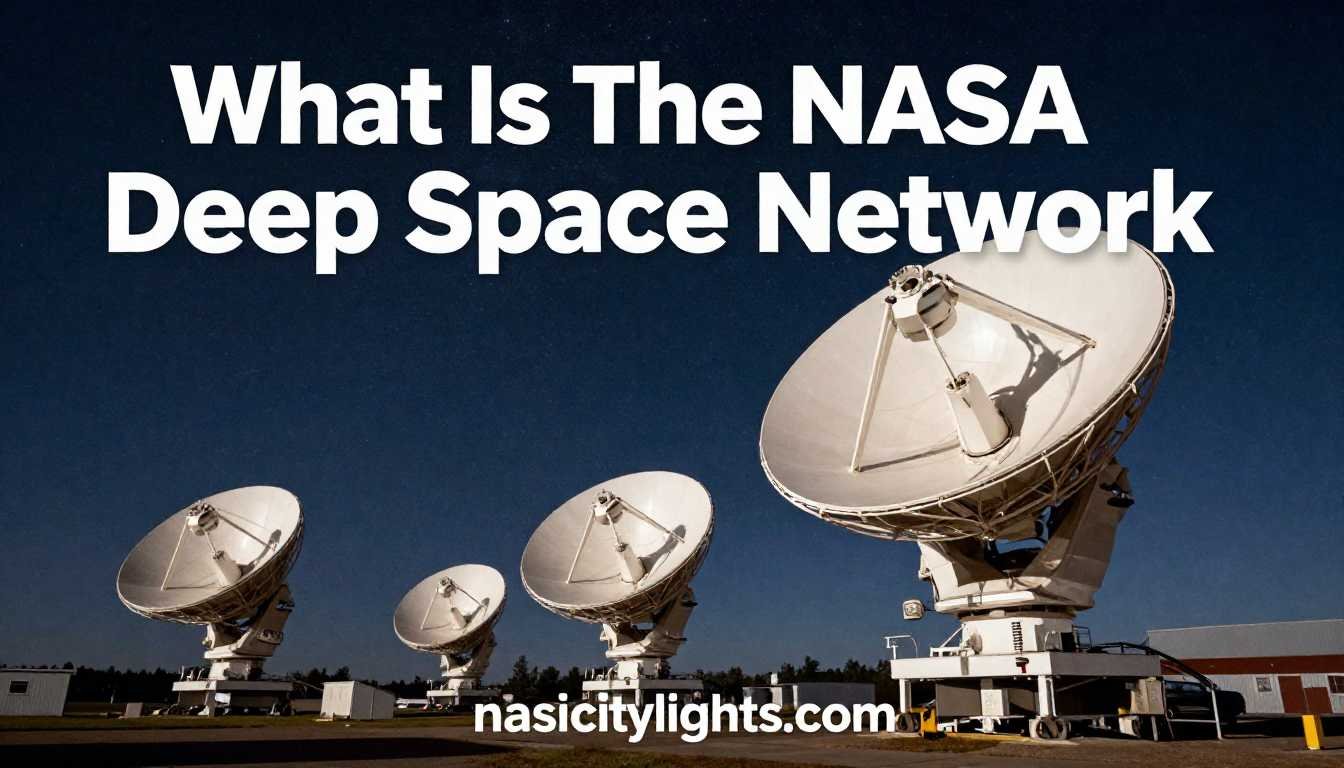
Each of the three DSN complexes has multiple large antennas. In total, the network includes more than a dozen antennas, with some measuring 34 meters wide and others reaching a massive 70 meters.
These antennas look like giant satellite dishes, but their scale is hard to imagine until you stand next to one. I have seen photos of the 70 meter dish, and it genuinely looks like something from a science fiction movie.
Which NASA Missions Use The Deep Space Network?
Almost every major NASA deep space mission relies on this network. Some well known examples include:
- Voyager 1 and Voyager 2
- Perseverance and Curiosity Mars rovers
- New Horizons, which explored Pluto
- Juno, studying Jupiter
- James Webb Space Telescope
Even missions from other countries and space agencies sometimes use DSN support through international agreements.
How Far Can The Deep Space Network Communicate?
This is one of the most impressive parts of the answer to what is the NASA Deep Space Network. The DSN can communicate with spacecraft billions of miles away.
Voyager 1, for instance, is now more than 15 billion miles from Earth and still sends data back through the DSN. That distance is almost impossible to picture, yet the network keeps the connection alive.
How Does The DSN Track Spacecraft?
The DSN does not just send messages. It also tracks spacecraft using precise measurements of signal timing and frequency shifts. This helps engineers calculate speed, direction, and exact location in space.
This tracking method is called radiometric tracking. It allows scientists to guide spacecraft with pinpoint accuracy across millions of miles.
What Technologies Does The Deep Space Network Use?
The DSN relies on advanced engineering to make deep space communication possible. Key technologies include:
- High powered radio transmitters
- Extremely sensitive receivers
- Atomic clocks for precise timing
- Signal processing software to clean up weak signals
Because signals weaken drastically over long distances, receivers must detect signals that are almost impossibly faint.
Can The Deep Space Network Communicate With Mars Missions?
Yes, absolutely. The Deep Space Network plays a major role in Mars exploration. It communicates directly with rovers like Perseverance and Curiosity, as well as orbiters circling the planet.
This connection allows scientists to send commands, receive images, and monitor rover health in near real time, considering the communication delay.
What Is The Difference Between The Deep Space Network And Satellite Communication?
Regular satellite communication works over short distances, usually within Earth’s orbit. The Deep Space Network, however, is built for extreme distances beyond Earth.
Here is a quick comparison:
| Feature | Satellite Communication | Deep Space Network |
|---|---|---|
| Distance | Thousands of miles | Millions to billions of miles |
| Signal delay | Seconds | Minutes to hours |
| Antenna size | Smaller | Massive, up to 70 meters |
| Purpose | Earth orbit tasks | Deep space missions |
This difference shows why the DSN needs such specialized and powerful equipment.
Who Operates The NASA Deep Space Network?
NASA’s Jet Propulsion Laboratory, known as JPL, manages the Deep Space Network. JPL has operated the network since its creation and continues to upgrade its technology to support future missions.
What Challenges Does The DSN Face?
Even a system this advanced faces real challenges. Some of the biggest ones include:
- Increasing demand from more missions launching each year
- Signal delay over extreme distances
- Aging infrastructure that requires constant upgrades
- Limited antenna time, since multiple missions compete for coverage
NASA continues investing in modernization to keep up with growing space exploration demands.
Future Upgrades And Modernization
NASA is actively working to expand the Deep Space Network. Plans include building new antennas, improving signal processing software, and preparing for future Moon and Mars missions.
As human exploration expands, the DSN will need to support even more spacecraft than ever before.
Importance For Moon And Mars Exploration
With NASA’s Artemis program aiming to return humans to the Moon, and future plans targeting Mars, the Deep Space Network will play an even bigger role. It will support astronaut communication, cargo missions, and scientific data transfer.
Conclusion
So, what is the NASA Deep Space Network? It is the invisible thread connecting Earth to humanity’s greatest space missions. From tracking Voyager 1 billions of miles away to guiding rovers across Mars, this network makes deep space exploration possible.
Next time you see a stunning photo from space, remember that it traveled through the Deep Space Network to reach you. What part of this system amazed you the most? Feel free to share this article with fellow space lovers.
Frequently Asked Questions (FAQs)
1. What is the NASA Deep Space Network in simple terms?
It is a global system of antennas that lets NASA communicate with spacecraft far beyond Earth.
2. Who built the Deep Space Network?
NASA’s Jet Propulsion Laboratory created and manages it.
3. How many stations does the DSN have?
Three stations, located in California, Spain, and Australia.
4. Can the Deep Space Network talk to Mars rovers?
Yes, it regularly communicates with Mars rovers and orbiters.
5. How far can the DSN send signals?
It can communicate with spacecraft billions of miles away, including Voyager 1.
6. Why does the DSN have stations in three different countries?
This spacing ensures constant coverage as Earth rotates.
7. Is the Deep Space Network the same as satellite TV systems?
No, satellite TV works over short distances, while the DSN handles deep space communication.
8. Will the Deep Space Network support future Moon missions?
Yes, it will play a key role in NASA’s Artemis program.
nasacitylights.com
Email: johanharwen314@gmail.com
Author Name: Hamid Ali
About The Author: Hamid Ali is a science and technology writer who enjoys breaking down complex space topics into simple, easy to understand articles. He is passionate about space exploration and loves sharing the wonders of the universe with everyday readers.