
Stunning Upcoming Meteor Showers in May 2026 You Must Not Miss
Introduction
Have you ever stood outside in the dark, looked up, and watched a streak of light tear across the sky in silence? There is something deeply moving about that moment. It connects you to the universe in a way that few things can.
May 2026 is shaping up to be one of the most exciting months for skywatchers. The upcoming meteor showers in May 2026 bring with them the promise of fast, brilliant streaks of light produced by the debris of one of history’s most famous comets. Whether you are a seasoned astronomer or someone who just discovered a love for the night sky, this guide covers everything you need to know to make the most of this spectacular month.
You will learn which showers to watch, when and where to look, how the moon will affect your view, and exactly what tips give you the best possible experience. Let us dive in.
What Causes a Meteor Shower?
Before you head outside, it helps to understand what you are actually watching.
Every year, Earth travels along its orbit around the Sun. Along this path, it passes through trails of dusty debris left behind by comets and, in some cases, asteroids. When tiny particles from those debris trails slam into Earth’s atmosphere at high speed, friction causes them to burn up in a flash of light. That flash is what you see as a shooting star.
A meteor shower happens when Earth crosses a particularly dense trail of debris. The meteors appear to radiate outward from a single point in the sky, called the radiant. Astronomers name showers after the constellation where that radiant sits.
The most dramatic May shower, the Eta Aquariids, comes from debris left behind by none other than Halley’s Comet, one of the most famous objects in the solar system.
The Star of the Month: The Eta Aquariid Meteor Shower
What Makes It Special?
The Eta Aquariids are not just another annual shower. They are fast, striking, and connected to a comet that humans have watched with awe for thousands of years.
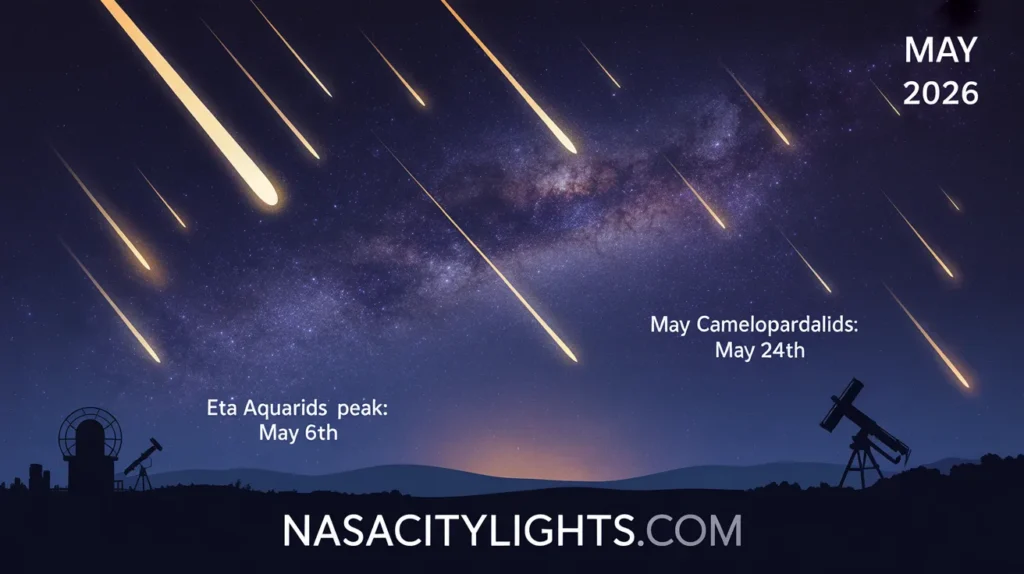
The Eta Aquariids shower runs annually from April 19 to May 28, and it peaks in 2026 on the night of May 6 and the morning of May 7. That is your main target night. However, the days surrounding the peak also offer elevated activity, so do not feel locked into a single evening.
The best morning to watch is May 5, 2026, in the hours before dawn. The American Meteor Society lists 3:51 UTC on May 5 as the shower’s predicted peak time, though activity stretches out over several days, making May 4 and May 6 also excellent mornings to watch.
How Many Meteors Can You Expect?
The Eta Aquariids can produce up to 60 meteors per hour at peak under ideal conditions. In the Northern Hemisphere, the rate can reach about 30 meteors per hour. Rates like that translate to roughly one meteor every two minutes, even from a moderately lit location.
The Eta Aquariids are a strong shower when viewed from the southern tropics. From the equator northward, they usually produce medium rates of 10 to 30 per hour just before dawn. These are swift meteors that produce a high percentage of persistent trains. A persistent train is that glowing trail that lingers in the sky for a second or two after the meteor has passed. It is one of the most beautiful things you can witness with the naked eye.
The Moon Problem in 2026
Here is the honest truth about this year’s peak: the moon is going to be a challenge.
In 2026, a waning gibbous moon will severely affect this shower, reducing hourly rates to less than 10. The moon will be about 84% full around the peak. That is a lot of natural light washing out the fainter meteors.
But do not cancel your plans just yet. Bright Eta Aquariid meteors still punch through moonlight. Here is what you can do to improve your odds:
- Find a dark spot away from city lights. Even a short drive to the countryside makes a huge difference.
- Block the moon physically. Stand so that a building, a hill, or a tree line hides the moon from your direct sight. This preserves your night vision.
- Focus on the pre-dawn window. The best time to watch is in the hours before dawn, looking generally toward the eastern sky. The radiant rises higher closer to sunrise, which boosts your chances.
- Give your eyes at least 20 to 30 minutes to adjust. Step away from your phone screen and any bright lights before you start watching.
Where in the Sky Should You Look?
Meteors will radiate from the constellation Aquarius, but can appear anywhere in the sky. Do not stare directly at the radiant. Instead, look about 45 degrees away from it and scan a wide area. Meteors near the radiant are shorter. The ones farther from it streak across larger portions of the sky and look far more dramatic.
The Lyrids: A Bonus Show at the Start of May
If you missed the Lyrid peak in late April, all is not lost.
The Lyrids peaked on April 22, 2026, displaying a maximum of about 18 meteors per hour in a clear sky. While the main peak has passed by the time May starts, the shower’s tail end still produces occasional bright meteors in the first few days of the month. Keep an eye out for lingering Lyrid activity if you are outside on clear early-May nights.
The Lyrids originate from debris shed by Comet C/1861 G1 Thatcher. They are known for occasionally producing bright fireballs, those extra-brilliant meteors that can light up the sky like a flashbulb.
The Arietids: The Best Daytime Shower You Have Probably Never Heard Of
Most people skip this one entirely. That is a mistake if you are willing to get up early.
The Arietids are sometimes described as the most active daytime meteor shower. In 2026, their predicted peak will be around the mornings of June 10. Watch for them in the sunrise direction in the dark hour before dawn breaks from May 22 to July 3.
Yes, this shower technically falls just outside of May. But its activity window starts in the last week of the month. You can begin watching for early Arietids in the pre-dawn hours starting around May 22.
The trick with this shower is timing. You need to watch in that narrow window between full darkness and sunrise, looking toward the east where the radiant rises just before the Sun. Look for meteors shooting up from near the horizon toward the constellation Aries.
How to Set Up the Perfect Meteor Watching Session
You do not need expensive equipment. In fact, telescopes and binoculars are completely useless for watching meteor showers because they narrow your field of view. Here is exactly what you need and what you should do:
Gear You Actually Need
- A reclining lawn chair or a blanket you can lie flat on
- Warm layers (nights are cold, even in May, especially after 2 a.m.)
- Snacks and a warm drink
- Red light flashlight if you need to see (red light does not destroy night vision the way white light does)
- A basic star map app on your phone, set to night mode
Location Tips
- Drive at least 20 to 30 minutes from the nearest city center
- Look for areas with an open horizon, away from trees and buildings
- Rural parks, hilltops, and open farmland all work well
- Avoid areas near highways, gas stations, or sports fields with bright lights
Timing Your Watch
For the best chance of seeing meteor showers, go somewhere dark, let your eyes adjust for about 20 to 30 minutes, and avoid bright lights, including your phone screen.
For the Eta Aquariids specifically, plan to be outside between 2 a.m. and 5 a.m. local time on the mornings of May 5 through May 7. That window gives you the best combination of a high radiant angle and pre-dawn darkness.
Understanding Your Location and Viewing Conditions
Where you live on Earth genuinely matters for the Eta Aquariids more than almost any other shower.
This shower favors more southerly latitudes, like those in the southern United States, and the Southern Hemisphere. If you are in South America, Australia, southern Africa, or southern Asia, you are in the ideal viewing zone. The radiant climbs higher in your sky before dawn, giving you more meteors and longer streaks.
If you live in northern Europe, Canada, or northern Asia, you will see fewer meteors simply because the radiant stays lower on the horizon. That does not mean it is not worth watching. You will still catch meteors, especially the brighter ones. Just set realistic expectations.
For viewers in Pakistan, India, and neighboring regions in South and Southeast Asia, you sit at a latitude that offers a reasonable view of the radiant. Pre-dawn hours between 3 a.m. and 5 a.m. local time should give you a decent window.
Weather and Cloud Cover: Plan Around It
Even the most perfectly timed meteor watch is ruined by clouds. Check your weather forecast in the 48 hours before your planned session.
If clouds are expected on the peak night of May 6, watch a night early or a night later. The Eta Aquariids’ peak stretches out over several days, so elevated meteor numbers continue a few days before and after the predicted peak. Flexibility is key.
Apps like Clear Outside, Clear Dark Sky, and Windy all provide detailed cloud and atmospheric seeing forecasts specifically for astronomers and skywatchers. Use them.
Can You Photograph the Meteor Shower?
Yes, and the results can be stunning even with a smartphone.
For smartphone photographers, use a night mode or a manual setting app. Set a long exposure of 10 to 30 seconds, point at the sky away from the moon, and place your phone on a stable surface or mini tripod.
For DSLR users, a wide angle lens (24mm or wider), an aperture of f/2.8 or faster, an ISO between 1600 and 3200, and exposures of 20 to 30 seconds will give you the best results. Take dozens of shots over the course of an hour. Meteors are unpredictable, and a high shot volume dramatically increases your chances of capturing one.
A Quick Look Ahead: More Great Showers After May
May sets the tone for a solid second half of the year. Here is a quick preview of what is coming:
Perseids (August 12 to 13): The Perseids are one of the best meteor showers to observe, with over 50 meteors per hour at their peak. August’s conditions look promising for 2026.
Draconids (October 8 to 9): The Draconids will peak when the Moon is only 1% full in 2026, so moonlight will not present any interference. The best viewing will be in the early evening from a dark location far away from city lights. This is one of the few showers best watched before midnight.
Geminids (December 13 to 14): The Geminids are the biggest meteor shower of the year, shooting stars streak across the sky the entire night, with 75 meteors per hour at their peak. In 2026, they coincide with a waxing crescent moon, making for nearly ideal viewing conditions.
So while May brings the first major challenge of the year, the calendar rewards patient skywatchers all the way through December.
Conclusion
May 2026 gives you a genuine, once-a-year opportunity to connect with one of the night sky’s most reliable spectacles. The upcoming meteor showers in May 2026, led by the Eta Aquariids, deliver fast, brilliant meteors born from the trail of Halley’s Comet. The moon will be bright, yes. But with the right preparation, a dark location, and a little patience, you will still catch streaks of cosmic light that stay with you long after the night is over.
Pick your night, pack your chair, set your alarm for 2 a.m., and get away from the city. The sky has something to show you.
Have you ever watched a meteor shower? Share your experience or ask your question in the comments below. And if this guide helped you plan your night, share it with a fellow skywatcher.
Frequently Asked Questions
1. When is the peak of the Eta Aquariid meteor shower in May 2026? The Eta Aquariids peak on the night of May 5 to 6, 2026. The best viewing window is in the hours before dawn on May 5. Activity remains elevated on May 4 and May 6 as well.
2. How many meteors can I expect to see during the Eta Aquariids in 2026? Under ideal dark sky conditions, the shower can produce up to 60 meteors per hour. However, because the moon will be about 84% full during the peak, rates will likely be reduced to fewer than 10 visible meteors per hour from most locations.
3. What direction should I look to see the Eta Aquariids? Look toward the eastern sky in the hours before dawn. The meteors radiate from the constellation Aquarius, but they can appear anywhere in the sky. Avoid staring directly at the radiant for the best views.
4. Do I need a telescope or binoculars to watch the meteor shower? No. Telescopes and binoculars narrow your field of view and actually make meteor watching harder. All you need are your naked eyes, a dark location, and patience.
5. What time should I go outside to watch the Eta Aquariids? Plan to be outside between 2 a.m. and 5 a.m. local time. The radiant rises higher as dawn approaches, which increases your chances of seeing meteors.
6. How does the moon affect meteor shower viewing? A bright moon acts like a natural light source that washes out faint meteors. In 2026, the nearly full waning gibbous moon will reduce visible rates significantly. You can partially offset this by physically blocking the moon behind a building or hillside.
7. Which hemisphere has the best view of the Eta Aquariids? The Southern Hemisphere and lower northern latitudes have the best view. The radiant sits higher in the sky for observers closer to the equator, producing more and longer meteor streaks. Northern latitudes will see fewer meteors due to the lower radiant angle.
8. Can I watch the Eta Aquariids from a city? You will see some meteors from a city, but your view will be dramatically reduced by light pollution. Even a short drive of 20 to 30 minutes to a rural area will significantly improve how many meteors you see.
9. What other meteor showers are active in May 2026? The Eta Aquariids are the main event, running from April 19 to May 28. Early Arietid activity also begins around May 22, visible in the pre-dawn sky looking toward the east. The tail end of the Lyrids may still produce occasional meteors in the first few days of May.
10. Is the Eta Aquariid shower visible every year? Yes. The Eta Aquariids are an annual shower that occurs every May when Earth passes through debris from Halley’s Comet. The intensity and viewing conditions vary from year to year depending mostly on moon phase and your geographic location.
Read More...
Author Bio
Layla Hassan is a science communicator and astronomy enthusiast with over a decade of experience writing about space, the night sky, and celestial events. She has covered meteor showers, solar eclipses, and planetary alignments for a global readership. When she is not writing, you will find her with a thermos of tea under a dark sky, watching the universe put on its show.