
Laws of Motion Explained with Real Life Examples (Easy Guide for Students 2026)

Introduction
Have you ever wondered why you lurch forward when a car brakes suddenly? Or why kicking a heavier ball feels harder than kicking a lighter one? These everyday moments are not random. They follow a set of rules that a brilliant scientist named Isaac Newton figured out more than 300 years ago.
The laws of motion explain how and why objects move the way they do. Once you understand them, the world around you starts making a lot more sense.
In this guide, you will learn all three of Newton’s laws of motion explained with real life examples. Whether you are preparing for an exam, trying to understand physics better, or simply curious, this article covers everything you need. Let us get started.
What Are the Laws of Motion?
The laws of motion are three fundamental rules that describe how objects behave when forces act on them. These laws apply to everything around us, from a rolling ball to a flying rocket.
They explain three key ideas:
- Why objects stay still or keep moving unless something stops or pushes them
- How force, mass, and acceleration are related
- Why every action produces an equal and opposite reaction
Together, these three laws form the backbone of classical mechanics in physics.
Who Discovered the Laws of Motion?
Sir Isaac Newton discovered and published the laws of motion in 1687 in his famous book Philosophiae Naturalis Principia Mathematica, which most people just call the Principia.
Newton built on earlier ideas from Galileo Galilei, who had studied how objects fall and move. But Newton took those ideas much further and gave the world a complete, mathematical framework.
Here are a few quick facts about Newton:
- Born in England in 1643
- Developed his laws during a period of intense study in the 1660s
- Also discovered the law of universal gravitation
- Considered one of the greatest scientists in human history
His three laws changed science forever and are still taught in schools and universities around the world today. Source:grc.nasa.gov
Newton’s First Law of Motion (Law of Inertia)
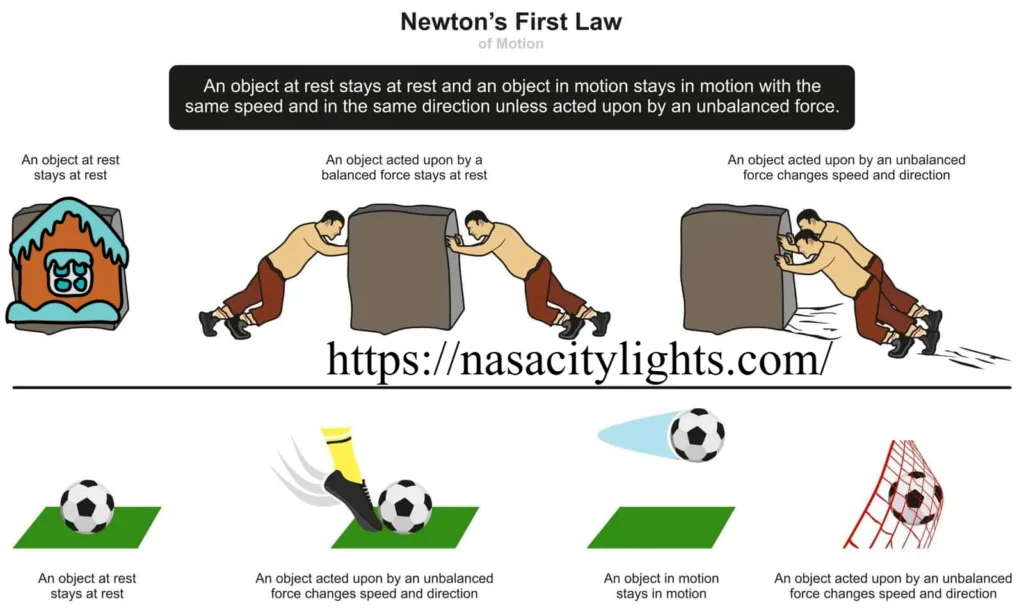
Newton’s First Law states: An object at rest stays at rest, and an object in motion stays in motion, unless an external force acts on it.
This is also called the Law of Inertia. Inertia is the tendency of an object to resist any change in its motion.
Real Life Examples of the First Law
Example 1: Seat Belts in a Car When a car stops suddenly, your body wants to keep moving forward. That is inertia at work. Your seat belt applies the external force needed to stop you. Without it, you would fly forward into the dashboard.
Example 2: A Book on a Table A book sitting on a table stays there until you push it. No force means no movement. That is the first law in its simplest form.
Example 3: A Rolling Ball If you roll a ball on a smooth floor, it gradually slows down. That happens because of friction, which is the external force acting against the motion. On a perfectly frictionless surface, it would roll forever.
Key Takeaway
The first law tells you that objects are “lazy” by nature. They do not change what they are doing unless something forces them to.
Newton’s Second Law of Motion
Newton’s Second Law states: The acceleration of an object depends on the net force acting on it and its mass.
The formula is simple and powerful:
Force = Mass × Acceleration (F = ma)
This means that if you apply more force, you get more acceleration. But if the object is heavier (more mass), it takes more force to achieve the same acceleration.
Real Life Examples of the Second Law
Example 1: Pushing a Shopping Cart An empty shopping cart is easy to push and accelerates quickly. A full cart, loaded with groceries, needs much more force to reach the same speed. The mass increased, so you need more force.
Example 2: Kicking a Football vs. a Medicine Ball You can kick a football and send it flying far. Try that with a heavy medicine ball and the result is very different. Same force, more mass, less acceleration.
Example 3: A Car Accelerating A sports car with a powerful engine can reach high speeds quickly. A heavy truck with the same engine would accelerate much more slowly. Mass matters.
Key Takeaway
The second law gives physics its most useful equation. It connects force, mass, and motion in a way that lets scientists and engineers calculate exactly how objects will behave.
Newton’s Third Law of Motion
Newton’s Third Law states: For every action, there is an equal and opposite reaction.
This means forces always come in pairs. When you push on something, it pushes back on you with the same amount of force but in the opposite direction.
Real Life Examples of the Third Law
Example 1: Jumping Off a Boat When you jump from a small boat onto a dock, the boat moves backward. You push against the boat (action), and the boat pushes back against you (reaction), which sends it in the opposite direction.
Example 2: A Rocket Launching Rockets work entirely because of the third law. Hot gases are expelled downward with great force (action). The rocket moves upward with an equal force (reaction). There is no engine pushing against the ground. The exhaust itself provides the push.
Example 3: Walking Every time you take a step, your foot pushes backward against the ground (action). The ground pushes forward on your foot (reaction). That reaction force is what moves you forward.
Key Takeaway
The third law explains why you cannot push something without being pushed back. Forces never act alone. They always work in pairs.
Laws of Motion in Everyday Life
You experience Newton’s laws every single day, often without realizing it.
- Washing machine spin cycle: The drum spins fast to push water out of clothes. This involves inertia and force working together.
- Hammering a nail: You apply force to the hammer (second law), and the nail experiences an equal force driving it into the wood (third law).
- Sliding on ice: Low friction means almost no external force to stop you, which is pure first law behavior.
- Opening a jar: You need enough force to overcome resistance. The harder the jar pushes back, the more force you need. That is F = ma in action.
Laws of Motion in Sports
Sports are basically physics in action. Every game you watch or play involves Newton’s laws.
- Cricket: A bowler applies force to the ball (second law). The ball moves toward the batsman. When the bat hits it, the ball changes direction because of the equal and opposite force (third law).
- Swimming: Swimmers push water backward with their arms and legs (action). The water pushes them forward (reaction). This is pure third law.
- Weightlifting: Lifting a heavier barbell requires more force. Less mass means less effort needed. That is the second law.
- Football tackle: A player with more mass and the same speed is harder to stop. This relates directly to inertia from the first law.
Laws of Motion in Transportation
Transportation engineering relies heavily on Newton’s laws.
- Car brakes: Brakes apply friction (external force) to stop a moving vehicle. Without that force, the first law says the car keeps moving.
- Aircraft takeoff: Engines generate thrust (force) to accelerate the plane. More thrust means faster acceleration, which is the second law.
- Rocket propulsion: As explained earlier, rockets use the third law to move through space. No air is needed. The reaction force from the exhaust is enough.
- Bicycle riding: Pedaling applies force to the wheels. The wheels push against the road, and the road pushes back, moving the bicycle forward.
How Does The International Space Station Get Oxygen
Why Are Newton’s Laws Important?
Newton’s laws are important because they form the foundation of classical physics and modern engineering.
Here is why they matter:
- Space exploration would be impossible without them. NASA uses Newton’s laws to calculate every rocket trajectory.
- Bridge and building design depends on understanding forces and motion.
- Vehicle safety features like airbags, crumple zones, and seat belts are all designed using these laws.
- Sports science uses them to help athletes improve performance and reduce injury.
- Everyday problem solving: Understanding these laws helps you make better decisions, from how you drive to how you carry heavy objects.
Simply put, without Newton’s laws, modern technology and science as we know it would not exist.
Common Misconceptions
A few myths about the laws of motion still confuse students. Let us clear them up.
Misconception 1: “Heavier objects fall faster.” Wrong. In a vacuum, all objects fall at the same rate regardless of mass. Galileo proved this. Air resistance is what causes the difference we see in real life.
Misconception 2: “An object in motion always slows down on its own.” Not true. Objects slow down because of friction or air resistance, which are external forces. Without them, the first law says the object would keep moving forever.
Misconception 3: “The third law means forces cancel out.” They do not cancel out because they act on different objects. When a bat hits a ball, the force on the bat and the force on the ball are both real and separate. They do not cancel each other.
Misconception 4: “You need constant force to maintain motion.” You only need force to start motion or change it. Once something is moving, no force is needed to keep it moving, unless friction is present.
How Does NASA Monitor Climate Change
Summary Table
| Law | Name | Statement | Real Life Example |
|---|---|---|---|
| First Law | Law of Inertia | Objects resist changes in motion | Seat belt stopping you in a crash |
| Second Law | F = ma | Force equals mass times acceleration | Pushing a loaded cart vs. an empty one |
| Third Law | Action and Reaction | Every action has an equal, opposite reaction | Rocket launching into space |
Conclusion
Newton’s laws of motion are not just textbook theories. They are the invisible rules running every moment of your physical world. From the way you walk to how rockets reach space, these three laws explain it all.
Understanding them gives you a powerful way to look at and interpret everything around you. Once you see physics in everyday life, it becomes impossible to ignore.
Which of the three laws surprised you the most? Drop your thoughts in the comments, or share this article with a classmate who is studying for their physics exam. It might just save their grade!
Frequently Asked Questions (FAQs)
What are Newton’s three laws of motion in simple words?
The first law says objects do not change their motion without a force. The second law says more force means more acceleration. The third law says every action has an equal and opposite reaction.
What is the best real life example of Newton’s first law?
A seat belt stopping you from flying forward during a sudden brake is one of the clearest examples of the first law in real life.
How does F = ma work in real life?
If you push a shopping cart with the same force every time, an empty cart moves faster than a full one. More mass means less acceleration for the same force.
Why does a rocket move upward?
A rocket expels hot gases downward with great force. According to Newton’s third law, the rocket gets pushed upward with an equal force. No ground contact is needed.
What is inertia in simple terms?
Inertia is the natural tendency of an object to stay doing what it is already doing. A resting object wants to stay still. A moving object wants to keep moving.
Are Newton’s laws still used today?
Yes, absolutely. Engineers, physicists, and scientists use Newton’s laws every day to design vehicles, build structures, plan space missions, and develop technology.
Do Newton’s laws work in space?
Yes, they do. In fact, Newton’s laws work even better in space because there is no air resistance or friction to complicate things.
What is the difference between mass and weight?
Mass is the amount of matter in an object. Weight is the force of gravity acting on that mass. Mass stays the same everywhere. Weight changes depending on gravity.
Can Newton’s laws be broken?
At very small (quantum) scales or at speeds near the speed of light, Newton’s laws do not apply perfectly. Einstein’s theory of relativity takes over at those extremes. For everyday life, Newton’s laws are completely reliable.
How can students remember the three laws easily?
Think of it this way: the first law is about stubbornness (objects resist change), the second is about effort (more mass needs more force), and the third is about fairness (every push gets a push back).
About the Author
Sarah Mitchell is a science educator and educational content writer with over eight years of experience simplifying complex physics and STEM topics for students of all ages. She holds a degree in Applied Physics and has contributed to several academic blogs and school curricula. Sarah believes that every student can love science when it is explained the right way.
Also Read In Nasacitylights.com
Email: johanharwen314@gmail.com
Author Name: Johan Harwen