
Difference Between Hubble And James Webb Telescope: The Ultimate Space Showdown
Introduction
Have you ever looked up at the night sky and wondered how scientists capture those breathtaking images of galaxies millions of light years away? Two names always come up in that conversation: Hubble and James Webb. If you have been confused about the difference between Hubble and James Webb telescope, you are not alone. Many people assume James Webb simply replaced Hubble, but that is not the full story.
In short, Hubble observes mainly visible and ultraviolet light, while the James Webb Space Telescope, often called JWST, primarily observes infrared light. This single difference allows JWST to see farther into the early universe and peek through thick clouds of cosmic dust that would normally block our view.
This article breaks down everything you need to know. We will cover their technology, their missions, their strengths, their weaknesses, and how they actually work as a team rather than competitors. By the end, you will understand the difference between Hubble and James Webb telescope so clearly that you could explain it to a friend over coffee.
What Is The Hubble Space Telescope?
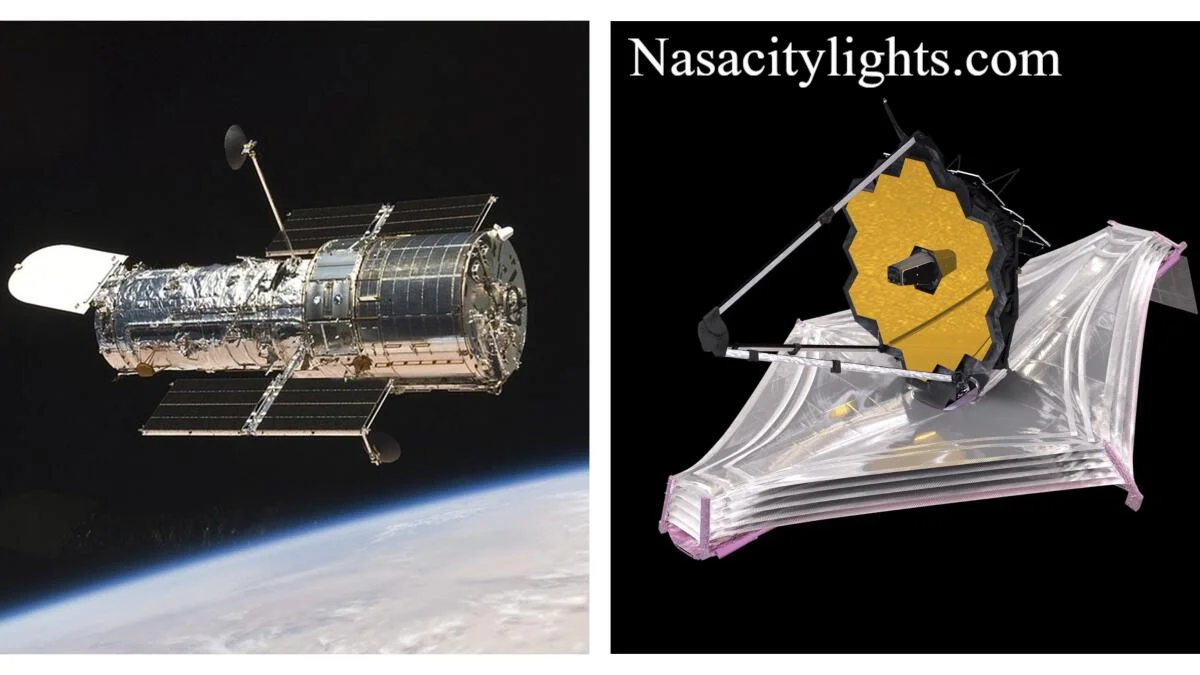
Hubble launched in 1990 and it changed astronomy forever. It orbits Earth at about 340 miles above the surface, close enough that astronauts once traveled up to repair and upgrade it.
Hubble mainly captures visible light, the same type of light your eyes can see, along with some ultraviolet light. This is why its images look so sharp and colorful to us. It gave humanity its first deep look at distant galaxies, stunning nebulae, and even helped scientists calculate the age of the universe.
What Is The James Webb Space Telescope?
JWST launched in December 2021 and represents a huge leap in engineering. Instead of orbiting close to Earth, it sits nearly 1 million miles away at a location called the second Lagrange point, or L2. This spot lets it stay in a stable position relative to Earth and the Sun.
JWST focuses on infrared light. Infrared has longer wavelengths than visible light, and it can pass through dust clouds that block visible light completely. This makes JWST incredibly good at spotting the very first galaxies that formed after the Big Bang.
Primary Differences Between Hubble And James Webb
Understanding the primary differences between Hubble and James Webb telescope becomes much easier when you break it down into simple categories. Let us go through the major ones.
Mirror Size And Light Collection
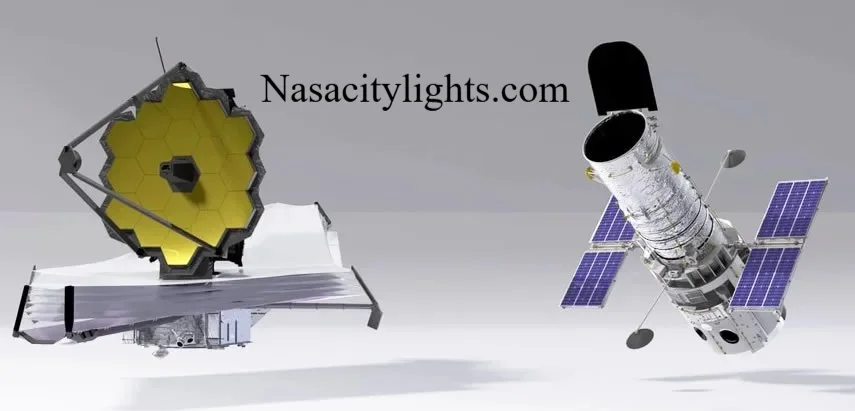
Hubble has a mirror that measures 2.4 meters across. JWST has a much larger mirror at 6.5 meters, made up of 18 gold coated hexagonal segments. A bigger mirror collects more light, which means JWST can detect fainter and more distant objects than Hubble ever could.
Orbit And Location
Hubble orbits Earth directly, completing a full orbit roughly every 95 minutes. JWST sits far away at L2, keeping it shielded from the heat and light of both the Earth and the Sun with the help of a massive five layer sunshield.
Wavelength Range
This is probably the biggest difference between Hubble and James Webb telescope. Hubble sees mostly visible and ultraviolet light. JWST sees near infrared and mid infrared light. Neither telescope is “wrong” or “outdated.” They simply see different parts of the light spectrum, similar to how a regular camera and a thermal camera capture completely different information about the same scene.
Mission Goals
Hubble was built to give humanity clear images of the cosmos in visible light and study things like star formation, galaxy structure, and planetary atmospheres in our solar system. JWST was designed specifically to look back in time toward the very first stars and galaxies, study exoplanet atmospheres in detail, and explore star formation hidden behind dust.
Why Can JWST See Older And More Distant Galaxies?
Here is where things get genuinely fascinating. As light travels across the universe, the expansion of space stretches its wavelength. This is called redshift. Light from the oldest, most distant galaxies started as visible or ultraviolet light billions of years ago, but by the time it reaches us, it has stretched into infrared wavelengths.
Since Hubble cannot detect much infrared light, it simply cannot see many of these ancient galaxies. JWST, built specifically to detect infrared, catches this stretched light easily. That is why JWST can peer back to just a few hundred million years after the Big Bang, something Hubble was never designed to do.
Side By Side Comparison Table
| Feature | Hubble Space Telescope | James Webb Space Telescope |
|---|---|---|
| Launch Year | 1990 | 2021 |
| Mirror Size | 2.4 meters | 6.5 meters |
| Orbit Location | Low Earth orbit, about 340 miles up | L2 point, about 1 million miles away |
| Wavelengths Observed | Visible and ultraviolet light | Near and mid infrared light |
| Main Mission Focus | Nearby galaxies, star formation, solar system | First galaxies, exoplanets, hidden star nurseries |
| Servicing | Serviced by astronauts five times | Not designed for physical servicing |
| Cooling Needs | Minimal cooling required | Requires extreme cold, near absolute zero |
| Sunshield | None | Five layer, tennis court sized shield |
Strengths And Limitations Of Each Telescope
Hubble Strengths
Hubble produces images in visible light that closely match what our eyes would see, making its pictures instantly recognizable and easy to relate to. It has decades of data, giving scientists a long timeline to study changes in the universe.
Hubble Limitations
Hubble cannot see through thick dust clouds, and it struggles to detect extremely distant, ancient galaxies because their light has shifted into infrared wavelengths it cannot capture.
JWST Strengths
JWST can see through dust, detect incredibly faint and distant light, and study the atmospheres of exoplanets with impressive detail. Its massive mirror gives it far greater sensitivity than Hubble.
JWST Limitations
JWST cannot observe ultraviolet light well, and because it sits so far from Earth, physical repairs are essentially impossible. If something breaks, scientists cannot send astronauts to fix it the way they did with Hubble.
Do Hubble And JWST Work Together?
Absolutely. Scientists often use both telescopes on the same object. Hubble captures the visible and ultraviolet data while JWST adds infrared details. Combining both datasets gives researchers a much fuller picture than either telescope could provide alone.
Think of it like this. If Hubble takes a normal photo of a forest, JWST adds a thermal scan showing hidden animals under the trees. Together, you get a complete story instead of just half of one.
Major Discoveries From Each Telescope
Hubble helped scientists measure the rate at which the universe is expanding, captured the iconic Pillars of Creation image, and provided key evidence supporting the existence of dark energy.
JWST has already detected some of the earliest known galaxies, found complex molecules in the atmospheres of distant exoplanets, and captured a stunningly detailed, deeper version of the Pillars of Creation, revealing structures Hubble could not show.
Why Infrared Observations Matter So Much
Infrared light matters because it reveals what visible light cannot. Stars form inside thick clouds of gas and dust, and normal visible light gets blocked before it ever reaches us. Infrared light passes through these clouds, allowing scientists to watch stars being born in real time.
Infrared also helps detect cooler objects, like planets and brown dwarfs, that do not emit much visible light at all. Without infrared technology, huge parts of the universe would remain permanently hidden from view.
Common Questions About Hubble And James Webb
Which Telescope Is More Powerful?
JWST is more powerful in terms of light collecting ability and sensitivity, mainly because of its much larger mirror. However, “more powerful” does not mean “better” for every task, since each telescope specializes in different wavelengths.
Why Is James Webb Better Than Hubble?
JWST is not necessarily better overall. It is better specifically for viewing distant, ancient galaxies and seeing through dust. Hubble remains excellent for visible and ultraviolet observations that JWST cannot perform.
Can Hubble And JWST Work Together?
Yes, and they frequently do. Astronomers combine visible light data from Hubble with infrared data from JWST to build a more complete understanding of cosmic objects.
Which Telescope Sees Farther Into Space?
JWST sees farther into space and further back in time due to its infrared capabilities and larger mirror, allowing it to detect extremely faint, ancient light that Hubble cannot capture.
Is Hubble Still Operating?
Yes, Hubble is still active and continues collecting valuable data more than three decades after launch, working alongside JWST rather than being replaced by it.
Final Thoughts
Understanding the difference between Hubble and James Webb telescope really comes down to one core idea. They are not rivals. They are teammates built for different jobs. Hubble shows us the universe the way our eyes might see it, while JWST reveals the hidden, ancient, dust covered corners that would otherwise stay invisible.
Both telescopes continue expanding what we know about space, and together they give scientists a richer, more complete view of the cosmos than either could offer alone. Next time someone asks you about the difference between Hubble and James Webb telescope, you will have a clear, confident answer ready to share.
What do you think is the more exciting discovery so far, Hubble’s classic images or JWST’s deep look into the early universe? Feel free to share your thoughts and pass this along to a fellow space enthusiast.
Frequently Asked Questions
1. What is the main difference between Hubble and James Webb telescope? Hubble observes visible and ultraviolet light while JWST observes infrared light, allowing JWST to see older, more distant, and dust covered objects.
2. Did James Webb replace Hubble? No, JWST did not replace Hubble. Both telescopes operate at the same time and often complement each other’s observations.
3. Why does JWST need to stay so cold? JWST detects infrared light, which is essentially heat radiation. If the telescope itself were warm, its own heat would interfere with readings, so it must stay extremely cold to work properly.
4. Can Hubble detect infrared light at all? Hubble has very limited infrared capability compared to JWST, which was specifically engineered for infrared observation.
5. Which telescope has better image resolution? JWST generally offers sharper resolution in infrared wavelengths thanks to its larger mirror, while Hubble remains excellent for visible light resolution.
6. Where is the James Webb telescope located? JWST orbits the Sun near the second Lagrange point, roughly 1 million miles from Earth, far beyond Hubble’s low Earth orbit.
7. Why can’t astronauts repair James Webb like they did Hubble? JWST sits too far from Earth for a crewed servicing mission, unlike Hubble, which orbits close enough for astronauts to reach.
8. Is JWST a bigger telescope than Hubble? Yes, JWST has a mirror nearly three times the diameter of Hubble’s mirror, giving it significantly more light gathering power.
Nasacitylights.com
Email: johanharwen314@gmail.com
Author Name: Hamid Ali
About The Author: Hamid Ali is a science writer who enjoys breaking down complex space topics into simple, easy to understand articles for everyday readers. He is passionate about astronomy and loves helping people connect with the wonders of the universe.