
Why Is Space Dark? The Surprising Truth Revealed in 2026
Why Is Space Dark? The Real Science Explained
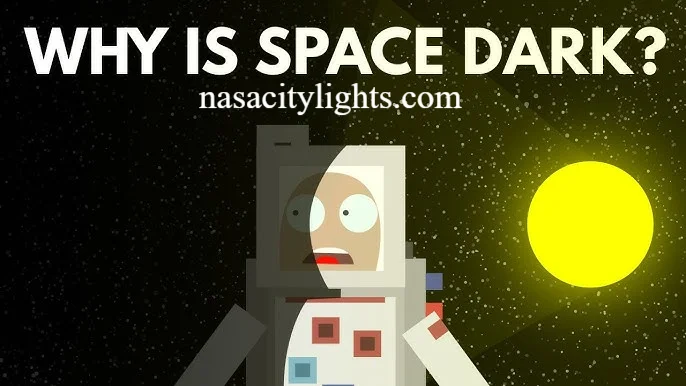
Space appears dark because there are very few particles floating around to scatter sunlight. On Earth, our atmosphere is packed with gas molecules that catch sunlight and spread it across the sky, which is why you see blue during the day. Out in space, there is almost nothing to catch that light. Light only becomes visible to your eyes when it bounces off something solid, like a planet, a moon, or a spacecraft, or when it travels straight into your eyes. Without that scattering effect, the space around stars and planets stays pitch black, even when the Sun is shining brighter than ever.
This single question, why is space dark, has puzzled curious minds for centuries. You would think that with billions of stars burning nonstop, the entire universe should glow. Yet astronauts who have floated outside their spacecraft describe a sky that looks like black velvet, dotted with sharp points of light. In this article, we will break down exactly why is space dark using simple science, cover what NASA and other space agencies say about it, and answer the most common questions people search for. By the end, you will understand this cosmic mystery better than most.
Why Is Space Dark If the Sun Is So Bright
It feels strange, right? The Sun is an enormous ball of fire, and yet the space around it looks like ink. The answer lies in how light actually works. Light itself is invisible while traveling. You only see a beam of light when it hits particles in the air, dust, water droplets, or your own eye.
On Earth, sunlight hits the atmosphere and scatters in every direction. That scattered light fills the sky and makes daytime bright and blue. In space, there is no atmosphere. There are no particles to bump into the sunlight and scatter it around. So sunlight just travels in a straight line through empty space without lighting anything up, unless it strikes an object directly. That object could be a planet, a satellite, or your own visor. This is the core reason why is space dark, and it surprises almost everyone who first learns it.
Why Is the Sky Black in Space
The sky looks black in space because there is nothing between you and the darkness of the universe to reflect or scatter light toward your eyes. Think of a laser pointer in a clean room. You cannot see the beam itself, only the dot it makes on the wall. Space works the same way on a massive scale.
Astronauts confirm this every time they step outside the International Space Station. They describe the sky as deep black, even during a spacewalk in full daylight. NASA has explained this many times in its educational material, noting that the black sky in space is simply the natural background of the universe once you remove the atmosphere that colors Earth’s sky.
Is Space Completely Dark
Not entirely. Space is mostly dark, but it is not empty of light. Stars, galaxies, nebulae, and reflected sunlight off planets and moons all add light to the darkness. The problem is that these light sources are spread across an unimaginably huge distance. Most of the space between them stays empty and dark.
Scientists sometimes call this puzzle Olbers Paradox. If the universe is infinite and filled with stars, shouldn’t the whole sky be lit up like daytime everywhere? The answer connects to the age and expansion of the universe. Many stars are so far away that their light has not even reached us yet, and some light has stretched out and weakened as the universe expands. So while space contains light, it is nowhere near enough to fill the vast darkness. This is another layer of why is space dark on such a massive cosmic scale.
Why Can’t We See Light in Empty Space
This part trips up a lot of people. Light travels through space constantly, yet the space itself never lights up. Here is a simple way to picture it. Imagine standing in a completely empty, dust free room with a flashlight pointed straight ahead. You would only see the spot where the beam lands, not the beam traveling through the air.
Your eyes only detect light when photons actually hit your retina, either directly from a light source or after bouncing off a surface. Empty space has almost no matter to bounce that light toward you. Without a surface or particle to interact with, sunlight simply passes through space unseen. That is a big part of the answer to why is space dark, and it comes down to basic human vision and physics working together.
Why Do Stars Shine in a Dark Universe
Stars shine because they produce their own light through nuclear fusion, and that light travels directly to your eyes across space. You are not seeing scattered light when you look at a star. You are seeing the star’s own light hitting your retina straight on.
This is exactly why stars appear as bright pinpoints against a black background instead of blending into a glowing sky. Each star is a direct light source, but the space between stars remains dark because there is nothing there to scatter or reflect that starlight sideways. It travels straight past you unless you happen to be looking right at it.
Does Space Ever Become Bright
Space itself never turns bright the way Earth’s sky does. However, certain regions can appear more colorful or glowing to telescopes, such as nebulae, which are clouds of gas and dust that reflect or emit light. Photos from powerful telescopes like Hubble or the James Webb Space Telescope often show vivid colors, but these images use long exposures and enhanced processing to reveal detail the human eye cannot naturally see.
To an astronaut’s naked eye, space still looks black surrounding these objects. The vacuum around stars, planets, and nebulae remains dark no matter how much light is technically present nearby. This is one more reason why is space dark stays true even in regions packed with cosmic activity.
Why Is Earth’s Sky Blue but Space Is Black
Earth’s sky is blue because of a process called Rayleigh scattering. Sunlight contains all colors, and when it hits the gas molecules in our atmosphere, blue light scatters more than other colors because it travels in shorter, smaller waves. That scattered blue light spreads across the sky, making it look blue during the day.
Space has no atmosphere and no gas molecules to scatter that blue light. Without an atmosphere, there is nothing to spread sunlight around, so the background stays black no matter how bright the Sun is. This contrast between Earth’s blue sky and space’s black sky is one of the clearest ways to understand why is space dark.
The Role of Vacuum, Sunlight, and Human Vision
Let us bring these ideas together simply.
Vacuum of space: Space is mostly empty, with extremely few atoms or molecules floating around compared to Earth’s dense atmosphere.
Sunlight in space: Sunlight travels in straight lines through this vacuum without spreading out or lighting up the surrounding darkness.
Human vision: Your eyes need light to enter them directly or bounce off a surface to actually see anything. Since there is nothing in most of space to bounce that light toward you, it stays invisible.
Put these three factors together and you get a clear, simple answer to why is space dark. I always tell people to picture a flashlight beam in a foggy room versus a clean one. Fog scatters the light and makes the beam visible. Space is the cleanest room imaginable, so nothing scatters the light except when it hits something solid.
Why Astronauts See a Black Sky
Astronauts on spacewalks often describe an intense contrast. Their sunlit side looks blindingly bright, while the sky around them stays completely black. This happens because the Sun is shining directly on their suit and the station, giving plenty of direct light, while the empty vacuum around them has nothing to scatter that light into a glow.
Photos from missions confirm this again and again. Even with the Sun fully visible and no clouds or atmosphere in the way, the background sky never turns blue or bright. It stays black, proving that atmosphere, not sunlight alone, is what creates a bright sky.
Conclusion
So, why is space dark? It comes down to a simple but fascinating combination of factors. Space has almost no atmosphere or particles to scatter sunlight, so light only becomes visible when it hits an object or shines straight into your eyes. Earth’s atmosphere gives us a blue daytime sky through scattering, while the vacuum of space offers no such effect, leaving a black backdrop dotted with stars.
Understanding why is space dark helps you appreciate just how special Earth’s atmosphere really is. It protects us, colors our sky, and lets us enjoy daylight the way we know it. Next time you look up at a clear night sky, remember that you are looking through a thin blanket of air into the vast, silent darkness beyond. What part of this surprised you the most? Feel free to share this article with a fellow space lover and keep exploring the mysteries above us.
Frequently Asked Questions
Why is space dark even though the Sun produces so much light?
Space stays dark because there is almost nothing in the vacuum to scatter sunlight. Light only becomes visible when it hits a surface or enters your eyes directly.
Is space actually completely black?
Space is mostly black, but it does contain light from stars, galaxies, and reflected sunlight off planets and moons. These sources are simply too spread out to light up the entire sky.
Why does Earth have a blue sky if space is black?
Earth’s atmosphere scatters sunlight through a process called Rayleigh scattering, which spreads blue light across the sky. Space has no atmosphere, so this scattering never happens.
Do astronauts see darkness even in daylight?
Yes, astronauts see a black sky surrounding them even when sunlight is shining directly on their spacecraft or suit, because there is nothing nearby to scatter that light.
Why can we see stars if space is dark?
Stars produce their own light through nuclear fusion, and that light travels straight to your eyes, making them visible as bright points against the black background.
Does the darkness of space prove the universe is empty?
No, the darkness mainly shows that light needs particles or surfaces to scatter or reflect off. The universe contains matter, but most of space between objects remains empty and dark.
Why is space dark in photos from telescopes?
Even detailed telescope images show a black background because the vacuum of space surrounding stars and nebulae still lacks the particles needed to scatter light into a glow.
nasacitylights.com
Email: johanharwen314@gmail.com
Author Name: Hamid Ali
About the Author: Hamid Ali is a science writer who enjoys breaking down complex space and astronomy topics into simple, easy to understand explanations for everyday readers. He focuses on accurate, research backed content that makes learning about the universe enjoyable for everyone.