
Crocodile Brain Size: Small Brain, Surprisingly Smart Hunter
Introduction
Picture a crocodile lying motionless at the edge of a river, waiting for the perfect moment to strike. That patience is not luck. It comes from a brain that works far harder than its size suggests. When people first learn about crocodile brain size, they often assume such a massive, powerful animal must carry an equally massive brain. It does not. A crocodile’s brain is tiny compared to its body, yet it still manages to outsmart prey, remember hunting spots, and adapt to changing surroundings.
In this article, you will learn exactly how big a crocodile’s brain is, what it looks like, and how it stacks up against alligators, other reptiles, and mammals. You will also discover why crocodile brain size has little to do with how intelligent these animals actually are. By the end, you will understand the real story behind one of nature’s most efficient predators.
How Big Is a Crocodile’s Brain?
Crocodile brain size is surprisingly modest. On average, a crocodile’s brain weighs only a few grams, even in animals that can grow over four meters long and weigh several hundred kilograms. You read that right. An animal capable of crushing bone with one bite carries a brain roughly the size of a small sausage.
To put this in perspective, consider these numbers.
- A large saltwater crocodile can weigh over 400 kilograms, yet its brain weighs only around 8 to 10 grams.
- A Nile crocodile of similar size shows a comparable pattern, with brain mass making up a tiny fraction of total body mass.
- Smaller crocodilian species carry proportionally smaller brains, sometimes just a few grams total.
This means crocodile brain size typically represents less than 0.05 percent of total body weight. Compare that to humans, whose brains make up roughly 2 percent of body weight, and the difference becomes obvious.
What Does a Crocodile’s Brain Look Like?
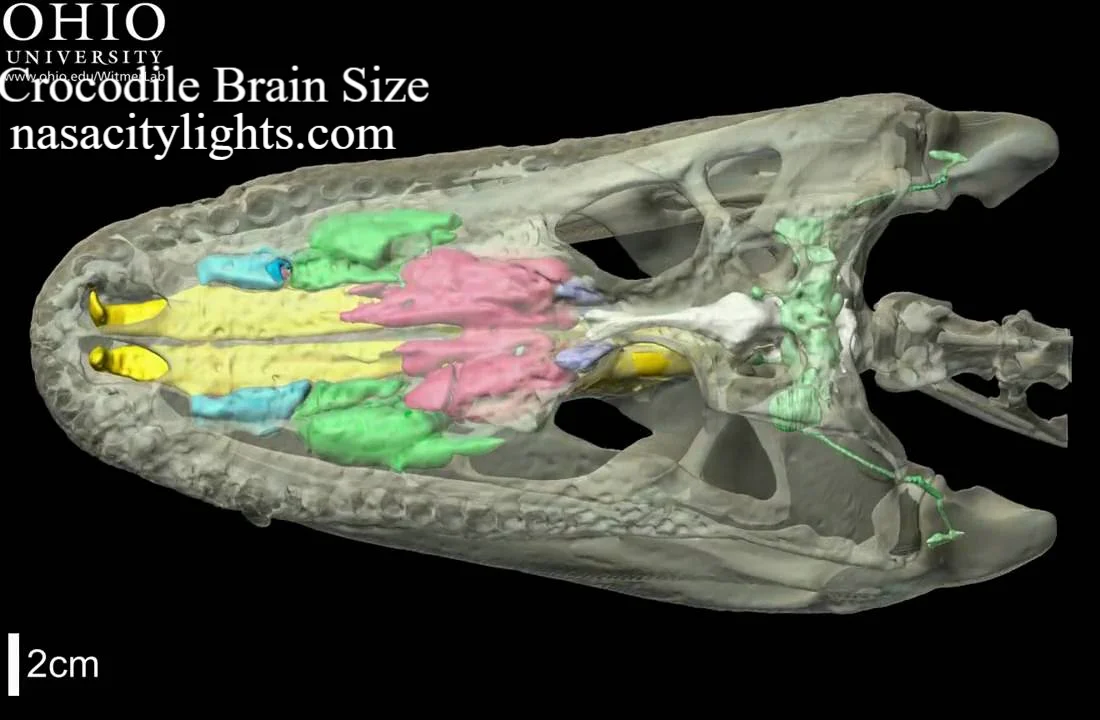
A crocodile’s brain does not resemble the rounded, folded brains you picture in mammals. Instead, it looks elongated and narrow, stretched out to fit inside a long, flattened skull. The surface stays smooth, without the deep wrinkles and folds seen in human or dolphin brains.
This simpler structure reflects how reptile brains evolved. Crocodiles rely heavily on:
- A well developed brainstem that manages basic survival functions
- A strong sense of smell processed through large olfactory bulbs
- Sensory centers tuned to vibration, pressure, and movement in water
The cerebral cortex, the part responsible for complex thought in mammals, stays thin and underdeveloped in crocodiles. Yet this does not mean crocodiles think in a limited way. It simply means their brains process information differently.
Crocodile Brain Size Compared to Other Animals
Understanding crocodile brain size becomes clearer when you compare it across species. Brain to body ratio, not raw brain weight, tells the real story of cognitive potential.
Crocodiles vs Alligators
Alligators and crocodiles share similar brain structures and proportions. Both carry small, elongated brains suited to ambush hunting. Research suggests alligators may show slightly more complex behavior in some memory tasks, but the overall brain size and shape remain very close between the two groups.
Crocodiles vs Other Reptiles
Compared to snakes and lizards, crocodile brain size actually ranks higher relative to body size. Crocodilians sit near the top of the reptile intelligence scale, alongside some turtle species. Their brains show more organized regions dedicated to hunting strategy and spatial memory than many other reptiles.
Crocodiles vs Mammals
This comparison highlights the biggest gap. A dolphin brain can weigh over 1,500 grams, while an elephant brain reaches roughly 5,000 grams. Even a small dog carries a brain proportionally larger than a crocodile’s. Mammals evolved larger, more complex brains to support social behavior, problem solving, and emotional processing, functions crocodiles rarely need in the same way.
Does Crocodile Brain Size Vary?
Yes, and quite a lot. Crocodile brain size depends on several factors.
- Species — Saltwater crocodiles, Nile crocodiles, and American alligators all show slightly different brain proportions.
- Age — Juvenile crocodiles have smaller brains that grow as the animal matures, though growth slows significantly after adulthood.
- Body size — Larger individuals generally carry larger brains, but the ratio to body weight actually decreases as crocodiles grow bigger.
- Individual variation — Just like humans, no two crocodiles are identical. Genetics and environment both play a role.
This variation reminds you that crocodile brain size is not a fixed number. It shifts based on the animal in question.
Are Crocodiles Intelligent?
Here is where things get interesting. Despite having a small brain, crocodiles show behavior that many scientists consider genuinely intelligent. You might be surprised by what these reptiles can actually do.
- They learn from experience and adjust hunting strategies over time.
- They recognize patterns, such as the sound of a boat motor signaling feeding time at wildlife parks.
- They use tools in a basic sense, balancing sticks on their snouts to lure nesting birds looking for material.
- They communicate through vocalizations, body posture, and even infrasound.
- They cooperate during group hunts, something once thought impossible for reptiles.
I find this part fascinating. A brain weighing just a few grams still manages to coordinate patient ambush tactics that fool prey animals with much larger brains. This proves that crocodile brain size alone cannot predict behavioral complexity.
Do Crocodiles Have Good Memory?
Yes, crocodiles show strong spatial memory. They remember migration routes, nesting sites, and productive hunting locations across seasons. Some individuals return to the exact same basking spot year after year. This kind of long term memory suggests their brains, despite the small size, handle certain cognitive tasks quite efficiently.
Brain Size Versus Intelligence: Why They Are Not the Same
It is tempting to assume bigger brain equals smarter animal. Crocodile brain size proves that assumption wrong. Intelligence depends on brain structure, neuron density, and how efficiently a brain processes information, not just total mass.
Crows, for example, have small brains yet solve puzzles that stump many mammals. Crocodiles follow a similar pattern. Their brains pack essential survival functions into a compact, efficient package. Every gram serves a purpose, from tracking prey movement to processing chemical signals in water.
So when you compare crocodile brain size to a human or dolphin brain, remember that raw size only tells part of the story.
What Controls a Crocodile’s Behavior?
The crocodile brain, small as it is, manages an impressive range of responsibilities. It coordinates:
- Movement and muscle control during ambush attacks
- Hunting behavior, including timing and stealth
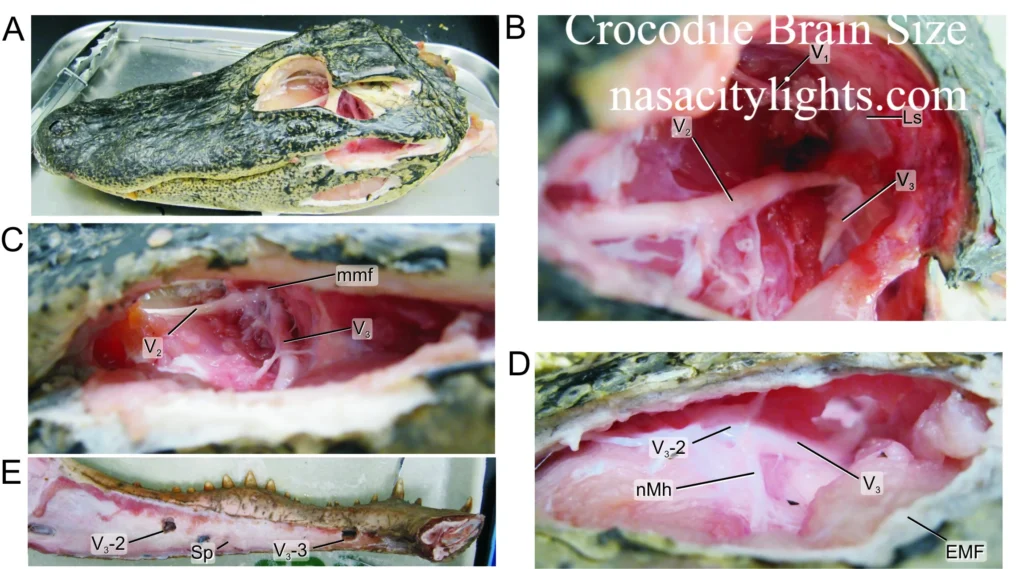
- Sensory processing from eyes, ears, and pressure receptors along the jaw
- Feeding responses and prey recognition
- Reproductive behavior, including nesting and parental care
- Environmental awareness, such as temperature regulation and threat detection
This wide range of functions shows just how efficiently a small brain can operate when finely tuned by millions of years of evolution.
Conclusion
Crocodile brain size might seem tiny compared to the animal’s massive body, but do not let that fool you. These reptiles prove that a compact brain can still support sharp memory, clever hunting tactics, and genuine problem solving. Crocodile brain size differs by species, age, and individual, yet across the board, these animals punch far above their weight when it comes to survival skills.
Next time you see a crocodile floating silently in the water, remember there is more going on behind those eyes than you might expect. What do you think, does this change how you view crocodile intelligence? Feel free to share this article with anyone who loves learning about wildlife.
Frequently Asked Questions
How big is a crocodile’s brain in grams? Most crocodiles carry a brain weighing between 5 and 10 grams, depending on species and body size.
Is crocodile brain size bigger than an alligator’s? Not significantly. Crocodile brain size and alligator brain size remain very similar, with only minor structural differences.
Why is crocodile brain size so small compared to body size? Reptile brains evolved to prioritize survival functions like sensory processing and reflexes rather than complex reasoning, keeping crocodile brain size compact.
Are crocodiles smarter than alligators? Both show comparable intelligence. Some studies suggest alligators perform slightly better on certain memory tasks, but the difference remains small.
Do crocodiles recognize humans? Some evidence suggests crocodiles in captivity recognize specific caretakers based on voice and routine, showing a level of learned recognition.
Does crocodile brain size increase with age? Yes, brain size grows as a crocodile matures, though the growth rate slows considerably once the animal reaches adulthood.
How does crocodile brain size compare to bird brain size? Many birds, especially crows and parrots, have a higher brain to body ratio than crocodiles, despite having smaller overall brain mass.
Can crocodiles feel emotions? Research remains limited, but crocodiles show stress responses and protective behavior toward offspring, suggesting some level of basic emotional processing.
nasacitylights.com
Author Name: Hamid Ali
Email: johanharwen314@gmail.com
About the Author: Hamid Ali is a science writer who enjoys breaking down complex animal biology into simple, engaging content for curious readers. He focuses on wildlife behavior, comparative anatomy, and the science behind how animals think, learn, and survive in the wild.