
How Do NASA Satellites Work? Amazing Secrets Behind Space Tech in 2026
Introduction
Have you ever looked up at the night sky and wondered how a tiny object floating thousands of miles above your head can predict tomorrow’s weather or track a wildfire from space? That is exactly what NASA satellites do every single day. If you have ever asked yourself how do NASA satellites work, you are not alone. Millions of people rely on the data these machines collect without even realizing it. In this article, I will walk you through everything from how satellites stay in orbit to how they send information all the way back to Earth. By the end, you will understand how do NASA satellites work in a way that actually makes sense, without confusing jargon or technical overload.
What Are NASA Satellites?
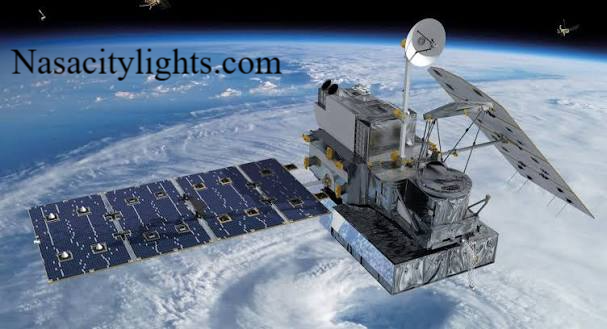
NASA satellites are specialized spacecraft built to observe Earth, study space, or support communication systems. They are designed for specific missions such as tracking hurricanes, mapping forests or studying distant galaxies. Each satellite carries unique instruments suited to its job. Some orbit close to Earth while others travel millions of miles away to study the sun, planets or deep space.
How Do NASA Satellites Work?
At its core, understanding how do NASA satellites work comes down to three simple things: power, movement and communication. A satellite needs energy to run its systems, a stable orbit to stay in position and a way to transmit data back to scientists on the ground. Once launched into space, the satellite uses onboard computers to collect information through sensors and cameras. This data gets processed and sent through radio signals to receiving stations on Earth. It sounds simple, but the engineering behind it is incredibly advanced.
How Do Satellites Stay In Orbit?
Satellites stay in orbit through a perfect balance between gravity and speed. Earth’s gravity constantly pulls the satellite downward, but the satellite is also moving forward at an extremely high speed. This forward motion combined with gravity’s pull creates a curved path around the planet instead of a straight line.
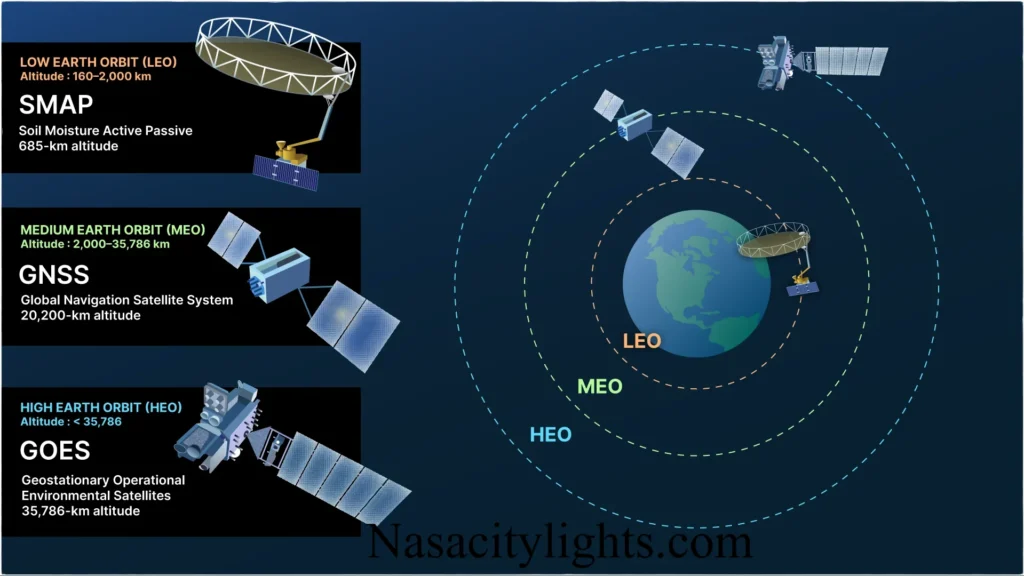
There are three main orbit types satellites use.
- Low Earth Orbit, known as LEO, sits close to Earth and is ideal for imaging and observation.
- Medium Earth Orbit, known as MEO, is often used for navigation systems.
- Geostationary Orbit, known as GEO, allows a satellite to match Earth’s rotation so it stays fixed above one location.
Each orbit type serves a different purpose depending on the mission’s goal.
What Powers NASA Satellites?
Most NASA satellites rely on solar panels for power. These panels convert sunlight into electricity, which charges batteries used when the satellite passes through Earth’s shadow. Some deep space missions that travel far from the sun use radioisotope thermoelectric generators instead, since sunlight becomes too weak to rely on. This power keeps onboard computers, instruments and communication systems running continuously.
How Do NASA Satellites Collect Data?
Satellites collect data using sensors, cameras and specialized instruments pointed toward Earth or space. These tools measure things like temperature, light wavelengths, atmospheric gases and surface changes. For example, an imaging sensor might capture visual data of a hurricane forming while another instrument measures ocean temperature at the same time.
This is one of the most fascinating parts of how do NASA satellites work, because a single satellite can gather multiple types of data simultaneously, giving scientists a complete picture rather than a single snapshot.
How Do NASA Satellites Send Data To Earth?
Once data is collected, it needs to travel back to Earth. Satellites transmit this information using radio waves sent to ground stations. These stations then relay the data to research centers where scientists analyze it. Some satellites store data temporarily before transmitting it during a scheduled pass over a ground station, while others send information almost instantly.
What Instruments Do NASA Satellites Use?
NASA satellites carry a wide range of instruments depending on their mission.
- Spectrometers measure light wavelengths to study atmospheric composition.
- Radiometers detect temperature and radiation levels.
- High resolution cameras capture detailed images of Earth’s surface.
- Radar systems penetrate clouds to measure land and ocean features.
Each instrument plays a specific role, and together they allow satellites to build a detailed understanding of our planet and beyond.
What Is The NASA Deep Space Network?
The Deep Space Network is a system of large antennas located around the world in California, Spain and Australia. This network allows NASA to communicate with satellites and spacecraft that travel far beyond Earth’s orbit. Because the antennas are spread across different continents, at least one is always in position to maintain constant communication, even as Earth rotates.
What Are The Different Types Of NASA Satellites?
NASA operates several categories of satellites, each built for a unique purpose.
- Earth observation satellites monitor weather, climate and natural disasters.
- Communication satellites support data relay between missions and ground control.
- Scientific research satellites study space phenomena like black holes and solar activity.
- Navigation satellites assist with positioning systems.
Understanding these categories makes it easier to see how do NASA satellites work across different fields of science and technology.
Why Are NASA Satellites Important?
Satellites play a massive role in daily life, even if people rarely notice it. They help predict natural disasters, support GPS navigation, monitor agriculture and track climate patterns. Without satellites, modern communication and weather forecasting would look completely different.
How Do NASA Satellites Help Weather Forecasting?
Weather satellites capture real time images of cloud formation, storm systems and temperature changes. Meteorologists use this data to predict hurricanes, track storm paths and issue early warnings. This technology has saved countless lives by giving communities time to prepare before severe weather strikes.
How Do NASA Satellites Monitor Climate Change?
Climate monitoring is another major part of how do NASA satellites work. Satellites track rising sea levels, melting ice caps, deforestation and changes in atmospheric carbon dioxide. Long term data collected over decades helps scientists understand climate trends and predict future environmental changes with greater accuracy.
How Do NASA Satellites Capture Images?
Satellites capture images using high resolution cameras and sensors that detect different wavelengths of light, including infrared and ultraviolet. These images are then processed and combined to create detailed maps or visual representations of Earth’s surface, weather systems or distant celestial objects.
How Long Do NASA Satellites Last?
Most NASA satellites are designed to operate for five to fifteen years, although some exceed their expected lifespan significantly. Factors like fuel supply, equipment wear and orbital decay determine how long a satellite remains functional. Regular monitoring from ground teams helps extend a satellite’s operational life whenever possible.
What Happens When A NASA Satellite Reaches The End Of Its Mission?
When a satellite completes its mission, engineers either guide it into a controlled reentry, moving it toward a safe area like the ocean, or push it into a higher graveyard orbit to avoid collisions with active satellites. This process helps reduce space debris and keeps orbital pathways safer for future missions.
Final Thoughts
So, how do NASA satellites work? In short, they rely on a careful mix of power, orbit stability, advanced instruments and constant communication with Earth. From predicting storms to studying distant galaxies, these machines quietly shape the way we understand our planet and universe. Next time you check a weather app or see a stunning image of Earth from space, you will know exactly what is happening behind the scenes. If you found this breakdown helpful, feel free to share it with someone who loves space as much as you do.
Frequently Asked Questions
1. How do NASA satellites work in simple terms?
They collect data using sensors, stay in orbit through gravity and speed, and send information back to Earth using radio signals.
2. What is the main power source for NASA satellites?
Most satellites use solar panels, while deep space missions often rely on radioisotope generators.
3. How do satellites avoid falling back to Earth?
Their forward speed balances Earth’s gravitational pull, keeping them in a stable orbit.
4. Do all NASA satellites orbit at the same height?
No, satellites operate in different orbits such as LEO, MEO and GEO depending on their mission.
5. How do satellites help with weather prediction?
They capture real time images of storms and atmospheric changes, helping forecasters issue accurate warnings.
6. What happens to old satellites?
They are either guided into controlled reentry or moved into a higher graveyard orbit.
7. How long can a satellite function in space?
Most last between five and fifteen years, though some operate much longer.
Nasacitylights.com
Email: johanharwen314@gmail.com
Author Name: Hamid Ali
About The Author: Hamid Ali is a science and technology writer passionate about space exploration and emerging innovations. He enjoys breaking down complex topics into simple, engaging content that helps everyday readers understand the world beyond our planet.