
Inside Black Holes: What Really Happens Beyond the Event Horizon in 2026?
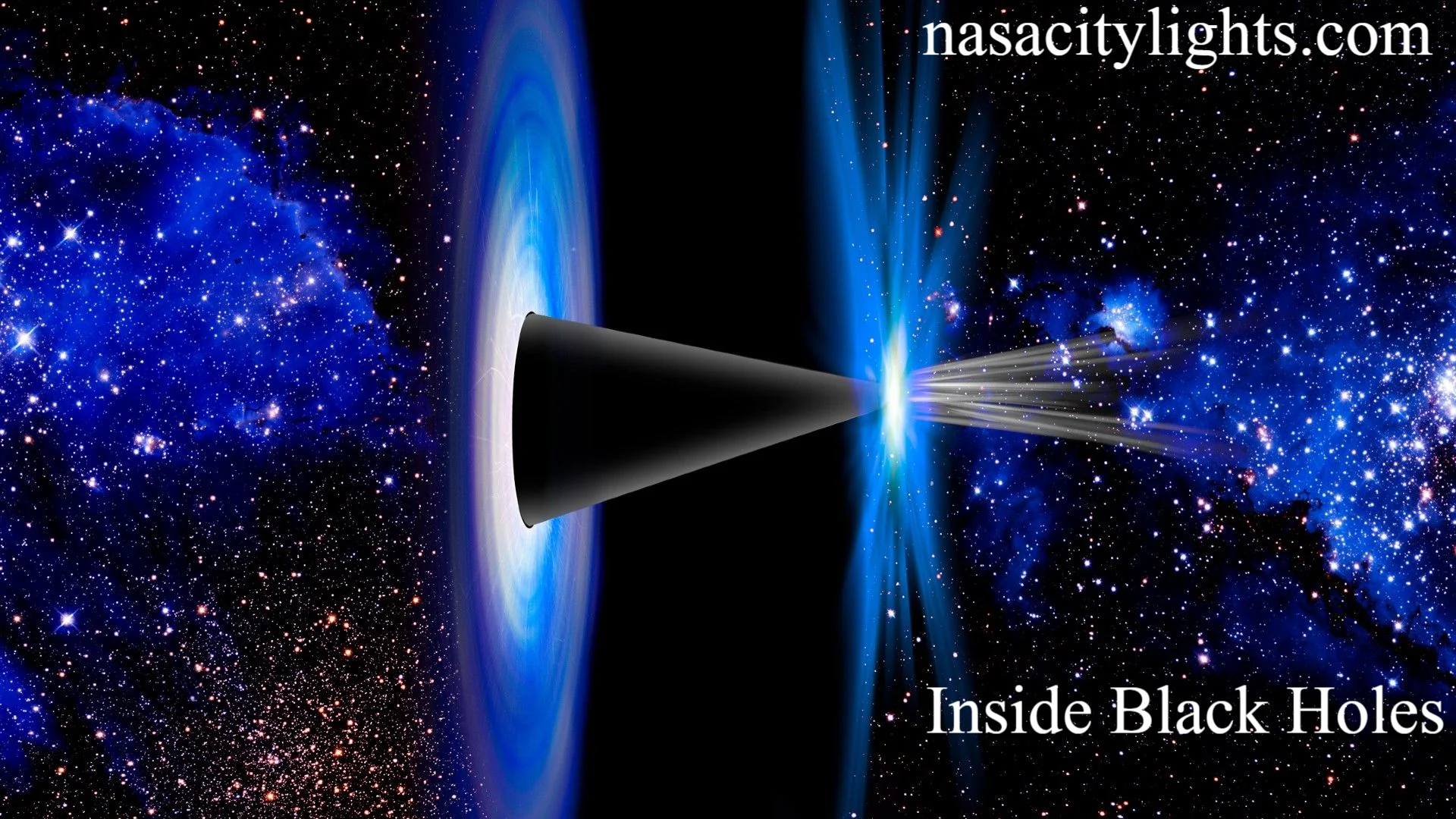
Black holes are among the most extreme objects in the universe. They are not empty holes in space but incredibly compact concentrations of matter whose gravity becomes strong enough that nothing passing the event horizon, including light, can escape.
But what is actually inside black holes?
The honest scientific answer is that we do not know everything. General relativity predicts that matter falling through the event horizon eventually reaches a region called a singularity, where the theory predicts extreme or infinite curvature and density. NASA notes that scientists do not yet know whether the singularity represents a real physical structure or signals that our current theory of gravity is incomplete.
That distinction is important. Scientists have strong evidence for black holes and understand many of their observable effects, but nobody has directly observed what happens beyond an event horizon.
What Is Inside a Black Hole?
According to general relativity, the interior contains a region where gravity and space-time become extraordinarily distorted, with the singularity predicted at the center of a simple non-rotating black hole.
A black hole is commonly described using several important regions:
- Event horizon: The point-of-no-return boundary.
- Interior: The region beyond the event horizon from which information cannot return to an outside observer.
- Singularity: The central region predicted by classical general relativity where the theory breaks down.
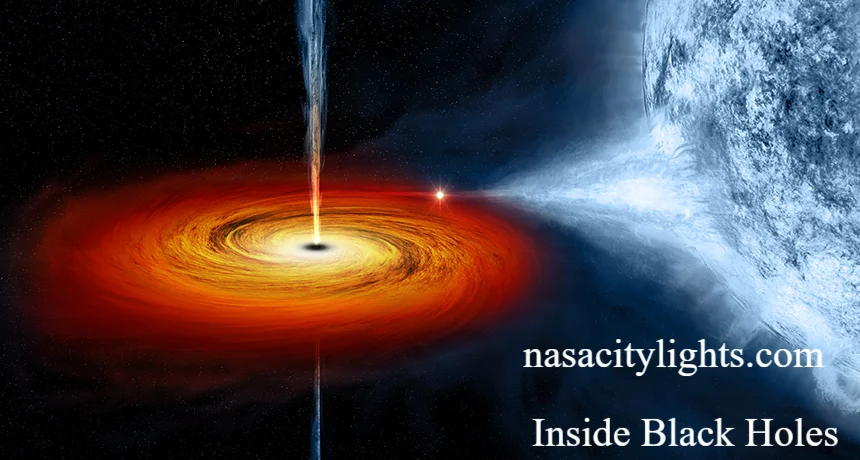
- Accretion disk: Hot gas and other material orbiting outside the event horizon, not the inside of the black hole.
The event horizon should not be thought of as a solid surface. It is a boundary in space-time. Once something crosses it, every possible future path leads deeper into the black hole according to classical general relativity.
What Happens When You Cross the Event Horizon?
For a sufficiently large black hole, crossing the event horizon would not necessarily involve hitting a physical wall or surface.
Instead, the event horizon marks a change in what paths through space-time can lead outward.
From far away, an observer would see the falling object become increasingly affected by gravitational time dilation and appear to slow as it approaches the horizon. NASA’s black-hole simulations illustrate this difference between the experience of a falling observer and the view of someone watching from a great distance.
For the person falling in, however, the experience is different. They cross the horizon in finite proper time.
After crossing, escaping becomes impossible.
What Happens Inside a Black Hole?
Once inside the event horizon, classical general relativity predicts that an object continues toward the black hole’s interior rather than finding a route back out.
The exact experience depends on the black hole’s mass, rotation and other properties.
One of the most important effects is the increasing difference in gravitational force across an object’s body. This can stretch the object in one direction while compressing it in another.
This effect is commonly called spaghettification.
NASA explains that the immense gravity around a black hole can compress an object horizontally and stretch it vertically.
For a smaller stellar-mass black hole, tidal forces can become destructive near the event horizon. For a supermassive black hole, the event horizon can be much farther from the central region, so an object could theoretically cross it before experiencing extreme tidal forces.
That does not mean the object survives indefinitely. The journey toward the center remains fatal under classical physics.
What Is a Singularity?
A singularity is the region where classical general relativity predicts that matter becomes compressed to an extreme state and space-time curvature becomes mathematically singular.
However, calling it a literal point of infinite density can be misleading.
NASA emphasizes that scientists do not currently know whether the singularity is an actual physical structure or a sign that general relativity reaches its limits under extreme conditions.
This is one of the biggest unanswered questions in black hole physics.
General relativity describes gravity extremely well on many scales, while quantum mechanics describes the behavior of matter and energy at microscopic scales. A complete theory of quantum gravity may eventually be needed to explain what truly happens at the deepest interior of a black hole.
Does Time Stop Inside a Black Hole?
Time does not simply “stop” for someone falling into a black hole.
The apparent freezing comes from the perspective of a distant observer.
As an object approaches the event horizon, gravitational time dilation becomes increasingly important. To a distant observer, the object appears to slow dramatically near the horizon.
But the falling observer experiences their own passage of time normally and can cross the event horizon in a finite amount of proper time.
NASA’s black-hole visualization demonstrates this difference: a camera falling toward a supermassive black hole reaches the horizon in its own frame, while a distant observer never sees it cleanly cross the boundary in the same way.
Can Anything Escape a Black Hole?
Nothing that crosses the event horizon can escape according to classical general relativity, including light.
This is what makes the object a black hole.
However, this statement needs an important qualification. Scientists have proposed Hawking radiation, a quantum effect associated with black holes that can cause them to lose energy extremely slowly over enormous periods of time.
Hawking radiation does not mean objects can simply fly back out through the event horizon. Instead, it is a quantum prediction about radiation associated with the black hole and its surrounding quantum fields.
NASA notes that Hawking radiation could ultimately cause a black hole to evaporate over an extremely long period.
What Does a Black Hole Look Like From the Outside?
A black hole itself does not emit or reflect ordinary light, so it cannot be viewed like a normal star.
Astronomers instead observe its effects on nearby matter and space-time.
A black hole may be surrounded by an accretion disk made of gas and other material. As this material moves through the intense gravitational environment, it can become extremely hot and emit radiation, including X-rays.
Scientists can also detect black holes through:
- Stars orbiting an invisible massive object
- X-rays from hot gas
- Gravitational lensing
- Gravitational waves from mergers
- Relativistic jets
- Changes in nearby gas and dust
NASA explains that astronomers identify black holes largely by observing how surrounding stars, gas and light are affected by their gravity.
What Is an Accretion Disk?
An accretion disk is a rotating structure of hot gas and other material outside a black hole’s event horizon.
It is important not to confuse the accretion disk with the inside of the black hole.
Material can orbit the black hole for some time before eventually moving inward. Friction and other physical processes can heat the gas to enormous temperatures, allowing astronomers to detect radiation from the region.
NASA identifies the accretion disk as a major source of observable light associated with black holes.
Some black holes can also produce powerful jets of particles that travel close to the speed of light. These jets originate from the environment around the black hole rather than being material escaping from inside the event horizon.
What Is Sagittarius A*?
Sagittarius A*, pronounced “Sagittarius A-star,” is the supermassive black hole at the center of our Milky Way galaxy.
It is surrounded by a complex environment of gas, stars and other material. Astronomers study stars orbiting near the galactic center to learn about the object’s enormous mass and gravitational influence.
NASA’s James Webb Space Telescope has also observed activity around Sagittarius A*, including bright flares and much fainter, rapidly changing emissions from extremely close to the black hole.
Studying Sagittarius A* gives scientists an opportunity to investigate extreme gravity relatively close to our cosmic neighborhood.
Are Black Holes Wormholes?
There is no observational evidence that ordinary black holes are portals or wormholes.
Popular science fiction often portrays a black hole as a tunnel connecting two distant locations or even different universes.
Some mathematical solutions in general relativity have been associated with wormhole-like structures, but that does not mean real astrophysical black holes function as usable portals.
The safest scientific answer is that black holes are not known to be gateways to other universes.
Who Discovered Black Holes?
There was no single person who “discovered” black holes in the modern observational sense.
The idea developed over centuries.
In the 18th century, scientists including John Michell and Pierre-Simon Laplace considered the possibility of extremely massive objects whose gravity could prevent light from escaping. Einstein’s general theory of relativity, published in 1915, provided the modern framework for understanding gravity and space-time.
In 1916, Karl Schwarzschild found a mathematical solution to Einstein’s equations describing what we now recognize as a non-rotating black hole.
The phrase “black hole” itself was later popularized by physicist John Wheeler in the 1960s. NASA traces this historical development from early “dark star” ideas through general relativity and the modern black-hole concept.
Strong observational evidence eventually transformed black holes from theoretical possibilities into established astronomical objects.
How Do Scientists Study Something They Cannot See?
Scientists study black holes indirectly because information from inside the event horizon cannot reach an outside observer.
They examine measurable effects around them.
1. Stellar Orbits
Stars can orbit an invisible massive object. Precise measurements of those orbits can reveal the object’s mass.
2. Accretion Disks
Hot gas around a black hole can emit detectable radiation, particularly X-rays.
3. Gravitational Waves
When massive compact objects such as black holes merge, they produce ripples in space-time called gravitational waves.
4. Gravitational Lensing
A black hole’s gravity can bend light from objects behind it, creating measurable distortions.
5. Direct Imaging of the Shadow
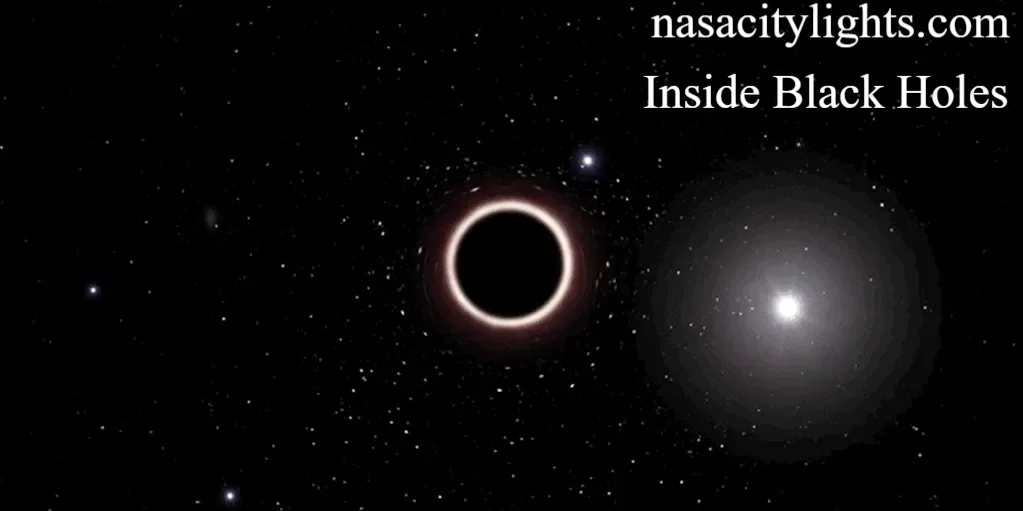
The Event Horizon Telescope produced the first image of a black hole’s shadow in 2019, showing the shadow of the supermassive black hole in galaxy M87. The black hole has a mass about 6.5 billion times that of the Sun.
Importantly, that image was not a photograph of the inside of the black hole. It captured the shadow against glowing material surrounding it.
When Will a Black Hole Hit Earth?
There is no known black hole on a collision course with Earth.
Black holes are not cosmic vacuum cleaners that automatically pull everything in from enormous distances. If an object is sufficiently far away, its gravitational influence behaves according to its mass just like the gravitational influence of other objects.
NASA notes that black holes are too far away to pull matter from our solar system into them.
There is also no known black hole close enough to pose a threat to Earth.
The black hole at the center of the Milky Way, Sagittarius A*, is enormously massive, but its distance from Earth means it does not threaten our planet.
How Long Do Black Holes Exist?
Black holes can potentially exist for extraordinarily long periods.
A black hole can gain mass by absorbing matter or merging with other black holes. Over much longer timescales, quantum effects such as Hawking radiation are predicted to make black holes lose mass.
For astrophysical black holes, this evaporation process would take an extraordinarily long time compared with the current age of the universe.
Can Black Holes Disappear?
In theory, yes.
Hawking radiation predicts that black holes can gradually lose energy and mass. A sufficiently isolated black hole could eventually evaporate.
However, this process is incredibly slow for large astrophysical black holes.
This is another area where black hole physics connects general relativity, quantum mechanics and thermodynamics. Scientists continue to investigate how these theories fit together.
Frequently Asked Questions About Inside Black Holes
Where do black holes take you?
According to classical general relativity, a person who crosses the event horizon cannot return to the outside universe. They would continue toward the black hole’s interior and, in the simplest model, toward the singularity. What ultimately happens at the deepest interior is not known because current physics is incomplete there.
Who discovered black holes?
Black holes were not discovered by one person. John Michell and Pierre-Simon Laplace proposed early ideas about objects from which light could not escape. Karl Schwarzschild later produced the relevant mathematical solution in 1916, while John Wheeler popularized the term “black hole” in the 1960s.
What is inside black holes in space?
The interior lies beyond the event horizon, where nothing can escape to an outside observer. Classical general relativity predicts a singularity toward the center, but scientists do not yet know whether this singularity represents a real physical object or a limitation of the theory.
What does “inside black holes” mean?
“Inside black holes” refers to the region beyond a black hole’s event horizon. It is different from the accretion disk and other material visible around the black hole. Once something crosses the event horizon, it cannot send information back to an outside observer.
What does NASA say about inside black holes?
NASA explains that the event horizon is the point beyond which nothing can escape and that general relativity predicts a singularity at the center. NASA also emphasizes that scientists do not yet know whether the singularity is a physical structure or a sign that a deeper theory of gravity is needed.
When will a black hole hit Earth?
There is currently no known black hole on a collision course with Earth. Black holes do not automatically suck in everything around them, and known black holes are far enough away that they do not pose a threat to our solar system.
The Bottom Line
The most accurate answer to “what is inside black holes?” is partly known and partly mysterious.
Scientists understand the event horizon, extreme gravity, tidal forces and the effects black holes have on surrounding matter. General relativity predicts that matter falling through the horizon eventually reaches a singularity in the simplest black-hole models.
But the singularity may also reveal where our current understanding of physics stops working.
That is why black holes remain such an important subject in astrophysics. They provide a natural laboratory for testing gravity, space-time and the relationship between general relativity and quantum physics.
The deeper scientists look into black holes, the clearer one fact becomes: we understand much about what happens around them, but the ultimate nature of what happens inside remains one of the biggest unanswered questions in modern physics.
About the Author: Hamid is a science writer covering astronomy, black holes, space discoveries, and astrophysics. He creates clear, research-based guides that make complex scientific topics easy to understand.
Author Name: Hamid Ali
Email: johanharwen314@gmail.com
Also Read: