
What Are the Types of Galaxies? A Complete Guide with Examples
Look up on a clear, dark night and you might spot a faint band of light stretching across the sky — that’s the Milky Way, our own galaxy, seen edge-on from the inside. But the Milky Way is just one of an estimated hundreds of billions of galaxies scattered across the observable universe, and they don’t all look — or behave — the same way. Some are flat spinning disks with sweeping arms. Others are smooth, football-shaped clouds of ancient stars. A few are chaotic, misshapen blobs still forming stars at a furious pace. Understanding the types of galaxies is really about understanding shape, structure, and what’s happening at a galaxy’s core.
What Is a Galaxy?
A galaxy is a massive, gravitationally bound system of stars, gas, dust, and dark matter, all orbiting a common center of mass. Galaxies range enormously in size — from dwarf galaxies with a few million stars to giant ellipticals containing trillions. Most galaxies also harbor a supermassive black hole at their center, and many are embedded within larger galaxy clusters held together by gravity and dark matter.
What Are the Main Types of Galaxies?
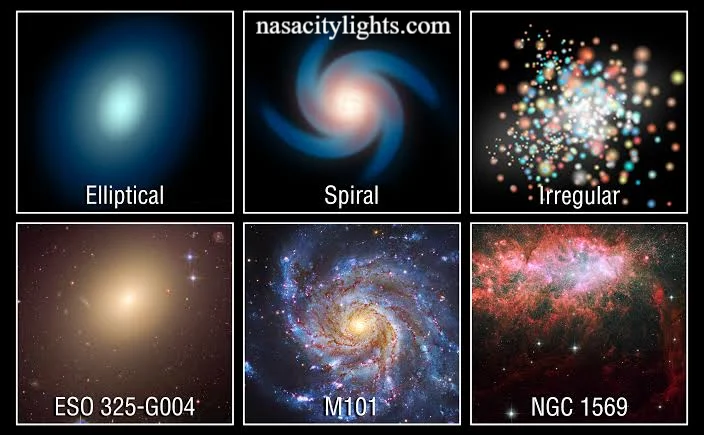
Astronomers generally group galaxies into four main categories based on their shape and structure:
- Spiral galaxies — flat, rotating disks with arms winding outward from a central bulge
- Elliptical galaxies — smooth, rounded or oval-shaped collections of older stars
- Lenticular galaxies — a hybrid type with a disk but no visible spiral arms
- Irregular galaxies — galaxies with no defined shape, often shaped by gravitational disruption
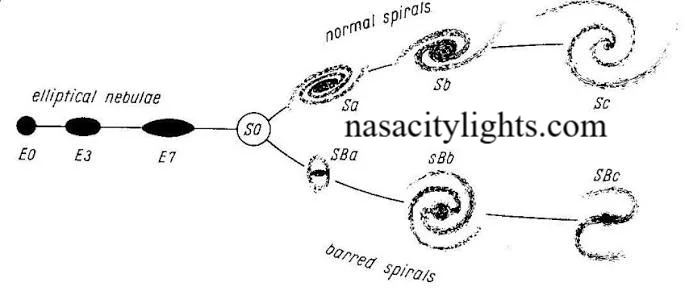
Beyond these shape-based categories, astronomers also classify galaxies by activity level — most notably active galaxies, which include Seyfert galaxies, quasars, and blazars. This system builds on the original galaxy classification scheme developed by astronomer Edwin Hubble in the 1920s, known as the Hubble sequence or “tuning fork” diagram, which is still used as the foundation for galaxy classification today.
Spiral Galaxies
What Is a Spiral Galaxy?
A spiral galaxy is a flattened, rotating disk of stars, gas, and dust with distinct spiral arms extending from a dense central bulge. These arms are regions of active star formation, glowing with young, hot stars, while the central bulge tends to house older stars and, in most cases, a supermassive black hole.
Spiral galaxies have three main structural components:
- Galactic bulge — the dense, roughly spherical core packed with older stars
- Spiral arms — the extended disk regions where gas clouds collapse to form new stars
- Galactic halo — a diffuse, roughly spherical region surrounding the disk, containing old stars, globular clusters, and dark matter
Many spiral galaxies also have a straight bar of stars cutting through the central bulge, with the spiral arms unwinding from the ends of that bar. These are called barred spiral galaxies, and they’re actually more common than unbarred ones — the Milky Way itself is a barred spiral galaxy.
Examples of Spiral Galaxies
- The Milky Way — our home galaxy, a barred spiral roughly 100,000 light-years across
- The Andromeda Galaxy (M31) — the nearest large spiral galaxy to the Milky Way, on a slow collision course with us
- The Pinwheel Galaxy (M101) — a face-on spiral known for its well-defined, symmetric arms
- The Whirlpool Galaxy (M51) — a spiral galaxy famous for its clearly defined arms and an interacting companion galaxy
Elliptical Galaxies
What Is an Elliptical Galaxy?
An elliptical galaxy is a smooth, largely featureless galaxy shaped like a sphere or a stretched-out ellipse, with little to no visible internal structure like spiral arms or a distinct disk. Elliptical galaxies are made up mostly of old, low-mass stars and generally contain very little gas and dust — which means star formation in them has mostly slowed to a crawl or stopped entirely.
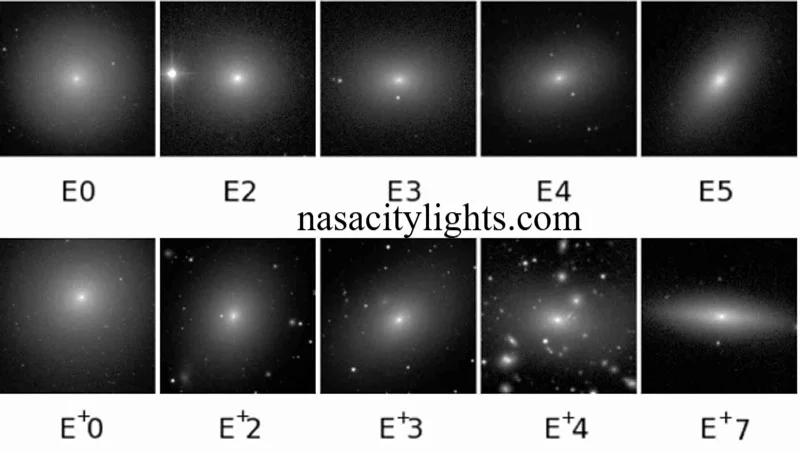
Astronomers rank ellipticals on a scale from E0 (nearly spherical) to E7 (highly elongated), based on how flattened they appear. Elliptical galaxies also span an enormous size range — from small dwarf ellipticals to some of the largest known galaxies, often found at the centers of massive galaxy clusters, likely built up over billions of years through repeated galaxy mergers.
Examples of Elliptical Galaxies
- M87 — a giant elliptical galaxy at the center of the Virgo Cluster, notable for hosting the first black hole ever directly imaged
- M49 — one of the brightest galaxies in the Virgo Cluster
- M32 — a compact dwarf elliptical companion to the Andromeda Galaxy
Lenticular Galaxies
What Is a Lenticular Galaxy?
A lenticular galaxy sits structurally between a spiral and an elliptical galaxy — it has a flat, disk-like shape similar to a spiral galaxy, but without visible spiral arms, and it typically contains very little gas or ongoing star formation. Lenticular galaxies are sometimes described as spiral galaxies that have used up or lost most of their star-forming gas, leaving behind a smooth disk of older stars.
A well-known example is NGC 5866, often used as a textbook illustration of the lenticular galaxy type due to its clearly defined edge-on disk with minimal structure.
Irregular Galaxies
What Is an Irregular Galaxy?
An irregular galaxy is a galaxy with no clear, organized shape — no defined spiral arms and no symmetrical elliptical form. Irregular galaxies often result from gravitational interactions, near-collisions, or mergers with other galaxies, which distort their structure. Despite their chaotic appearance, many irregular galaxies are rich in gas and dust and experience vigorous star formation.
Well-known examples include the Large Magellanic Cloud and Small Magellanic Cloud, two dwarf irregular galaxies visible from the Southern Hemisphere and gravitationally bound to the Milky Way.
Active Galaxies
Not every galaxy classification depends on shape. Active galaxies are grouped by what’s happening at their core: an unusually bright, energetic central region called an active galactic nucleus (AGN), powered by a supermassive black hole rapidly pulling in surrounding matter through an accretion disk.
Seyfert Galaxies
A Seyfert galaxy is a spiral galaxy with an extremely bright, compact nucleus that outshines the rest of the galaxy across the electromagnetic spectrum, particularly in radio and X-ray wavelengths. Unlike quasars, Seyfert galaxies are relatively close and their surrounding galactic structure remains visible even though the nucleus is intensely bright.
Quasars
A quasar is the extremely luminous core of a distant active galaxy, powered by a supermassive black hole consuming enormous amounts of gas and dust through its accretion disk. Quasars are among the most energetic objects in the universe and can outshine their entire host galaxy, which is why they were originally mistaken for individual stars when first discovered.
Blazars
A blazar is a type of active galaxy whose jet of high-energy particles, launched from near the supermassive black hole, happens to point almost directly at Earth. Because we’re looking straight down the jet, blazars appear especially bright and highly variable. Active galaxies are further split into radio-loud and radio-quiet categories depending on how strongly they emit radio waves — blazars and many quasars fall into the radio-loud group.
How Are Galaxies Classified?
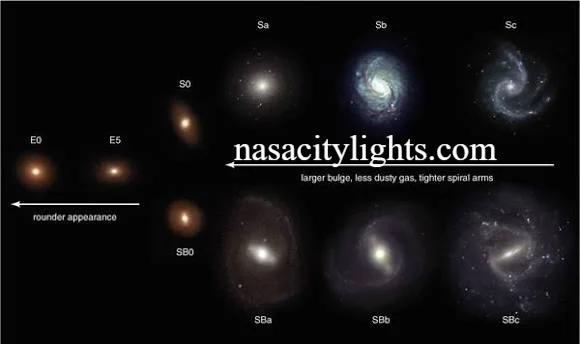
Galaxies are classified mainly by two factors: their visible shape and structure, and the level of activity at their nucleus. The shape-based system traces back to Edwin Hubble’s tuning-fork diagram, which arranges galaxies along a sequence from ellipticals through lenticulars to spirals and barred spirals. Modern astronomers still use this framework as a starting point, though they now combine it with data across the electromagnetic spectrum — radio, infrared, X-ray, and gamma-ray observations — to identify active galaxies and understand a galaxy’s internal dynamics, gas content, and black hole activity more precisely.
What Is the Most Common Type of Galaxy?
Elliptical and irregular galaxies, particularly dwarf varieties, are actually the most numerous type in the universe, even though spiral galaxies tend to get more attention because they’re bright, symmetrical, and easy to photograph. Small dwarf elliptical and dwarf irregular galaxies vastly outnumber large spirals in galaxy surveys — they’re just harder to spot because they’re fainter and less visually striking.
What Type of Galaxy Is the Milky Way?
The Milky Way is a barred spiral galaxy, meaning it has a central bar-shaped structure of stars with spiral arms winding outward from the ends of that bar. It contains a galactic bulge, a disk with spiral arms including the Orion Arm where our solar system sits, and a surrounding halo of older stars and dark matter. At its center lies a supermassive black hole known as Sagittarius A*.
How Do Galaxies Form and Evolve?
Galaxies form from the gravitational collapse of gas and dark matter in the early universe, gradually pulling together into the structured systems we see today. Over billions of years, galaxies evolve through:
- Star formation — ongoing collapse of gas clouds into new stars, especially active in spiral arms and irregular galaxies
- Galaxy mergers and interactions — collisions between galaxies that can trigger bursts of star formation, distort shapes, and eventually produce elliptical galaxies
- Gas depletion — as a galaxy uses up or loses its gas supply, star formation slows, which is thought to explain how spirals can evolve into lenticulars and, through mergers, into ellipticals
- Black hole growth — as supermassive black holes accrete matter, they can briefly power the intense activity seen in Seyfert galaxies, quasars, and blazars
Andromeda and the Milky Way are currently on a collision course, expected to merge in roughly 4–5 billion years — a real-time illustration of how galaxy mergers reshape structure over cosmic timescales.
Types of Galaxies
How many types of galaxies are there?
Astronomers generally recognize four main shape-based types — spiral, elliptical, lenticular, and irregular — plus a separate category of active galaxies (including Seyfert galaxies, quasars, and blazars) classified by nuclear activity rather than shape.
What are the 4 main types of galaxies?
The four main types are spiral galaxies, elliptical galaxies, lenticular galaxies, and irregular galaxies, based on the classification system pioneered by Edwin Hubble.
What is the rarest type of galaxy?
Lenticular galaxies and highly active galaxies like quasars and blazars are considered relatively rare compared to the vast numbers of dwarf elliptical and irregular galaxies found throughout the universe.
Is the Milky Way a spiral galaxy?
Yes. More specifically, the Milky Way is a barred spiral galaxy, featuring a central bar of stars with spiral arms extending outward, a supermassive black hole at its core, and a surrounding halo of older stars and dark matter.
What is the difference between spiral and elliptical galaxies?
Spiral galaxies are flat, rotating disks with visible spiral arms, active star formation, and significant gas content, while elliptical galaxies are smooth, rounded systems made mostly of old stars with little gas and minimal ongoing star formation.
FAQ Section
What are the types of galaxies with names?
The main types are spiral galaxies (like the Milky Way and Andromeda), elliptical galaxies (like M87 and M32), lenticular galaxies (like NGC 5866), and irregular galaxies (like the Large and Small Magellanic Clouds), alongside active galaxy types such as Seyfert galaxies, quasars, and blazars.
What are the types of galaxies with examples?
Spiral: the Milky Way, Andromeda, and the Whirlpool Galaxy. Elliptical: M87 and M49. Lenticular: NGC 5866. Irregular: the Large Magellanic Cloud. Active galaxies: Seyfert galaxies, quasars, and blazars, identified by their extremely bright cores rather than their overall shape.
Spiral galaxy
A spiral galaxy is a flat, rotating disk of stars, gas, and dust with spiral arms extending from a central bulge. It’s one of the most common visually striking galaxy types and includes both the Milky Way and Andromeda.
Elliptical galaxy
An elliptical galaxy is a smooth, rounded or oval-shaped galaxy made mostly of older stars, with little gas or dust and minimal ongoing star formation. Ellipticals range from small dwarf galaxies to some of the largest galaxies known.
4 types of galaxies
The four main galaxy types, based on shape, are spiral, elliptical, lenticular, and irregular. This classification system originates from Edwin Hubble’s tuning-fork diagram and remains the foundation of galaxy classification today.
What type of galaxy is the Milky Way?
The Milky Way is a barred spiral galaxy, with a central bar of stars, spiral arms, a galactic bulge, and a halo, all orbiting around the supermassive black hole Sagittarius A* at its center.
What are the types of galaxies in order?
There’s no strict evolutionary “order,” but Hubble’s classification arranges them along a sequence from elliptical galaxies, through lenticular galaxies, to spiral and barred spiral galaxies — a structural sequence rather than a proven timeline of formation.
How many types of galaxies are there?
There are four main shape-based types — spiral, elliptical, lenticular, and irregular — plus active galaxies, a separate classification based on core activity rather than shape.
Author Bio: Hamid Ali is a science writer covering astronomy, space exploration, galaxies, and fascinating discoveries about the universe. He focuses on making complex scientific topics clear, engaging, and easy to understand.
Author Name: Hamid Ali
Email: johanharwen314@gmail.com
Also Read: