
How Big Is Pluto in Diameter, Size Compared to Earth, the Moon, and Other Planets
Introduction
Pluto is one of the most fascinating objects in our Solar System. Located far beyond Neptune in a region called the Kuiper Belt, this icy world has attracted scientific attention since its discovery in 1930. Although Pluto was once considered the ninth planet, astronomers reclassified it as a dwarf planet in 2006. Its small size, unusual orbit, and frozen surface make it an interesting subject for space enthusiasts.
If you have ever wondered how big Pluto is, the answer may surprise you. According to NASA Science, Pluto has an equatorial diameter of approximately 2,377 kilometers (1,477 miles), making it much smaller than Earth and even smaller in diameter than our Moon. Understanding its dimensions becomes easier when comparing Pluto with familiar objects, other planets, and geographical distances on Earth.
How Big Is Pluto?
Pluto has an approximate diameter of 2,377 kilometers (1,477 miles) at its equator. This measurement represents the distance from one side of Pluto to the other through its center. Although it appears as a tiny point in ordinary telescope images, spacecraft observations have revealed a complex world with mountains, plains, glaciers, and a thin atmosphere.
Pluto is nearly spherical because its own gravity pulls its material into a rounded shape. However, it is far smaller than the eight major planets orbiting the Sun. Its small dimensions do not make it unimportant; instead, Pluto provides scientists with valuable information about icy objects, planetary formation, and the distant regions of our Solar System.
How Big Is Pluto in Diameter?
The diameter of Pluto is approximately 2,377 kilometers (1,477 miles) at its equator, while its mean diameter is about 2,370 kilometers (1,473 miles). These figures are commonly used to describe its overall size. The small difference comes from the measurement used and the way the body’s dimensions are calculated. science.nasa.gov
Diameter is the distance across a spherical object through its center, whereas radius measures the distance from the center to its surface. Pluto’s mean radius is approximately 1,185 kilometers (736 miles). These measurements help astronomers compare Pluto with Earth, the Moon, and other celestial bodies using consistent units.
Pluto’s Size in Kilometers and Miles
The following table summarizes Pluto’s basic dimensions and provides an easy reference for readers who want the measurements at a glance.
| Measurement | Approximate size |
|---|---|
| Equatorial diameter | 2,377 km (1,477 miles) |
| Mean diameter | 2,370 km (1,473 miles) |
| Mean radius | 1,185 km (736 miles) |
| Classification | Dwarf planet |
| Location | Kuiper Belt |
| Largest moon | Charon |
Pluto’s diameter is comparable to the distance across a large geographical region on Earth. However, comparing a spherical world with a distance measured across a continent is only a visualization aid. Pluto is a complete celestial body with its own gravity, surface, and atmosphere, not a flat region of land.
How Big Is Pluto Compared to Earth?
Pluto is dramatically smaller than Earth. Earth’s mean diameter is approximately 12,742 kilometers (7,918 miles), while Pluto’s mean diameter is around 2,370 kilometers (1,473 miles). This means Pluto measures only about 18.6% of Earth’s diameter, or roughly one-fifth of the width of our planet.
The difference becomes even more noticeable when comparing their volumes. Earth contains vastly more material than Pluto because volume increases much faster than diameter. Although Pluto is large enough to be rounded by its own gravity, Earth is a much larger rocky planet with a substantial atmosphere, liquid-water oceans, and a far more extensive surface area.
| Feature | Pluto | Earth |
|---|---|---|
| Mean diameter | 2,370 km | 12,742 km |
| Mean radius | 1,185 km | 6,371 km |
| Classification | Dwarf planet | Terrestrial planet |
| Approximate diameter ratio | 18.6% of Earth | 100% |
Earth’s diameter is about 5.4 times Pluto’s mean diameter. This comparison shows why Pluto appears relatively small in illustrations of the Solar System. Nevertheless, Pluto remains an important world for understanding how small icy bodies develop and evolve in the outer Solar System.
How Big Is Pluto Compared to Our Moon?
Pluto is smaller in diameter than Earth’s Moon, which measures approximately 3,475 kilometers (2,159 miles) across. With a mean diameter of around 2,370 kilometers, Pluto is about 68% of the Moon’s diameter. This comparison surprises many people because Pluto is classified as a dwarf planet, while the Moon is Earth’s natural satellite. hub.jhu.edu
Despite their difference in size, both objects are scientifically interesting. Pluto has an icy surface, mountains, and a thin atmosphere, while the Moon has a heavily cratered surface and virtually no substantial atmosphere. Their environments also differ because they occupy different regions of the Solar System and experience different temperatures and gravitational influences.
| Feature | Pluto | Earth’s Moon |
|---|---|---|
| Mean diameter | 2,370 km | 3,475 km |
| Mean radius | 1,185 km | 1,738 km |
| Relative diameter | About 68% | 100% |
| Classification | Dwarf planet | Natural satellite |
How Big Is Pluto Compared to Mercury?
Mercury is the smallest of the eight major planets, but it is still larger than Pluto. Mercury has a diameter of approximately 4,879 kilometers (3,032 miles), making it slightly more than twice Pluto’s mean diameter. Pluto measures about 49% of Mercury’s diameter, demonstrating that even the smallest major planet is considerably wider than this distant dwarf planet.
Their locations and environments are also different. Mercury orbits relatively close to the Sun and experiences extreme temperature variations, while Pluto lies far beyond Neptune in the cold Kuiper Belt. Mercury is a rocky planet with a large metallic core, whereas Pluto contains a mixture of rock and ice. These differences make both worlds valuable subjects for planetary research.
How Big Is Pluto Compared to Mars?
Mars is substantially larger than Pluto, with a diameter of approximately 6,779 kilometers (4,212 miles). Pluto’s mean diameter is about 35% of Mars’s diameter, meaning Mars is nearly three times as wide. This difference becomes particularly clear when viewing accurate scale models of the two worlds rather than illustrations that enlarge distant objects for visibility.
Mars is a terrestrial planet with a rocky surface, polar ice caps, volcanoes, and a thin atmosphere. Pluto also has mountains and frozen surface materials, but its extremely cold environment supports different types of geological activity. Comparing these worlds helps explain why planetary scientists study both rocky planets near the Sun and icy bodies in the outer Solar System.
How Big Is Pluto Compared to Other Planets?
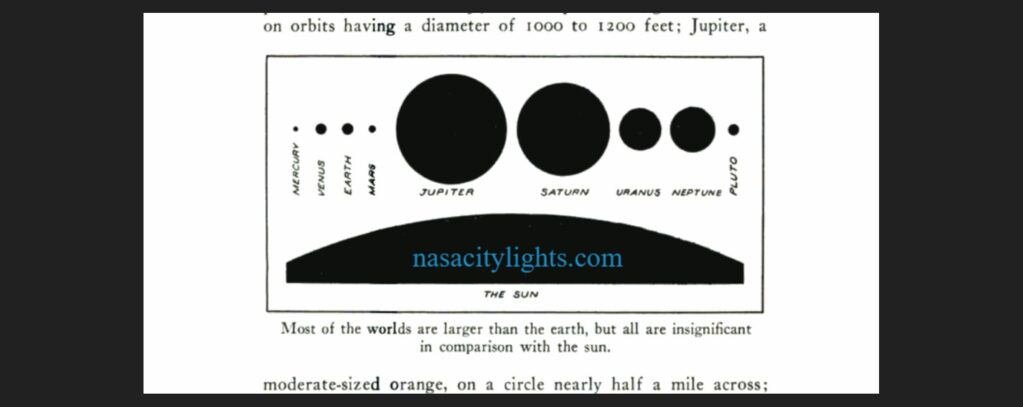
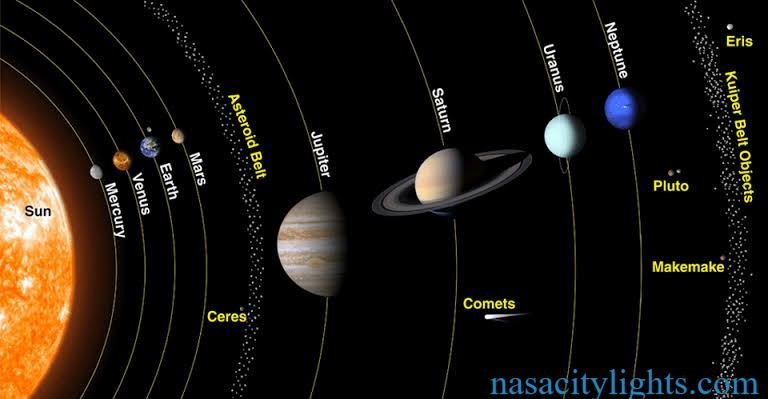
Pluto is smaller in diameter than every one of the eight major planets. Jupiter is the largest, while Mercury is the smallest. The four inner planets are primarily rocky, whereas Jupiter and Saturn are gas giants and Uranus and Neptune are ice giants. Pluto belongs to a different category because of its characteristics and its position in the outer Solar System.
The following table provides approximate mean diameters for Pluto and the major planets. These figures make it easier to understand the enormous range of sizes found within our planetary system.
| Celestial body | Approximate diameter |
|---|---|
| Pluto | 2,370 km |
| Mercury | 4,879 km |
| Mars | 6,779 km |
| Venus | 12,104 km |
| Earth | 12,742 km |
| Neptune | 49,244 km |
| Uranus | 50,724 km |
| Saturn | 116,460 km |
| Jupiter | 139,820 km |
The comparison shows that Pluto is tiny beside the giant planets. However, its relatively small dimensions do not mean it lacks complexity. NASA’s New Horizons spacecraft revealed a surprisingly varied landscape, including icy plains and towering mountains, demonstrating that small worlds can have fascinating geological features.
How Big Is Pluto Compared to a Human?
A human being is incredibly small compared with Pluto. If an adult is approximately 1.7 meters tall, Pluto’s mean diameter of 2,370 kilometers is equivalent to about 1.4 million adult heights placed end to end. This calculation provides an imaginative way to understand the scale difference between a person and a distant dwarf planet.
Of course, humans could not stand on Pluto without specialized protection because its surface is extremely cold and its atmosphere is unsuitable for human survival. Nevertheless, this comparison demonstrates how even a relatively small celestial body can be enormous compared with everyday objects. Scale models, planetarium displays, and astronomical illustrations can help make these vast distances and dimensions easier to imagine.
How Big Is Pluto Compared to Australia and the United States?
Pluto’s diameter can also be compared with familiar geographical distances. Australia spans roughly 4,000 kilometers across its widest east-west extent, depending on the points measured. Pluto’s diameter is approximately 2,370 kilometers, so it is considerably smaller than Australia’s broadest width. This comparison helps readers connect astronomical measurements with distances they may already understand.
The contiguous United States stretches roughly 4,500 kilometers across at its widest commonly cited extent, depending on the endpoints selected. Pluto’s diameter is also smaller than that distance. However, these are comparisons between the diameter of a spherical body and distances across land, not comparisons of total surface area. They provide a useful mental picture without suggesting that Pluto is shaped like a continent.
Why Is Pluto Classified as a Dwarf Planet?
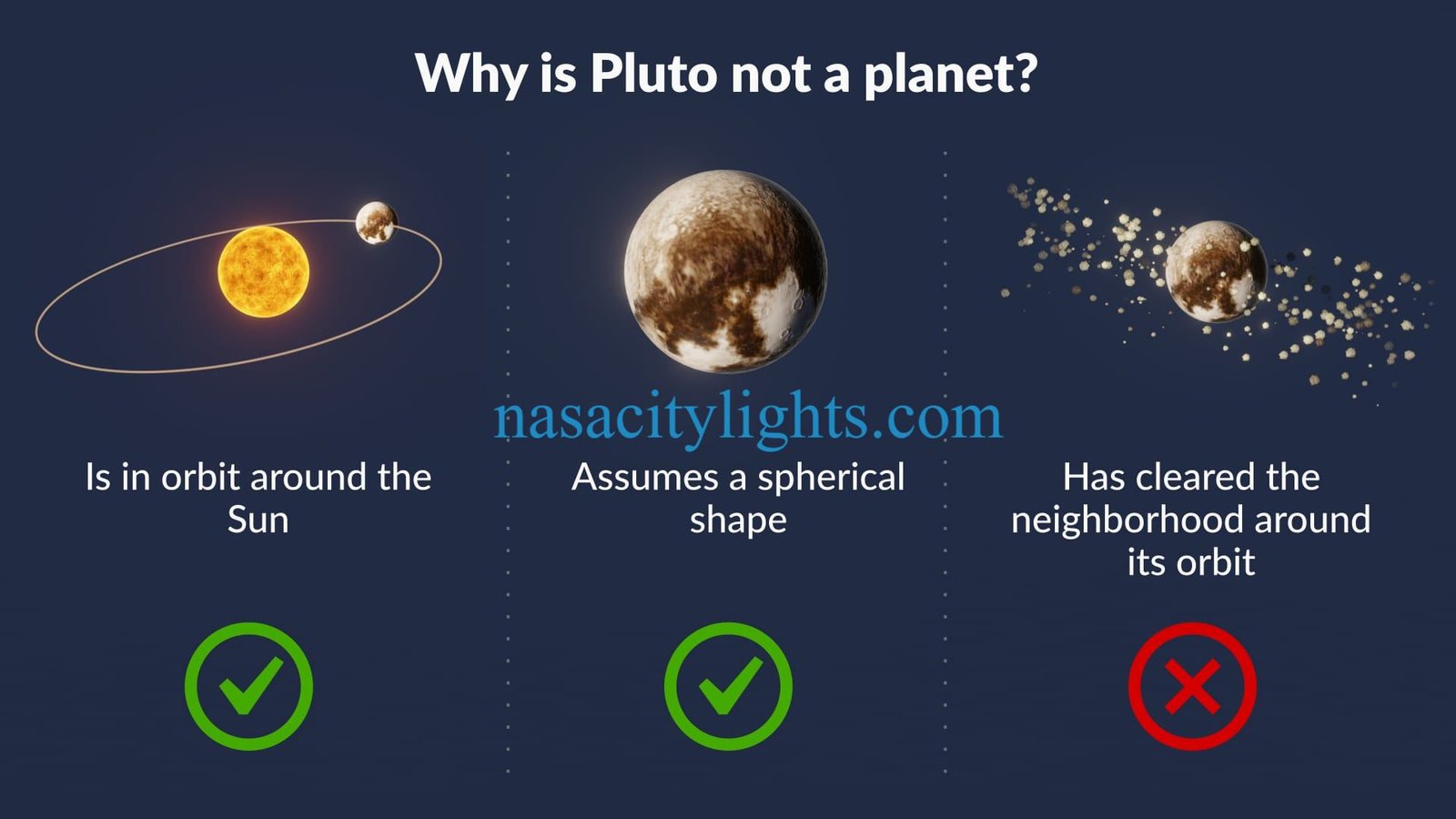
Pluto was discovered in 1930 and was originally classified as the ninth planet. In 2006, the International Astronomical Union established a formal definition of a planet that includes three criteria: an object must orbit the Sun, have enough gravity to become nearly round, and have cleared its orbital neighborhood of other objects of comparable size.
Pluto satisfies the first two requirements but has not cleared its orbital neighborhood. It shares its distant region with other icy bodies, so it is classified as a dwarf planet. Its classification does not diminish its scientific importance. Studying Pluto helps astronomers understand the Kuiper Belt, the formation of planetary systems, and the variety of objects that orbit our Sun.
How Did NASA Measure Pluto’s Size?
Astronomers estimated Pluto’s size through observations long before a spacecraft visited it. Telescopes, stellar occultations, and other astronomical techniques helped scientists refine measurements of its dimensions. However, because Pluto is extremely distant and appears tiny from Earth, determining its precise size presented significant technical challenges.
NASA’s New Horizons spacecraft flew past Pluto in July 2015 and collected detailed images and scientific measurements. These observations improved scientists’ understanding of its diameter, surface features, atmosphere, and moons. The mission helped establish the commonly cited equatorial diameter of approximately 2,377 kilometers, giving researchers a much clearer picture of this distant world.
Conclusion: Pluto Is Small but Fascinating
Pluto has an equatorial diameter of approximately 2,377 kilometers (1,477 miles) and a mean diameter of about 2,370 kilometers (1,473 miles). It is roughly one-fifth of Earth’s diameter, about two-thirds the diameter of our Moon, and less than half the diameter of Mercury. These comparisons show just how small Pluto is beside the major planets.
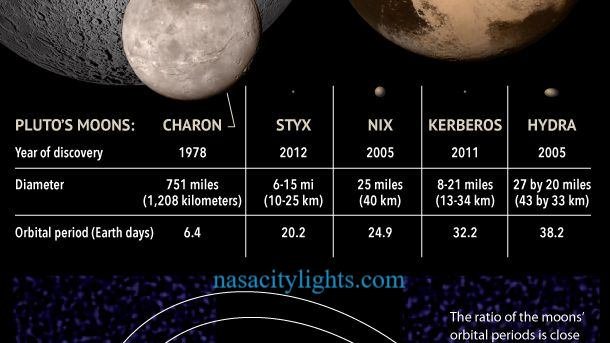
Despite its modest size, Pluto remains one of the most interesting objects in the outer Solar System. Its icy landscapes, thin atmosphere, and largest moon, Charon, provide valuable clues about planetary evolution. NASA’s New Horizons mission transformed our understanding of this distant world, showing that a small dwarf planet can reveal important discoveries about the history and diversity of our Solar System.
Frequently Asked Questions
How big is Pluto?
Pluto has a mean diameter of approximately 2,370 kilometers (1,473 miles) and an equatorial diameter of about 2,377 kilometers (1,477 miles).
How big is Pluto compared to Earth?
Pluto’s mean diameter is about 18.6% of Earth’s diameter, making it roughly one-fifth as wide as our planet.
Is Pluto bigger than Earth’s Moon?
No, Pluto is smaller than the Moon, measuring about 68% of the Moon’s diameter.
How big is Pluto in miles?
Pluto’s equatorial diameter is approximately 1,477 miles, while its mean diameter is about 1,473 miles.
How big is Pluto in kilometers?
Pluto measures approximately 2,377 kilometers across its equator and about 2,370 kilometers in mean diameter.
Is Pluto bigger than Mercury?
No, Mercury is larger, with a diameter of approximately 4,879 kilometers compared with Pluto’s mean diameter of 2,370 kilometers.
Can Pluto fit inside Earth?
Yes, Earth is vastly larger than Pluto in both diameter and volume, so Pluto could fit inside Earth in a simplified spherical comparison.
Why is Pluto called a dwarf planet?
Pluto is classified as a dwrf planet because it orbits the Sun and is nearly round but has not cleared its orbital neighborhood of other objects.
Author Name: Hamid Ali
Email: johanharwen314@gmail.com
Also Read: