
How to Recall an Email in Outlook: Complete 2026 Guide
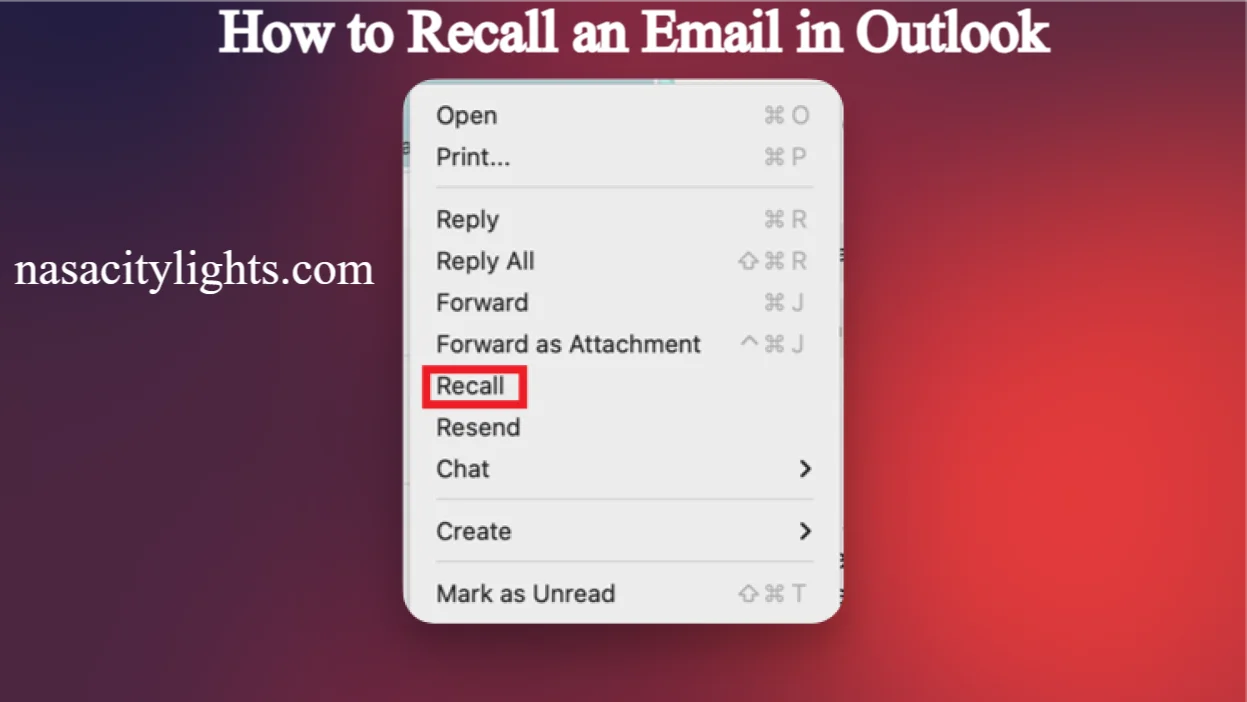
Have you ever clicked Send and immediately realized that you used the wrong recipient, forgot an attachment, or sent an email containing incorrect information? If so, you may be wondering how to recall an email in Outlook.
Microsoft Outlook has a built-in Message Recall feature, but it does not work for every email. The most important requirement is that both the sender and recipient generally need Microsoft 365 work or school accounts within the same organization, and the recipient must not have opened the message.
This guide explains how Outlook email recall works in 2026, how to recall messages in new and classic Outlook, what happens when recall is unavailable, and how Outlook’s recall feature differs from Undo Send.
Can You Recall an Email in Outlook?
Yes, but only under specific conditions.
Microsoft’s current documentation says message recall is available in new Outlook for Windows, classic Outlook, and Outlook on the web when both sender and recipient have Microsoft 365 work or school accounts in the same organization and the recipient has not opened the message.
This means Outlook recall is not a universal “delete email from everyone’s inbox” feature.
Outlook recall generally requires:
- A Microsoft 365 work or school account
- Sender and recipient in the same organization
- The message has not been opened
- A supported Outlook environment
- An organization where the feature is available
Personal accounts such as Outlook.com, Hotmail.com, Live.com, and MSN.com cannot use the standard Message Recall feature. Microsoft recommends Undo Send for applicable personal Outlook.com accounts instead.
How to Recall an Email in Outlook
How to Recall an Email in Outlook
The exact process depends on which version of Outlook you’re using.
How to Recall an Email in New Outlook
If you’re using new Outlook for Windows, follow these steps:
- Open Sent Items.
- Double-click the email you want to recall.
- Open the message in its own window.
- Select Recall Message from the ribbon.
- Confirm the recall.
- Check your inbox for the Message Recall Report.
The report tells you whether the recall succeeded, is pending, or failed.
If you need to correct an email, Outlook can also allow you to recall the original and send a replacement message.
Example
Suppose you send a proposal but realize that the attached document is outdated.
If the recall requirements are satisfied, you can attempt to:
Recall original → Replace message → Attach correct document → Send
However, recall is not guaranteed.
How to Recall an Email in Classic Outlook
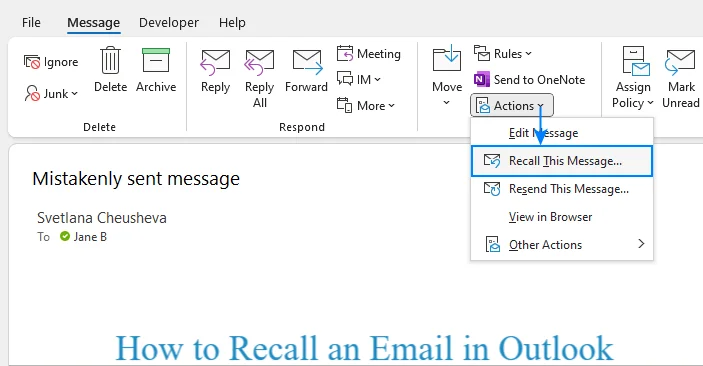
Classic Outlook for Windows provides the traditional recall process.
- Open Sent Items.
- Double-click the email you want to recall.
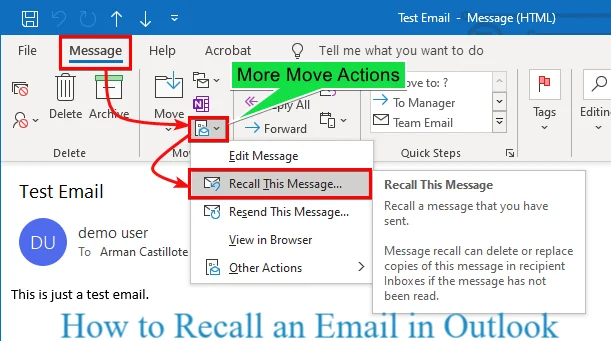
- Select the Message tab.
- Choose More Move Actions and then Recall This Message.
Depending on your ribbon configuration, you may find the command under More commands (…) → Actions → Recall This Message.
You will then see two main choices:
- Delete unread copies of this message
- Delete unread copies and replace with a new message
Choose the appropriate option and select OK.
If you’re replacing the email, edit the replacement message and send it.
Important
Simply selecting an email in the reading pane is not enough in classic Outlook. Microsoft says you need to open the message in its own window to access the recall command.
How to Recall an Email in Outlook Web
There is an important distinction between Outlook on the web for work or school accounts and Outlook.com for personal accounts.
Outlook on the web for Microsoft 365
For supported Microsoft 365 work or school accounts:
- Open Sent Items.
- Double-click the sent message.
- Select Recall Message.
- Confirm the action.
- Check the Message Recall Report.
Microsoft currently documents Message Recall for Outlook on the web for supported organizational accounts.
Outlook.com personal accounts
If you’re using a personal Outlook.com, Hotmail.com, Live.com, or MSN.com account, you cannot recall a message after it has been sent. Instead, you can use Undo Send, which delays delivery and gives you a short window to cancel the message.
How Does Outlook Email Recall Work?
Outlook recall is better understood as an attempt to retrieve an unread message, rather than a guaranteed deletion mechanism.
When you submit a recall, Outlook attempts to retrieve the message from recipient mailboxes where the message has not yet been opened. You can also request that the original be replaced with a corrected message.
Microsoft provides a Message Recall Report that indicates whether the operation succeeded, is pending, or failed.
This is why sending a recall request does not necessarily mean the email has disappeared.
When Can You Recall an Outlook Email?
The most important factor is the account and organizational setup.
| Situation | Recall availability |
|---|---|
| Microsoft 365 work/school accounts in same organization | Generally supported |
| Recipient has not opened message | Required |
| Personal Outlook.com account | Not supported |
| Gmail recipient | Not supported by Outlook’s native recall |
| External recipient outside your organization | Native recall generally unavailable |
| Recipient already opened message | Recall generally won’t work |
| Outlook mobile app | Native recall/undo isn’t currently available |
| Outlook on the web with supported work/school account | Supported |
Microsoft specifically states that personal Outlook.com accounts cannot use Message Recall and that the standard recall feature is intended for supported Microsoft 365 organizational accounts.
When Outlook Email Recall Does Not Work
There are several situations where recall may fail.
The recipient already opened the email
The native feature is designed to retrieve messages that have not yet been opened. Once the recipient has read the message, recall generally cannot remove it from their mailbox.
The recipient is outside your organization
If you accidentally send an email to a customer using Gmail or to another external organization, Outlook’s native recall is generally not available.
You’re using a personal Outlook.com account
Microsoft does not provide Message Recall for personal Outlook.com, Hotmail.com, Live.com, or MSN.com accounts.
You’re using Outlook on a phone
Microsoft’s current support documentation says that Outlook for Android and Outlook for iOS cannot undo or recall a sent email.
Your organization doesn’t support the feature
If you cannot find the recall command, your account type or organizational configuration may not support it. Microsoft notes that the command may be unavailable when you don’t have an appropriate Exchange account or when the feature isn’t available in the organization.
Can You Recall an Email After It Is Read?
Generally, no.
Outlook’s native Message Recall is intended for messages that the recipient has not opened. If the email has already been read, you should assume that the recipient still has access to the information.
If the email contains sensitive information, don’t rely solely on the recall process. Consider contacting the recipient and asking them to delete the message and any downloaded attachments.
For highly sensitive business communications, organizations may also use dedicated email security and access-control technologies.
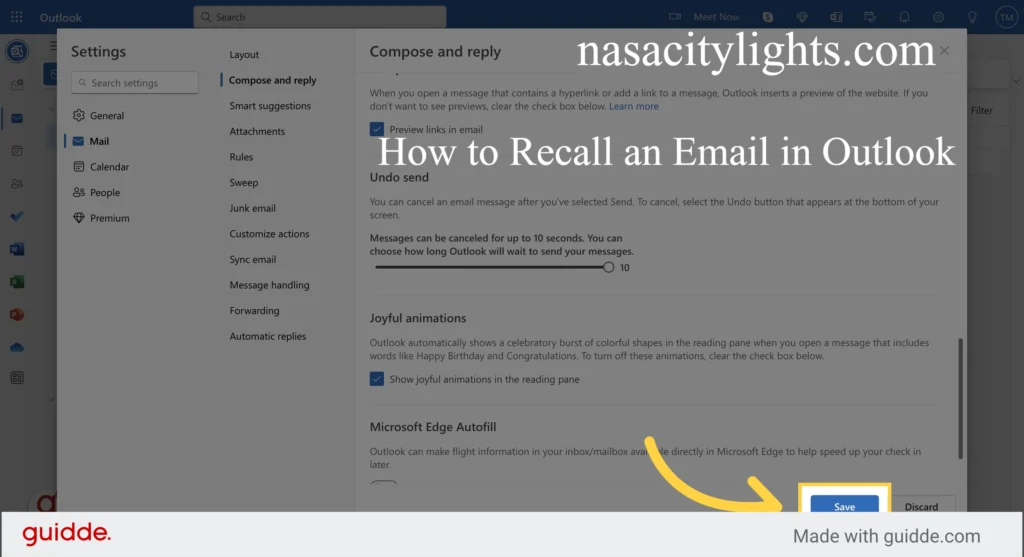
How to Undo a Sent Email in Outlook
Undo Send is different from Message Recall.
Instead of retrieving an email after delivery, Undo Send delays sending long enough for you to cancel it.
For Outlook.com, Microsoft allows users to configure an Undo Send delay of up to 30 seconds.
New Outlook for Windows also provides an Undo Send option. Microsoft currently documents an undo window of up to 10 seconds in its new Outlook guidance.
The difference is simple:
Undo Send:
You cancel the message before it is actually sent.
Message Recall:
You attempt to retrieve a message that has already been sent under supported organizational conditions.
For preventing accidental emails, a short send delay can therefore be useful because it gives you a brief opportunity to catch mistakes before delivery.
Outlook Email Recall vs. Undo Send
| Feature | Message Recall | Undo Send |
|---|---|---|
| Works after sending? | Yes, under specific conditions | No, it delays sending |
| Requires same organization? | Generally yes | No |
| Works with personal Outlook.com? | No | Yes |
| Can work after recipient opens message? | No | Not applicable |
| Main purpose | Retrieve an eligible sent message | Cancel before delivery |
| Best use | Internal organizational mistakes | Preventing accidental sends |
How to Recall an Email in Outlook 365
If you’re using Microsoft 365 with a work or school account, the process depends on whether you have new Outlook or classic Outlook.
New Outlook
Sent Items → Open message → Recall Message → Confirm
Classic Outlook
Sent Items → Open message → Message → More Move Actions → Recall This Message
Microsoft currently documents Message Recall for Microsoft 365 work and school accounts when the sender and recipient are within the same organization and the recipient has not opened the email.
How to Recall an Email in Outlook App
If by “Outlook app” you mean the Outlook mobile app for iPhone or Android, there is an important limitation.
Microsoft currently says that sent emails cannot be undone or recalled from Outlook for iOS or Android.
If you need to prevent accidental sends on supported desktop or web versions, configuring an appropriate send delay can be more useful than relying on mobile recall.
How to Recall an Email in Outlook on Mac
Outlook for Mac has its own feature availability and interface, so Windows instructions should not automatically be applied to the Mac version.
If the recall option isn’t visible, don’t assume that the same Windows workflow applies. Check Microsoft’s current Outlook for Mac documentation for the account type and version you’re using.
The broader requirement remains important: native Message Recall is primarily designed for supported Microsoft 365 organizational accounts rather than ordinary external email.
How to Recall an Email in Outlook to External Recipients
You generally cannot use Outlook’s native recall feature to retrieve an email sent to an external recipient.
For example, if you accidentally send confidential information from your company’s Microsoft 365 account to a Gmail address, the standard Outlook recall mechanism isn’t designed to remove that message from the external mailbox.
In that situation, consider:
- Contacting the recipient immediately.
- Asking them to delete the message.
- Asking them to delete downloaded attachments.
- Notifying your organization’s security or IT team if sensitive information was exposed.
- Reviewing whether additional access-control or encryption tools should be used for future messages.
How to Recall an Email in Outlook Without the Recipient Knowing
There is no reliable way to guarantee a completely invisible recall.
Outlook can generate a Message Recall Report showing whether a recall succeeded, is pending, or failed.
More importantly, native recall does not give you universal control over an email once it has reached an external recipient.
If privacy is important, it is better to use appropriate security controls before sending sensitive information rather than depending on recall afterward.
How to Protect Confidential Outlook Emails
For sensitive communications, prevention can be more reliable than trying to recall a message after an error.
Businesses can consider:
- Email encryption
- Microsoft information-protection features
- Sensitivity labels
- Access controls
- Data-loss prevention policies
- Secure file-sharing systems
- Send delays
- Human approval for high-risk communications
Microsoft Outlook supports sensitivity labels in supported environments, allowing organizations to apply information-protection policies to messages.
What About Virtru for Outlook?
Virtru offers email-security and data-protection products designed to give organizations additional control over protected communications.
This is different from Outlook’s native recall feature. With an access-control approach, the goal is to control access to protected content rather than simply depending on Outlook’s ability to retrieve an unread message.
For organizations considering this type of system, the key question is whether their security requirements justify additional encryption and access-management controls.
What Should You Do If Outlook Recall Fails?
If the message has already been delivered and recall fails, act quickly.
For a normal mistake
Send a short correction:
“Please disregard my previous email. I sent it in error. I’ll follow up with the correct information shortly.”
For confidential information
Take the situation more seriously.
- Contact the recipient.
- Ask them not to use or distribute the information.
- Request deletion where appropriate.
- Notify your organization’s IT or security team.
- Follow your company’s incident-response procedure.
- If credentials or access tokens were exposed, revoke or rotate them immediately.
The appropriate response depends on what information was sent and who received it.
Frequently Asked Questions
Can I recall an email in Outlook?
Yes, if you’re using a supported Microsoft 365 work or school account and the sender and recipient are in the same organization, with the recipient having not opened the message.
How long do I have to recall an Outlook email?
There isn’t a simple universal time limit such as “10 minutes.” The critical factor is whether the message remains eligible for recall, particularly whether the recipient has opened it. Microsoft says recall requests may be retried for up to 24 hours in some circumstances when execution is temporarily unavailable.
Can I recall an email sent to Gmail?
Not with Outlook’s native Message Recall feature. Native recall is designed for supported Microsoft 365 work or school accounts within the same organization.
Can I recall an email after someone reads it?
Generally, no. Outlook’s native recall is designed to retrieve unread messages.
Can I recall an email from Outlook on iPhone?
Microsoft currently says that Outlook for iOS does not support undoing or recalling a sent email.
Conclusion
Knowing how to recall an email in Outlook can save you from some common sending mistakes, but the feature has important limitations.
For supported Microsoft 365 work or school accounts, you can generally find the message in Sent Items, open it, choose Recall Message, and then monitor the Message Recall Report.
However, native recall is not a universal solution. It generally depends on the sender and recipient being within the same organization and the recipient not having opened the message.
For personal Outlook.com accounts, Undo Send is the practical alternative because it gives you a short window to cancel a message before it is delivered.
For sensitive business communications, prevention through encryption, access controls, information protection, and appropriate organizational policies can provide a stronger security strategy than relying on recall after an email has already been sent.
Author Bio: Hamid Ali is a technology and digital marketing writer covering Microsoft Outlook, AI, automation, SEO, and emerging digital tools. He focuses on creating practical, easy-to-understand guides that help readers solve everyday technology and productivity challenges.
Also Read: