
Sulfuric Acid Uses: Essential Applications Transforming Modern Industry
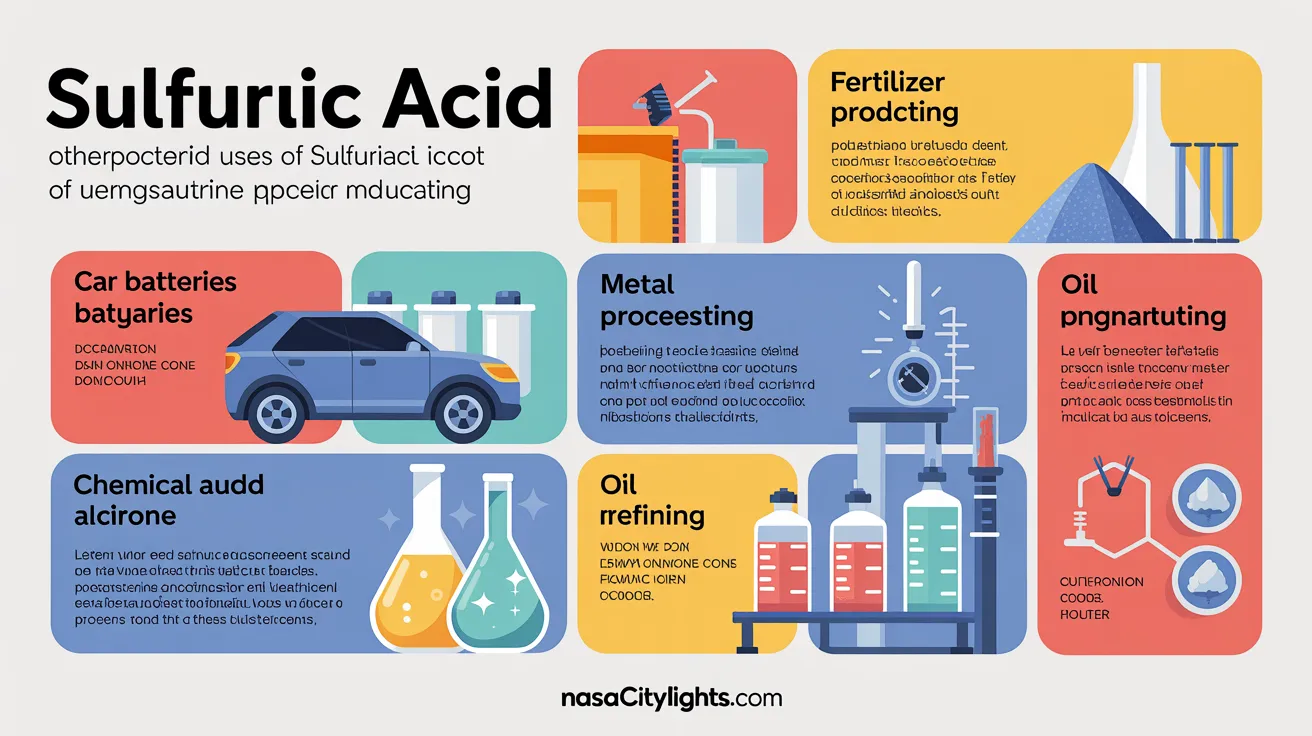
You encounter sulfuric acid’s impact every single day, even if you don’t realize it. The fertilizers growing your food, the car battery starting your vehicle, and countless household products all depend on this remarkable chemical. Sulfuric acid stands as one of the most produced and utilized chemicals in the world, with global production exceeding 260 million tons annually.
Understanding sulfuric acid uses reveals how deeply this compound influences modern civilization. From agriculture to technology, from pharmaceuticals to petroleum refining, sulfuric acid plays an irreplaceable role in processes that shape our daily lives. Its versatility comes from unique chemical properties that make it indispensable across dozens of industries.
This comprehensive guide explores the diverse sulfuric acid uses that power our world. You’ll discover why industries rely so heavily on this chemical, how it contributes to products you use regularly, and what makes it so valuable despite its corrosive nature. Whether you’re a student, professional, or simply curious about the chemistry behind everyday life, this article illuminates the fascinating applications of one of chemistry’s most important compounds.
What Makes Sulfuric Acid So Useful
Before exploring specific sulfuric acid uses, understanding what makes this chemical so versatile helps explain its widespread adoption. Sulfuric acid possesses unique properties that few other chemicals can match.
Chemical Properties and Characteristics
Sulfuric acid is a strong mineral acid with the chemical formula H₂SO₄. It appears as a clear, colorless, odorless liquid in its pure form. The acid demonstrates exceptional strength, completely dissociating in water to release hydrogen ions. This makes it one of the strongest acids available for industrial applications.
The compound’s hygroscopic nature means it aggressively absorbs moisture from its surroundings. This property proves useful in dehydration processes and explains why concentrated sulfuric acid must be stored carefully. When diluting sulfuric acid, you must always add acid to water, never water to acid, to prevent dangerous exothermic reactions.
Sulfuric acid exists in various concentrations, each suited for different applications. Dilute solutions work well for certain chemical processes, while concentrated forms tackle more demanding industrial tasks. The ability to use different strengths expands the range of sulfuric acid uses significantly.
Temperature affects sulfuric acid’s behavior dramatically. At room temperature, it remains stable and manageable in proper containers. However, heating increases its reactivity and corrosiveness. Understanding these temperature relationships is crucial for safe and effective industrial application.
Why Industries Choose Sulfuric Acid
Cost effectiveness ranks among the top reasons industries favor sulfuric acid. Production methods developed over centuries have made manufacturing highly efficient and economical. The Contact Process, which produces most commercial sulfuric acid today, yields large quantities at relatively low costs.
Availability is another major factor. Sulfuric acid production facilities exist worldwide, ensuring steady supply chains for industries that depend on it. This global production network prevents supply disruptions that could cripple manufacturing processes.
The chemical’s versatility cannot be overstated. Sulfuric acid participates in reactions as an acid, dehydrating agent, oxidizing agent, and catalyst. Few chemicals offer such broad functionality, making sulfuric acid the practical choice for diverse industrial needs.
Established infrastructure and expertise also drive continued use. Decades of industrial experience have created extensive knowledge about handling, transporting, and applying sulfuric acid safely. This institutional knowledge makes adopting sulfuric acid solutions more practical than exploring alternatives.
Fertilizer Production: The Largest Use
The single biggest application among sulfuric acid uses is fertilizer manufacturing. Approximately 60% of all sulfuric acid produced globally goes toward creating fertilizers that feed the world’s population.
Phosphate Fertilizer Manufacturing
Phosphate fertilizers depend almost entirely on sulfuric acid for production. The process begins with phosphate rock, a naturally occurring mineral containing calcium phosphate. In its natural state, phosphate rock is too insoluble for plants to use effectively.
Sulfuric acid reacts with phosphate rock to create phosphoric acid and calcium sulfate. The phosphoric acid then becomes the foundation for various phosphate fertilizers. Without sulfuric acid, extracting usable phosphorus from rock would be virtually impossible at industrial scales.
Superphosphate fertilizers represent a direct sulfuric acid use. Treating phosphate rock with sulfuric acid produces single superphosphate, one of the oldest commercial fertilizers still in use. This fertilizer provides both phosphorus and sulfur, two essential plant nutrients.
The efficiency of this process explains why it has remained largely unchanged for over a century. Modern refinements have improved yields and reduced waste, but the fundamental chemistry still relies on sulfuric acid’s unique properties. This application alone justifies calling sulfuric acid agriculture’s most important chemical.
Impact on Global Food Production
The connection between sulfuric acid uses and food security is direct and profound. Without sulfuric acid-based fertilizers, current agricultural productivity would be impossible. Crop yields would plummet, and feeding the global population would become an insurmountable challenge.
Phosphorus is a non-negotiable nutrient for plant growth. It plays crucial roles in photosynthesis, energy transfer, and genetic material formation. Plants cannot grow without adequate phosphorus, and natural soil phosphorus is often insufficient for high-yield agriculture.
Sulfuric acid-derived fertilizers have enabled the Green Revolution that transformed agriculture in the 20th century. These fertilizers allowed farmers to dramatically increase production on existing farmland. The result was billions of people fed who would otherwise have faced food shortages.
Today’s agriculture depends on continuous sulfuric acid supply. Any significant disruption in sulfuric acid production would ripple through the food system within months. This dependency underscores how critical this chemical has become to modern civilization.
Battery Manufacturing Applications
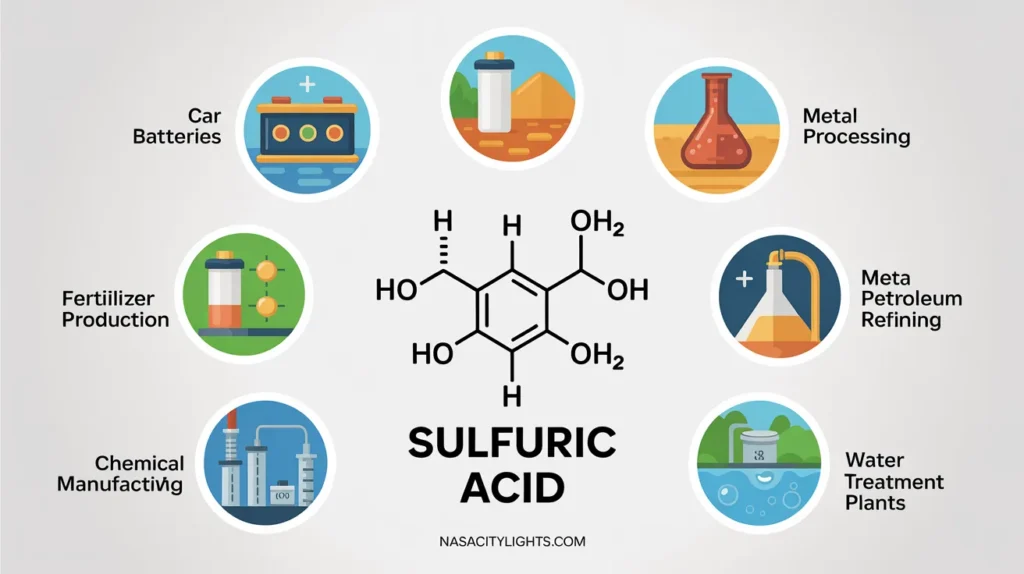
Lead acid batteries represent another major category among sulfuric acid uses. These batteries power vehicles, provide backup power, and store energy for countless applications worldwide.
Automotive Battery Production
Every conventional car battery contains sulfuric acid as its electrolyte. The acid enables the chemical reactions that generate electrical current and allow recharging. This application consumes substantial quantities of sulfuric acid annually.
In lead acid batteries, sulfuric acid reacts with lead plates to create lead sulfate and release electrons. This electrochemical process produces the electrical energy that starts your car. When you recharge the battery, the reaction reverses, restoring the acid and lead plates.
The concentration of sulfuric acid in batteries is carefully controlled. Battery acid typically contains about 30 to 35% sulfuric acid by weight. This concentration balances electrical performance with safety and longevity. Too concentrated, and the acid would be overly corrosive; too dilute, and electrical output would suffer.
Automotive applications continue driving demand for battery-grade sulfuric acid. Despite the rise of electric vehicles with lithium-ion batteries, lead acid batteries remain essential for starting conventional engines. They also serve as auxiliary batteries in hybrid and electric vehicles.
Industrial Battery Systems
Beyond automotive uses, sulfuric acid batteries power forklifts, golf carts, and industrial equipment. These applications often use larger batteries that contain significantly more acid than car batteries. Material handling operations worldwide depend on these sulfuric acid-powered systems.
Backup power systems for telecommunications, hospitals, and data centers frequently employ large lead acid battery banks. These systems ensure critical operations continue during power outages. The reliability and cost effectiveness of lead acid technology keeps it relevant despite newer battery chemistries.
Renewable energy storage represents a growing sulfuric acid use. Large battery installations store excess solar and wind power for later use. While lithium-ion batteries dominate headlines, lead acid batteries still serve many grid-scale storage applications due to lower costs.
The recyclability of lead acid batteries enhances their environmental profile. Over 95% of battery components, including the sulfuric acid, can be recovered and reused. This closed-loop recycling makes lead acid batteries one of the most successfully recycled consumer products.
Chemical Manufacturing and Processing
Chemical synthesis represents a diverse category of sulfuric acid uses. Countless chemical products require sulfuric acid at some stage of their manufacturing process.
Production of Other Chemicals
Sulfuric acid serves as a starting material or processing aid for hundreds of different chemicals. Hydrochloric acid, nitric acid, and phosphoric acid production all involve sulfuric acid at various stages. These acids then become ingredients in countless downstream products.
Detergent manufacturing relies heavily on sulfuric acid. The acid helps produce alkylbenzene sulfonates, the active cleaning agents in many laundry detergents and household cleaners. Without sulfuric acid, producing these ubiquitous cleaning products would require completely different chemistry.
Dye and pigment industries use sulfuric acid extensively. Many colorants undergo sulfonation reactions that incorporate sulfur-containing groups into their molecular structures. These modifications improve water solubility and color fastness in textile applications.
Pharmaceutical manufacturing employs sulfuric acid in synthesizing numerous medications. The acid might serve as a catalyst, reactant, or processing chemical depending on the specific drug being produced. Many life-saving medications owe their existence partly to sulfuric acid chemistry.
Catalytic Applications
Sulfuric acid functions as a catalyst in various industrial processes. Catalysts enable chemical reactions without being consumed themselves. This makes sulfuric acid economically attractive since smaller quantities can process large volumes of materials.
Petroleum refining uses sulfuric acid as a catalyst in alkylation processes. These reactions combine smaller hydrocarbon molecules into larger, more valuable ones used in gasoline production. The resulting high-octane fuel components improve engine performance and efficiency.
Organic synthesis frequently employs sulfuric acid catalysis. Esterification reactions, which create esters from alcohols and acids, proceed much faster in sulfuric acid’s presence. These esters become fragrances, flavorings, plasticizers, and solvents.
Polymerization reactions sometimes use sulfuric acid as an initiator or catalyst. Certain plastics and synthetic materials depend on acid-catalyzed reactions during manufacturing. The specific properties of sulfuric acid make it preferable to other acid catalysts in these applications.
Metal Processing and Refining
The metallurgical industry represents another significant area of sulfuric acid uses. Metal extraction, purification, and finishing processes frequently require this versatile chemical.
Ore Processing and Extraction
Extracting metals from ores often requires sulfuric acid treatment. Copper mining provides a prime example. Heap leaching operations spray dilute sulfuric acid over crushed ore containing copper minerals. The acid dissolves copper, creating a solution from which pure metal can be recovered.
Uranium extraction for nuclear fuel relies on sulfuric acid leaching. The acid dissolves uranium compounds from ore, allowing concentration and purification. This application, though smaller in volume than others, holds strategic importance for nuclear energy production.
Rare earth element recovery increasingly depends on sulfuric acid processing. These elements, essential for modern electronics and renewable energy technologies, occur in difficult-to-process ores. Sulfuric acid helps break down these ores and separate valuable rare earth elements.
Zinc production uses sulfuric acid in the roasting and leaching stages. The acid helps convert zinc sulfide ores into soluble zinc sulfate, from which pure zinc metal is eventually extracted. This process produces much of the world’s zinc supply.
Metal Finishing and Treatment
Pickling operations use sulfuric acid to remove oxidation and scale from metal surfaces. Steel manufacturing facilities maintain large pickling baths where hot-rolled steel passes through dilute sulfuric acid. This treatment produces clean, scale-free surfaces ready for further processing.
Anodizing aluminum requires sulfuric acid electrolyte baths. The process creates protective oxide layers on aluminum surfaces, improving corrosion resistance and allowing decorative coloring. Architectural aluminum, consumer electronics, and cookware often undergo sulfuric acid anodizing.
Electroplating operations sometimes employ sulfuric acid-based electrolytes. The acid provides the conductive medium in which metal ions travel and deposit onto workpieces. Chrome plating and other decorative metal finishes may use sulfuric acid solutions.
Passivation treatments for stainless steel use sulfuric acid to remove free iron from surfaces. This enhances the natural corrosion resistance of stainless steel by allowing a protective chromium oxide layer to form. Medical devices, food processing equipment, and chemical plants benefit from this treatment.
Petroleum Refining Applications
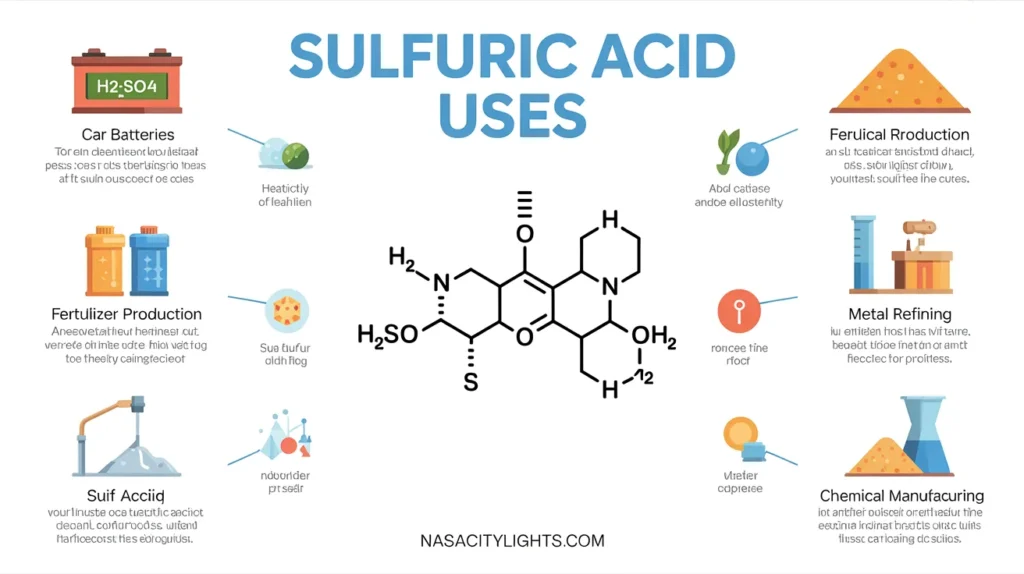
The petroleum industry counts among the major consumers in sulfuric acid uses. Refining crude oil into usable products requires various acid-based processes.
Alkylation Processes
Alkylation ranks among the most important refining processes using sulfuric acid. This reaction combines light hydrocarbons from cracking operations into larger, branched molecules ideal for gasoline. The resulting alkylate provides high-octane, clean-burning fuel components.
Sulfuric acid serves as the catalyst in alkylation units at many refineries. While some facilities use hydrofluoric acid instead, sulfuric acid alkylation remains common due to safety considerations and established expertise. The process demands careful acid management and periodic regeneration.
The alkylate produced by these units constitutes a premium gasoline blending component. It contains no sulfur, olefins, or aromatics that contribute to air pollution. As environmental regulations tighten, alkylate’s value in gasoline formulation increases.
Acid consumption in alkylation requires continuous makeup. The acid gradually degrades through side reactions and contamination. Spent acid from these units becomes feed for acid regeneration processes or finds uses in other applications where high purity is not required.
Treating and Purification
Sulfuric acid helps remove impurities from various petroleum fractions. Acid washing treats kerosene, lubricating oils, and other products to remove undesirable compounds. The acid reacts with sulfur compounds, nitrogen compounds, and unsaturated hydrocarbons, improving product quality.
Purification of petroleum-derived chemicals often involves sulfuric acid treatment. The acid selectively removes impurities while leaving desired products largely untouched. This selectivity makes sulfuric acid valuable despite the need for subsequent neutralization and disposal.
Sulfuric acid regeneration from refinery processes represents an important secondary use. Spent acid from various refining operations undergoes treatment to restore its strength and purity. This recycling reduces fresh acid consumption and manages acid waste streams effectively.
The petroleum industry’s sulfuric acid demand fluctuates with refining capacity and product requirements. As gasoline formulations change to meet environmental standards, alkylation and other acid-dependent processes may expand or contract. This creates dynamic demand patterns for sulfuric acid suppliers.
Water and Wastewater Treatment
Water treatment represents a less obvious but important category among sulfuric acid uses. Managing pH and removing contaminants often requires acid addition.
pH Adjustment Applications
Many industrial water treatment processes require pH control. Sulfuric acid provides an economical way to lower pH when necessary. Cooling water systems, boiler feedwater preparation, and industrial process water often need pH adjustment to prevent scaling or corrosion.
Municipal water treatment plants sometimes use sulfuric acid for pH control. After certain purification steps raise water pH too high, acid addition brings it back to acceptable levels. The precise pH control possible with sulfuric acid helps optimize subsequent treatment stages.
Swimming pool chemistry occasionally employs sulfuric acid for pH reduction, though other acids are more common for residential applications. Large commercial pools and water parks may use sulfuric acid due to its cost effectiveness at scale. Proper pH is essential for disinfection effectiveness and user comfort.
Agricultural irrigation systems use sulfuric acid to adjust water pH for optimal plant growth. Many crops prefer slightly acidic conditions, and alkaline water sources can be corrected with acid addition. This application connects directly to the broader role of sulfuric acid in supporting agriculture.
Wastewater Treatment Processes
Neutralizing alkaline wastewater streams frequently requires sulfuric acid. Many industrial processes generate high-pH effluent that must be neutralized before discharge or further treatment. Sulfuric acid provides reliable, economical neutralization.
Metal precipitation from wastewater sometimes uses sulfuric acid for pH adjustment. The optimal pH for precipitating various metal contaminants differs, and sulfuric acid allows precise control. This helps facilities meet discharge limits for heavy metals and other regulated substances.
Membrane filtration systems may use sulfuric acid to control scaling. Adjusting pH before reverse osmosis or nanofiltration prevents calcium and other minerals from precipitating on expensive membrane surfaces. This acid use protects capital equipment and maintains treatment efficiency.
Sludge conditioning in wastewater treatment plants occasionally employs sulfuric acid. Adjusting pH can improve dewatering performance, reducing the volume of sludge requiring disposal. This represents a minor but useful application of sulfuric acid in environmental management.
Emerging and Specialized Uses
Beyond the major applications, numerous specialized sulfuric acid uses serve niche industries and emerging technologies. These applications, while smaller in volume, demonstrate the chemical’s continued relevance.
Advanced Manufacturing Technologies
Semiconductor manufacturing uses ultra-pure sulfuric acid for wafer cleaning. The electronics industry demands exceptional chemical purity to avoid contaminating sensitive components. Specialized producers supply semiconductor-grade sulfuric acid meeting extraordinarily stringent specifications.
Solar panel production employs sulfuric acid in various manufacturing steps. Cleaning silicon wafers and processing other materials involves acid treatment. As solar energy expands, this application of sulfuric acid grows alongside it.
Battery technologies beyond traditional lead acid sometimes use sulfuric acid. Flow batteries, which show promise for large-scale energy storage, may employ sulfuric acid-based electrolytes. Research continues into new battery chemistries where sulfuric acid’s properties offer advantages.
Nanotechnology and advanced materials research occasionally explore sulfuric acid applications. The acid’s strong dehydration properties and reactivity enable certain specialized synthesis procedures. While these uses remain small, they represent the continuing evolution of sulfuric acid applications.
Specialized Industrial Processes
Explosives manufacturing historically relied heavily on sulfuric acid. While less common today, the acid still plays roles in producing certain energetic materials. The nitration reactions that create explosives often require sulfuric acid alongside nitric acid.
Bleaching and oxidation processes in textile and paper industries sometimes employ sulfuric acid. The acid helps activate other chemicals or controls pH during bleaching. These applications have declined as industries adopt alternative chemistries, but they haven’t disappeared entirely.
Wood processing and pulp production use sulfuric acid in certain processes. The acid helps break down lignin and cellulose in wood, facilitating conversion to paper pulp or other products. Sulfite pulping, though less common than kraft pulping, represents one example.
Analytical chemistry laboratories use sulfuric acid constantly. Digestion procedures for analyzing metals in samples rely on sulfuric acid’s oxidizing power. Countless analytical tests include sulfuric acid as a reagent, supporting scientific research and quality control across industries.
Safety and Environmental Considerations
Discussing sulfuric acid uses requires addressing safety and environmental aspects. The chemical’s hazards demand respect, but proper handling enables its benefits while minimizing risks.
Handling and Storage Requirements
Sulfuric acid is highly corrosive and requires appropriate containers. Carbon steel works well for concentrated acid, while dilute acid demands acid-resistant materials like rubber-lined steel or certain plastics. Material selection prevents leaks and containment failures.
Personal protective equipment is mandatory when working with sulfuric acid. Acid-resistant gloves, face shields, and protective clothing shield workers from splashes. Eye protection is especially critical since sulfuric acid can cause permanent vision damage.
Spill response procedures must be established wherever sulfuric acid is used. Neutralizing spills safely requires proper materials and training. Facilities maintain spill kits with absorbents and neutralizing agents like soda ash or lime.
Transportation of sulfuric acid follows strict regulations. Specialized tank trucks and railcars move the chemical between production facilities and users. Placards and documentation ensure emergency responders understand the hazard if accidents occur.
Environmental Management
Sulfuric acid releases to the environment must be prevented or controlled. Even dilute acid can harm aquatic ecosystems and contaminate soil. Facilities using large quantities implement containment systems to prevent releases.
Spent sulfuric acid from industrial processes requires proper management. Regeneration returns the acid to usable strength when economically feasible. Otherwise, neutralization converts spent acid to neutral sulfate salts for disposal or potential use.
Air emissions from sulfuric acid production and use require control. Sulfur dioxide, the precursor to sulfuric acid, contributes to acid rain if released. Modern facilities employ scrubbers and other pollution control equipment to minimize emissions.
The environmental impact of sulfuric acid uses varies by application. Fertilizer production, while essential for food security, contributes to nutrient runoff if fertilizers are overapplied. Responsible use considers both immediate benefits and broader environmental consequences.
Conclusion
The extensive sulfuric acid uses detailed in this guide illustrate why this chemical earned the title “king of chemicals.” From the fertilizers feeding billions to the batteries powering our vehicles, from metal refining to petroleum processing, sulfuric acid enables countless essential processes. Its unique combination of strength, versatility, and economy explains why global production exceeds 260 million tons annually.
Understanding these applications helps you appreciate the complex chemical infrastructure supporting modern life. The next time you eat fresh produce, start your car, or use countless other products, remember that sulfuric acid likely played a role in making them possible. This chemical’s influence extends far beyond chemistry laboratories into every aspect of daily existence.
The future will undoubtedly bring new sulfuric acid uses as technologies evolve. However, the fundamental applications in agriculture, batteries, and chemical manufacturing will continue driving demand. As long as civilization requires fertilizers, energy storage, and industrial chemicals, sulfuric acid will remain indispensable.
Consider how deeply chemical processes influence your world. What other chemicals play similarly crucial yet underappreciated roles in modern society? Understanding these connections enriches your perspective on the technology and industry that shape contemporary life.
Frequently Asked Questions
What is the most common use of sulfuric acid?
Fertilizer production represents the largest sulfuric acid use globally, consuming approximately 60% of total production. The chemical converts insoluble phosphate rock into usable phosphate fertilizers essential for modern agriculture. Without sulfuric acid, current food production levels would be impossible to maintain.
Is sulfuric acid dangerous to handle?
Yes, sulfuric acid is highly corrosive and dangerous without proper precautions. It causes severe burns on contact with skin and can permanently damage eyes. However, industries safely handle billions of gallons annually by following established safety protocols, using appropriate protective equipment, and implementing proper storage and containment systems.
Why do car batteries use sulfuric acid?
Car batteries use sulfuric acid because it enables the electrochemical reactions that generate electrical current. The acid reacts with lead plates to produce electrons and can be recharged by reversing the reaction. Its availability, cost effectiveness, and well-understood chemistry make sulfuric acid ideal for lead acid battery applications.
Can sulfuric acid be recycled or reused?
Yes, sulfuric acid can be recycled in several ways. Spent acid from industrial processes undergoes regeneration to restore its strength. Lead acid batteries are extensively recycled, with over 95% recovery rates including the sulfuric acid. Some applications use spent acid from one process as feed for another where high purity is not required.
What happens if you dilute sulfuric acid incorrectly?
Adding water to concentrated sulfuric acid causes a violent exothermic reaction that can explosively boil the water and splatter dangerous acid. Always add acid to water slowly while stirring, never the reverse. This allows the large volume of water to absorb the heat generated safely without reaching boiling temperature.
How is sulfuric acid produced industrially?
Most industrial sulfuric acid is produced by the Contact Process. This involves burning sulfur or roasting sulfide ores to create sulfur dioxide, oxidizing it to sulfur trioxide using a vanadium catalyst, and then absorbing the trioxide in water. This efficient process produces high-purity acid economically.
What industries use the most sulfuric acid?
The fertilizer industry is the largest consumer, followed by chemical manufacturing, battery production, petroleum refining, and metal processing. These five sectors account for the vast majority of global sulfuric acid consumption. Demand from each sector fluctuates with economic conditions and agricultural cycles.
Is sulfuric acid natural or man-made?
Sulfuric acid occurs naturally in volcanic emissions and acid mine drainage, but industrial quantities are entirely man-made. Natural sources produce negligible amounts compared to industrial needs. The Contact Process and other manufacturing methods supply the hundreds of millions of tons required annually.
What are alternatives to sulfuric acid in its major uses?
Few practical alternatives exist for many sulfuric acid applications. Phosphoric acid production specifically requires sulfuric acid. Some processes use hydrochloric or nitric acid instead, but sulfuric acid’s combination of strength, availability, and cost makes it the preferred choice for most applications where alternatives exist.
How much sulfuric acid does the world produce annually?
Global sulfuric acid production exceeds 260 million metric tons annually, making it one of the most produced chemicals worldwide. Production volume serves as an economic indicator since sulfuric acid demand correlates with overall industrial activity. China, the United States, and India rank among the largest producers.
Author Bio
A chemical engineer and industrial chemistry specialist with extensive experience in chemical manufacturing and process optimization. Passionate about explaining complex chemical processes in accessible language that helps readers understand the chemistry shaping modern industry. Dedicated to promoting chemical literacy and helping people appreciate the remarkable role chemistry plays in supporting contemporary civilization and technological advancement.