
Diatomic Molecules: Definition, Types, Examples & Facts in 2026
A diatomic molecule is a molecule made of exactly two atoms. The two atoms can be identical, such as H₂, or different, such as CO and HF. When both atoms are the same element, the molecule is called a homonuclear diatomic molecule. When they are different elements, it is called a heteronuclear diatomic molecule.
Diatomic molecules are among the simplest chemical molecules, but they are important throughout chemistry. They provide basic examples of covalent bonding, molecular orbitals, bond order, polarity, and molecular structure.
What Are Diatomic Molecules?
Diatomic molecules contain exactly two atoms joined by a chemical bond.
The atoms may be:
- Two atoms of the same element
- Two atoms of different elements
For example:
- H₂ contains two hydrogen atoms.
- O₂ contains two oxygen atoms.
- N₂ contains two nitrogen atoms.
- CO contains one carbon atom and one oxygen atom.
- HF contains one hydrogen atom and one fluorine atom.
The word diatomic simply refers to the number of atoms in the molecule. It does not mean that the two atoms must belong to the same element.
Quick Examples
| Molecule | Atoms | Type |
|---|---|---|
| H₂ | Hydrogen + hydrogen | Homonuclear |
| N₂ | Nitrogen + nitrogen | Homonuclear |
| O₂ | Oxygen + oxygen | Homonuclear |
| F₂ | Fluorine + fluorine | Homonuclear |
| Cl₂ | Chlorine + chlorine | Homonuclear |
| Br₂ | Bromine + bromine | Homonuclear |
| I₂ | Iodine + iodine | Homonuclear |
| CO | Carbon + oxygen | Heteronuclear |
| HF | Hydrogen + fluorine | Heteronuclear |
| NO | Nitrogen + oxygen | Heteronuclear |
What Are the Seven Diatomic Elements?
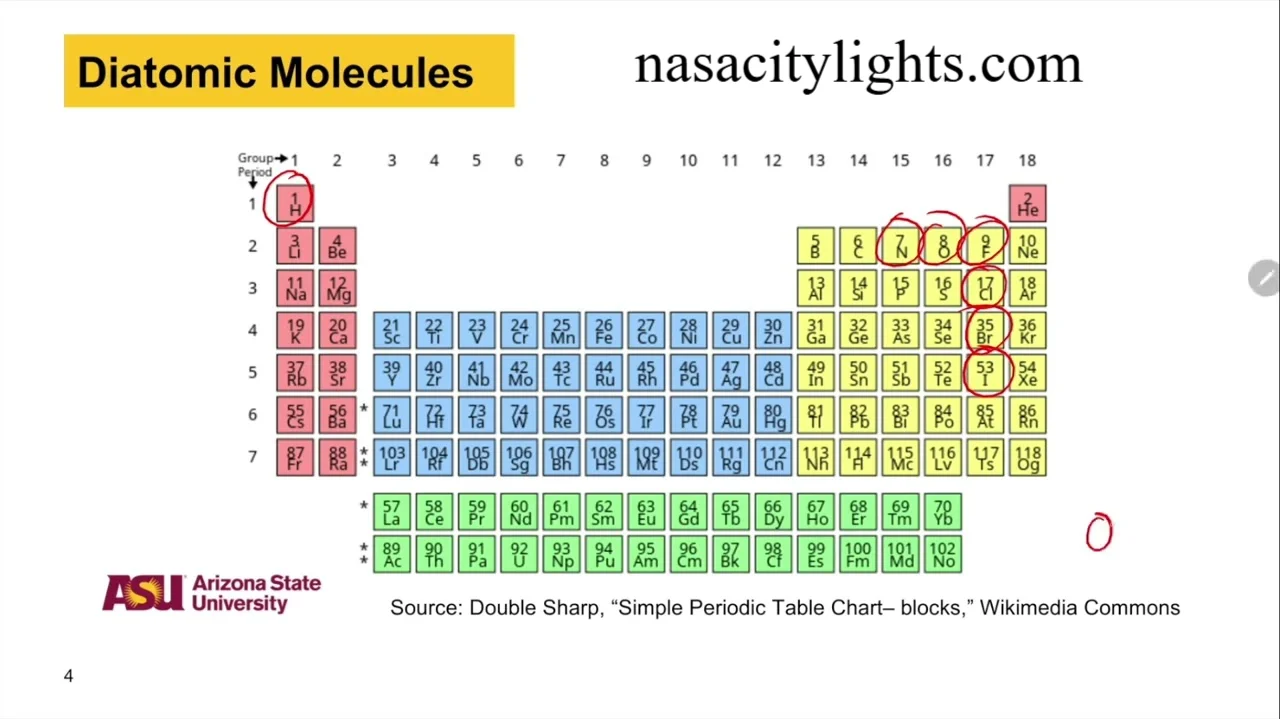
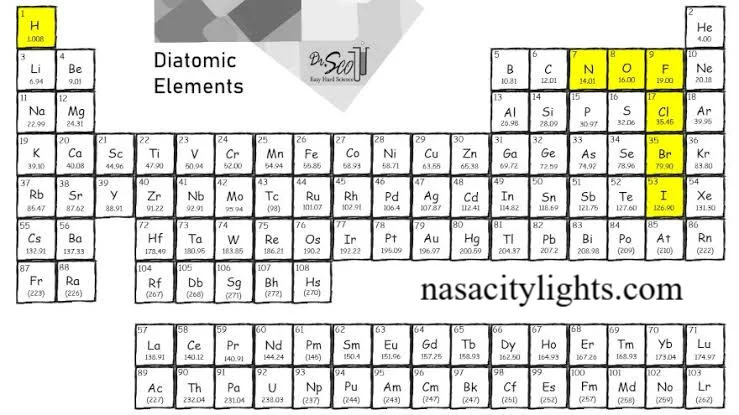
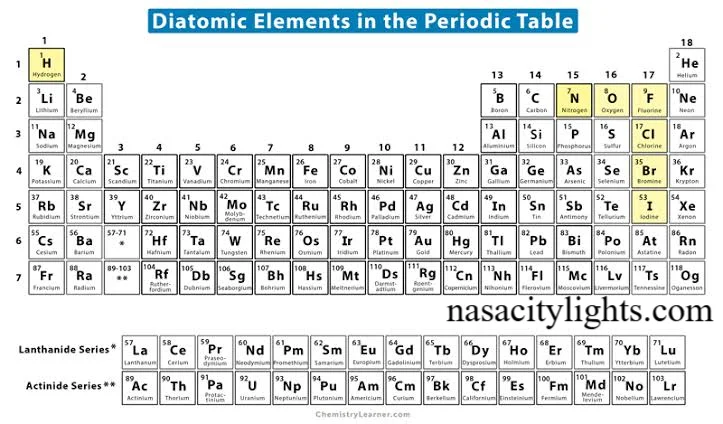
The seven elements commonly taught as diatomic elements are:
- Hydrogen — H₂
- Nitrogen — N₂
- Oxygen — O₂
- Fluorine — F₂
- Chlorine — Cl₂
- Bromine — Br₂
- Iodine — I₂
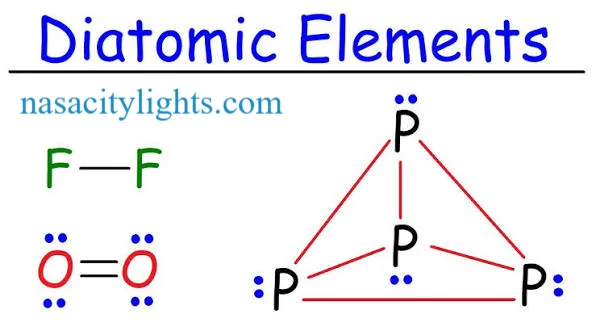
The Royal Society of Chemistry lists these seven elemental forms as H₂, N₂, O₂, F₂, Cl₂, Br₂, and I₂ and describes the bonding as covalent. Hydrogen and the group 17 elements listed form single bonds, oxygen forms a double bond, and nitrogen forms a triple bond.
A common classroom mnemonic for remembering the seven is:
HOFBrINCl
This represents:
Hydrogen
Oxygen
Fluorine
Bromine
Iodine
Nitrogen
Cllorine
The Diatomic Elements List
| Element | Molecular Formula | Bond |
|---|---|---|
| Hydrogen | H₂ | Single |
| Nitrogen | N₂ | Triple |
| Oxygen | O₂ | Double |
| Fluorine | F₂ | Single |
| Chlorine | Cl₂ | Single |
| Bromine | Br₂ | Single |
| Iodine | I₂ | Single |
This list is particularly useful when writing chemical equations. For example, elemental oxygen is normally represented as O₂ rather than O when describing molecular oxygen.
Are There Five or Seven Diatomic Elements?
The answer depends on what conditions and definition are being used.
At ordinary laboratory conditions, the familiar set of stable homonuclear diatomic elemental substances includes hydrogen, nitrogen, oxygen, fluorine, chlorine, bromine, and iodine. Hydrogen, nitrogen, oxygen, fluorine, and chlorine are gases at room temperature, while bromine is a liquid and iodine is a solid.
This explains why some educational sources emphasize five gaseous diatomic elements at room temperature while chemistry references commonly teach seven diatomic elements.
The distinction is therefore not really a contradiction. It comes from whether the discussion is about the seven elements that characteristically occur as diatomic molecules or only the five that are gases under ordinary conditions.
Homonuclear Diatomic Molecules
A homonuclear molecule contains atoms from the same element.
Examples include:
- H₂
- N₂
- O₂
- F₂
- Cl₂
- Br₂
- I₂
Because the two atoms are identical, they have the same electronegativity. As a result, their covalent bonds have no permanent bond dipole from an electronegativity difference. OpenStax identifies Br₂ and N₂ as examples of homonuclear diatomic molecules with zero dipole moment.
The strength and type of the bond can still differ substantially. For example, N₂ has a triple bond, O₂ has a double bond, and H₂ has a single bond.
Heteronuclear Diatomic Molecules
A heteronuclear diatomic molecule contains two atoms from different elements.
Common examples include:
- Carbon monoxide — CO
- Nitric oxide — NO
- Hydrogen fluoride — HF
- Hydrogen chloride — HCl
Unlike homonuclear molecules, heteronuclear molecules can have unequal electron sharing because the atoms may have different electronegativities.
For example, OpenStax explains that CO has a dipole moment and HF has a larger dipole because the electronegativity difference between the atoms is greater.
This makes polarity an important difference between many homonuclear and heteronuclear molecules.
What Is the Difference Between Diatomic Elements and Diatomic Molecules?
These terms are related but should not be treated as identical.
A diatomic molecule is any molecule containing exactly two atoms.
A diatomic element refers to an element that naturally occurs in its elemental molecular form as pairs of atoms under the relevant conditions.
For example:
- O₂ is both a diatomic molecule and the elemental molecular form of oxygen.
- N₂ is both a diatomic molecule and elemental nitrogen.
- CO is a diatomic molecule but is not a diatomic element because it contains two different elements.
This distinction helps prevent a common chemistry mistake.
How Do Diatomic Molecules Form?
Diatomic molecules commonly form when two atoms share electrons through a covalent bond.
Consider H₂. Each hydrogen atom has one electron and can achieve a more stable arrangement by sharing its electron with another hydrogen atom. The two atoms therefore form a covalent bond.
The same basic idea applies to many other elemental diatomic molecules, although the number and nature of shared electrons differ.
Single, Double, and Triple Bonds
Diatomic molecules can contain different bond orders.
H₂, F₂, Cl₂, Br₂, and I₂ have single covalent bonds.
O₂ has a double bond in the standard Lewis description.
N₂ has a triple bond.
Molecular orbital theory provides a more detailed description of these bonds by considering bonding and antibonding molecular orbitals. OpenStax uses H₂, N₂, O₂, and other second-period molecules to explain how molecular orbitals relate to bond order and stability.
Why Are Diatomic Molecules Linear?
All molecules containing exactly two atoms have a linear arrangement because only two atomic positions are involved.
There is no third atom that could create an angle.
Thus, a simple representation looks like:
A — B
For a homonuclear molecule:
A — A
The molecular geometry of a diatomic molecule is therefore described as linear. OpenStax notes that diatomic molecules have one bond, and their molecular polarity is determined by that bond.
Diatomic Molecules and Molecular Polarity
Polarity depends on how electrons are distributed between atoms.
Homonuclear molecules
Molecules such as H₂, N₂, and O₂ contain identical atoms. Their electronegativities are equal, so their bonds do not produce a permanent dipole from unequal electronegativity.
Heteronuclear molecules
Molecules such as HF and CO contain different elements. If the atoms attract the shared electrons differently, the molecule can have a dipole moment.
Therefore:
Homonuclear + identical atoms → generally nonpolar bond
Heteronuclear + different electronegativities → potentially polar bond
The actual electronic structure can be more complicated than this simple rule, but it is a useful starting point for understanding molecular polarity.
Are Binary Compounds Always Diatomic?
No.
A binary compound contains two different elements, but that does not mean it contains only two atoms.
For example:
- CO contains two atoms total, so it is a heteronuclear diatomic molecule.
- CO₂ contains three atoms, so it is not diatomic.
- H₂O contains three atoms, so it is not diatomic.
- NaCl has a 1:1 composition but is normally described as an ionic compound rather than as a discrete diatomic molecule in the same way as gaseous CO or HF.
This distinction is important:
Binary tells you there are two types of elements.
Diatomic tells you there are exactly two atoms.
A substance can be binary without being diatomic.
What About Noble Gases?
The common noble gases do not normally exist as diatomic molecules under ordinary conditions. Helium, neon, argon, krypton, xenon, and radon are generally treated as monatomic gases.
This is another reason why the term diatomic element should be learned as a specific chemical property rather than assumed to apply to every gaseous element.
Unusual Diatomic Molecules in the Gas Phase
The seven familiar diatomic elements are not the only cases where pairs of identical atoms can occur.
Under specialized conditions, some elements can form diatomic species in the gas phase. Examples discussed in advanced chemistry include P₂, S₂, Li₂, W₂, and Mo₂.
These species should not be confused with the standard list of seven diatomic elements taught for ordinary conditions. Their existence and stability depend strongly on temperature, phase, and chemical environment.
For example, molecular orbital theory can be used to investigate unusual species and determine whether a proposed bond has a favorable bond order. A bond order of zero indicates that a stable bond is not expected under that simple molecular-orbital model.
Diatomic Molecules in the Earth’s Atmosphere
Diatomic molecules are extremely important in Earth’s atmosphere.
The two major molecular gases in dry air are:
- Nitrogen (N₂)
- Oxygen (O₂)
Nitrogen makes up roughly 78% of dry air by volume, while oxygen accounts for roughly 21%. These values are commonly used as approximate atmospheric composition figures and demonstrate how important diatomic molecules are to Earth’s environment.
Nitrogen and oxygen are not chemically identical despite both being diatomic. Their molecular structures and bonding are different: N₂ has a triple bond, whereas O₂ is commonly represented with a double bond in Lewis structures. Their electronic structures also produce different magnetic behavior; molecular orbital theory explains why O₂ is paramagnetic.
Why Are Diatomic Molecules Important in Chemistry?
Diatomic molecules provide a simple way to understand several major chemistry concepts.
They help students learn about:
- Covalent bonding
- Electron sharing
- Bond order
- Molecular orbitals
- Electronegativity
- Molecular polarity
- Lewis structures
- Molecular geometry
- Chemical formulas
- Gas-phase chemistry
- Spectroscopy
- Chemical reactions
They are also important in laboratory chemistry because several familiar elemental gases occur naturally as diatomic molecules.
Diatomic Molecules vs. Monatomic Molecules
A monatomic substance consists of individual atoms rather than bonded pairs.
A simple comparison is:
| Type | Number of atoms | Example |
|---|---|---|
| Monatomic | 1 | He |
| Diatomic | 2 | O₂ |
| Triatomic | 3 | H₂O |
| Polyatomic | More than two | Many complex molecules |
Noble gases such as helium are common examples of monatomic gases, while oxygen and nitrogen are familiar diatomic gases.
Key Takeaways
Diatomic molecules are molecules containing exactly two atoms. The atoms may be identical or different.
The seven commonly taught diatomic elements are:
H₂, N₂, O₂, F₂, Cl₂, Br₂, and I₂.
The most important points to remember are:
- Homonuclear means the two atoms are the same element.
- Heteronuclear means the two atoms are different elements.
- Diatomic molecules have linear geometry.
- H₂, F₂, Cl₂, Br₂, and I₂ have single bonds in the standard Lewis description.
- O₂ has a double bond in the standard Lewis description.
- N₂ has a triple bond.
- CO and HF are diatomic molecules but are not diatomic elements.
- A binary compound is not necessarily diatomic.
- Nitrogen and oxygen are major diatomic molecules in Earth’s atmosphere.
- Molecular orbital theory provides a deeper explanation of bonding, stability, and magnetic properties.
Understanding these basics makes it easier to study more advanced topics such as molecular orbital diagrams, bond order, spectroscopy, chemical reactivity, and molecular polarity.
Frequently Asked Questions
What are diatomic molecules?
Diatomic molecules are molecules made of exactly two atoms. The atoms may be from the same element, such as H₂, or from different elements, such as CO.
What are the seven diatomic elements?
The seven commonly taught diatomic elements are hydrogen, nitrogen, oxygen, fluorine, chlorine, bromine, and iodine. Their molecular formulas are H₂, N₂, O₂, F₂, Cl₂, Br₂, and I₂.
What is a homonuclear molecule?
A homonuclear molecule contains atoms of the same element. Examples include H₂, N₂, O₂, and Cl₂.
What is a heteronuclear molecule?
A heteronuclear molecule contains atoms from different elements. Examples include CO, NO, HF, and HCl.
Why are some elements diatomic?
Certain elements form stable pairs because sharing electrons between two atoms can produce a lower-energy, more stable molecular arrangement. The specific bonding and stability depend on the electronic structures of the atoms.
What is the difference between diatomic and binary compounds?
Diatomic means a molecule contains exactly two atoms. Binary means a compound contains two different elements. A binary compound can contain more than two atoms, so not every binary compound is diatomic.
Why are diatomic molecules linear?
A molecule containing only two atoms has only one connection between them, so its molecular arrangement is necessarily linear.
Do noble gases form diatomic molecules?
Common noble gases such as helium, neon, and argon normally exist as individual atoms rather than stable diatomic molecules under ordinary conditions.
What are examples of heteronuclear diatomic molecules?
Examples include CO, NO, HF, and HCl. Each contains exactly two atoms belonging to different elements.
What are H₂, N₂, and O₂?
H₂ is molecular hydrogen, N₂ is molecular nitrogen, and O₂ is molecular oxygen. All three are homonuclear diatomic molecules because each contains two atoms of the same element.
Why is N₂ different from O₂?
N₂ and O₂ have different electron configurations and bond orders. In the standard Lewis description, N₂ has a triple bond while O₂ has a double bond. Molecular orbital theory also explains important differences in their magnetic properties.
Author Bio: Hamid Ali is a science and educational content writer who covers chemistry, biology, physics, and emerging scientific topics. He focuses on clear, research-based explanations that make complex scientific concepts easier for students and general readers to understand.
Author Name: Hamid Ali
Email: johanharwen314@gmail.com
Also Read: