
Vir Biotechnology: Pipeline, Partnerships & Strategy
Few mid-cap biotechs have changed shape as visibly in the past five years as this one. The company that delivered one of the pandemic’s most widely used antibody treatments now spends most of its investor calls talking about liver disease and prostate cancer. That shift — and the deal-making that paid for it — is the real story behind the name.
What Is Vir Biotechnology?
Short answer: Vir Biotechnology (Nasdaq: VIR) is a San Francisco–based clinical-stage biopharmaceutical company that engineers immune-system-directed medicines. Its current focus is chronic hepatitis delta and a portfolio of masked T-cell engagers for solid tumors.
The company describes its mission as powering the immune system to transform lives through medicines for serious infectious diseases and cancer, with a clinical portfolio spanning chronic hepatitis delta and multiple PRO-XTEN dual-masked T-cell engagers across validated solid tumor targets. It was founded in 2016, is headquartered in San Francisco, California, and listed on Nasdaq in 2019.
| Company Snapshot | Detail |
|---|---|
| Founded | 2016, San Francisco, CA |
| Ticker | VIR (Nasdaq) |
| IPO | October 11, 2019 |
| CEO | Marianne De Backer, M.Sc., Ph.D., MBA |
| Employees | Approximately 367 |
| 2025 revenue | $68.56 million |
| Cash position | Over $1.0 billion as of Q2 2026 |
| Lead focus areas | Chronic hepatitis delta; oncology (T-cell engagers) |
How the Company Evolved: A Condensed Timeline
The trajectory matters, because it explains why the pipeline looks nothing like it did in 2021.
- 2016–2017 — Formation. The company was seeded out of the ARCH Venture Partners ecosystem with early backing that included the Bill & Melinda Gates Foundation and SoftBank. Former Biogen CEO George Scangos joined as chief executive shortly after inception, and the 2017 acquisition of Swiss antibody-engineering firm Humabs BioMed expanded platform capabilities.
- 2019 — IPO. Nasdaq listing provides public-market funding for an infectious-disease-first strategy.
- 2020–2021 — The COVID-19 antibody era. In April 2020, GSK and Vir entered a collaboration to research and develop solutions for coronaviruses, using the company’s proprietary monoclonal antibody platform. That work produced sotrovimab, authorized in 2021 and a rare example of a small biotech generating large-pharma-scale revenue almost overnight.
- 2022–2023 — Contraction. The FDA withdrew sotrovimab’s emergency use authorization in April 2022 as the Omicron BA.2 sub-variant spread, and in February 2023 GSK narrowed the collaboration, retaining an interest in sotrovimab and one early-stage antibody while the company continued other programs independently or with new partners.
- 2024 — The pivot. In July 2024 the board approved a strategic restructuring that phased out influenza, COVID-19 and the T-cell-based viral vector platform, and reduced headcount by roughly 25%, while an exclusive worldwide license from Sanofi delivered three clinical-stage masked T-cell engagers plus exclusive use of the PRO-XTEN masking platform in oncology and infectious disease.
- 2025–2026 — Rebuild. Registrational hepatitis delta trials, a European commercialization licensee, and a billion-dollar-plus oncology alliance.
What Science Underpins the Pipeline?
Three technologies do most of the work:
- Monoclonal antibody discovery and engineering. The platform identifies rare, broadly neutralizing antibodies from recovered patients and then optimizes them. Tobevibart’s Fc domain, for example, was engineered to increase immune engagement and clearance of HBsAg immune complexes, and incorporates Xencor’s Xtend technology to extend half-life.
- siRNA gene silencing. Elebsiran is an investigational hepatitis B virus–targeting small interfering RNA discovered by Alnylam Pharmaceuticals — an in-licensed capability rather than an internally built one.
- PRO-XTEN dual masking. The technology is designed to improve the therapeutic index of a drug candidate by exploiting the high protease activity found in the tumor microenvironment, so the active molecule is released preferentially in the tumor, potentially reducing the off-target toxicity associated with systemic immune activation from conventional T-cell engagers.
What Is in the Pipeline Right Now?
Short answer: one near-registrational infectious disease program and three clinical-stage oncology assets, supported by preclinical candidates.
Chronic hepatitis delta (CHD). The tobevibart plus elebsiran combination is the company’s nearest-term commercial opportunity. Phase 2 SOLSTICE data showed undetectable hepatitis delta virus RNA in 77% of combination-therapy participants at Week 72, rising to 88% among those evaluated through Week 96, versus 53% and 46% respectively for antibody monotherapy, with no grade 3 or higher treatment-related adverse events in the combination arm. Enrollment is now complete across the entire ECLIPSE registrational program, and topline data are anticipated in Q4 2026 and Q1 2027, with FDA Breakthrough Therapy and Fast Track designations plus EMA PRIME and Orphan Drug designations already granted. Vir Biotechnology Provides Updates on Chronic Hepatitis Delta and Oncology Programs and Upcoming 2026 Clinical Milestones +2
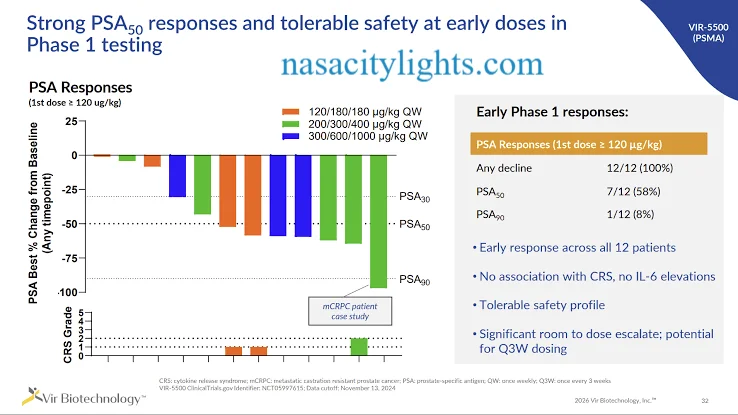
Oncology. Three PRO-XTEN dual-masked T-cell engagers are in Phase 1: VIR-5500 (PSMA, prostate cancer), VIR-5818 (HER2), and VIR-5525 (EGFR). Updated VIR-5818 dose-escalation data — monotherapy and in combination with pembrolizumab, in a basket design across multiple tumor types — are expected in the second half of 2026, while the VIR-5525 Phase 1 continues enrolling. Beyond the three clinical assets, management has pointed to seven preclinical programs on the same platform.
Vir Biotechnology Partnerships: An Alliance-Built Business
Short answer: partnerships are not a side activity here — they supply the technology, the capital and the commercial reach.
Look at how each major collaboration performs a different job:
| Partner | Year | What it provides |
|---|---|---|
| GSK | 2020 | Global development and commercial scale for sotrovimab |
| Alnylam | — | siRNA technology behind elebsiran |
| Xencor | — | Xtend half-life extension technology |
| Sanofi (Amunix) | 2024 | Three clinical TCEs + PRO-XTEN platform rights |
| Norgine | 2025 | European, Australian and NZ commercialization |
| Astellas Pharma | 2026 | Global co-development and cost-sharing in prostate cancer |
Two recent deals show the model maturing.
Norgine (December 2025). Under the exclusive license, the company received an initial reimbursement payment of EUR 55 million and is eligible for up to EUR 495 million in clinical, regulatory and sales milestones plus tiered mid-teen to high-twenties percentage royalties in Norgine’s territory; Norgine also contributes roughly 25% of go-forward external costs for the ECLIPSE program. Rights in the United States and other markets outside the Greater China territory were retained.
Astellas (2026). The VIR-5500 collaboration carries $1.7 billion in upfront payments and milestones and a 50/50 US profit-and-loss share, structured as $240 million upfront in cash, a $75 million equity investment at $10.36 per share, and a $20 million near-term manufacturing technology transfer milestone.
Original insight: the pattern here is capability-matched partnering rather than opportunistic licensing. Discovery-stage technology is in-licensed (Alnylam, Xencor, Amunix). Late-stage commercial infrastructure in regions where the company has no footprint is out-licensed (Norgine). Where an asset is large enough to justify shared risk and shared upside, it becomes a co-development alliance (Astellas). Each structure answers a different question — and each requires different governance.
How Biotech Alliance Management Actually Works
For anyone studying biopharma alliance strategy, Vir’s portfolio is a useful teaching case. Effective alliance management in this sector generally depends on:
- Clear governance architecture. Joint steering committees, defined escalation paths, and decision rights agreed before the first disagreement — not after.
- Economic alignment. Profit-share structures like the 50/50 US arrangement with Astellas create shared incentives that pure royalty deals do not.
- Cost-sharing discipline. Norgine’s ~25% contribution to ECLIPSE costs converts a commercial partner into a development stakeholder.
- Exit planning. The 2023 GSK amendment is instructive: collaborations end, and the terms that govern an unwinding matter as much as the terms that govern the honeymoon.
- Portfolio-level thinking. Alliances should be managed as a portfolio with a coherent risk profile, not as unrelated contracts.
The broader lesson: for a company of this size, business development capability is a core scientific asset, not a support function.
Leadership and Recent Developments
Marianne De Backer, M.Sc., Ph.D., MBA, serves as Chief Executive Officer, having joined from a senior business development role in large pharma — fitting, given the alliance-heavy strategy. The company has been recruiting a new Chief Financial Officer and a Chief Medical Officer with a strong medical oncology background to lead the pipeline transition. virtheglobeandmail
Financially, Q2 2026 was lifted by a large collaboration payment from Astellas, pushing cash above $1 billion and producing net income of $80.1 million compared with a loss a year earlier. Management has guided to a cash runway extending into the second half of 2028.
On commercial readiness, human factor studies are underway to bridge from hospital administration to in-home self-administration with monthly co-packaged doses — and management estimated US hepatitis delta diagnosis rates at just 10–15%, leaving significant room for growth through universal reflex testing and updated clinical guidelines.
What Comes Next?
The next twelve months are unusually binary. ECLIPSE 1 topline data in Q4 2026 will either validate a first-of-its-kind hepatitis delta regimen or force another strategic reset. In parallel, oncology readouts will test whether dual masking delivers the therapeutic index advantage the platform promises. Success in both would complete one of the more dramatic reinventions in recent biotech history: from pandemic-response antibody specialist to a commercial-stage liver disease and immuno-oncology company.
4. Frequently Asked Questions
What is the latest Vir Biotechnology news?
As of September 2026, the most significant developments are the completion of enrollment across all three ECLIPSE Phase 3 hepatitis delta trials, the closing of the Astellas collaboration for VIR-5500 in prostate cancer, and a Q2 2026 cash position above $1 billion. Topline ECLIPSE 1 data are expected in Q4 2026.
Is there a Vir Biotechnology Wikipedia page?
Yes — the company has an encyclopedia entry covering its founding, the GSK sotrovimab collaboration and its pipeline. For current, verifiable information, the investor relations section at investors.vir.bio and SEC filings are more reliable and more frequently updated than third-party wiki entries.
How is Vir Biotechnology stock performing?
VIR trades on Nasdaq. Shares were priced at $9.09 on May 14, 2026, roughly double their level a year earlier, and the stock has traded between a 12-month low of $4.16 and a high of $11.66 with a market capitalization near $1.49 billion. This is information, not investment advice — biotech shares are volatile and clinical readouts can move them sharply.
What does the Vir Biotechnology logo look like?
The brand uses a clean, minimal wordmark built around the company name, consistent with its scientific and clinical positioning. Official brand assets appear across the corporate website, press releases and investor presentations.
What careers are available at Vir Biotechnology?
Open roles typically span clinical development, translational medicine, regulatory affairs, biostatistics, manufacturing and commercial functions, concentrated in the San Francisco Bay Area. Current openings are listed in the careers section of vir.bio.
What is in the Vir Biotechnology pipeline?
The clinical pipeline centers on the tobevibart and elebsiran combination for chronic hepatitis delta, plus three PRO-XTEN dual-masked T-cell engagers: VIR-5500 (PSMA), VIR-5818 (HER2) and VIR-5525 (EGFR). Additional masked T-cell engagers are in preclinical development.
Has Vir Biotechnology had layoffs?
Yes. A restructuring discontinued the influenza, COVID-19 and T-cell viral vector programs and reduced the workforce from 587 to 408 employees, a cut of approximately 30%, following an earlier restructuring announced in December 2023. Headcount is now around 367.
Where can I follow Vir Biotechnology on LinkedIn?
The company maintains an active LinkedIn presence used for corporate announcements, scientific milestones and recruitment. Searching the exact company name on LinkedIn will surface the verified page.
Author BIo: Hamid Ali is a healthcare and biotech content writer who covers drug development, clinical pipelines, and pharmaceutical partnership strategy. He breaks down complex biopharma news into clear, practical insights for investors, industry professionals, and curious readers.
Author Name: Hamid Ali
Email: johanharwen314@gmail.com
Also Read: