
What Are Lagrange Points? The Powerful Secret Behind Space Missions in 2026
Introduction
Have you ever wondered how a telescope can sit perfectly still in space without burning endless fuel? That question leads us straight to what are Lagrange points and why scientists call them one of the most powerful tools in modern space exploration. These invisible spots in space let spacecraft stay balanced between the gravity of two large bodies, like the Earth and the Sun, without constantly firing their engines.
If you are new to this topic, do not worry. You do not need a physics degree to understand it. In this article, we will break down what are Lagrange points, why they matter, and how missions like the James Webb Space Telescope actually use them. By the end, you will know exactly why space agencies love these spots and how they shape the future of Moon, Mars, and interplanetary missions.
What Are Lagrange Points, Exactly?
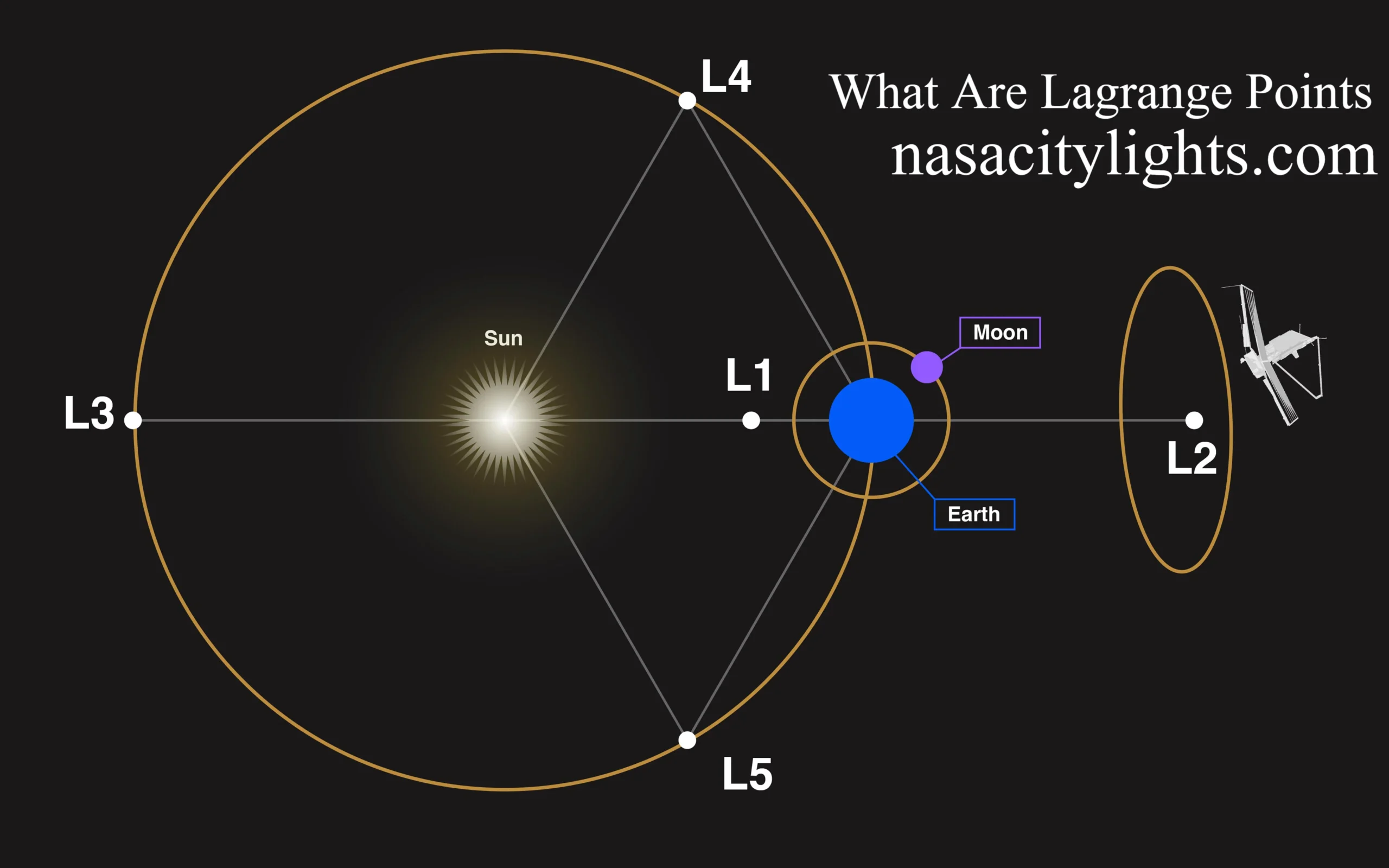
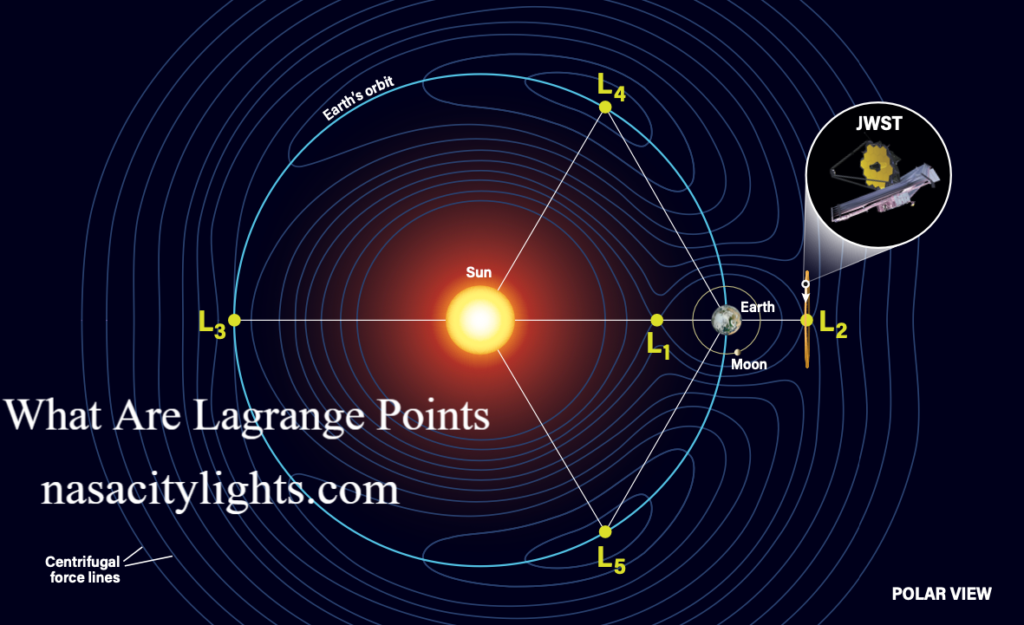
So what are Lagrange points in simple terms? They are five specific positions in space where the gravitational pull of two large objects, such as the Earth and the Sun, balances the centrifugal force felt by a smaller object, like a satellite. At these points, gravity and motion work together instead of against each other.
Named after mathematician Joseph Louis Lagrange, who discovered them in the eighteenth century, these points let a small spacecraft stay in a fixed position relative to the two larger bodies. Instead of orbiting endlessly and burning fuel to correct its path, the spacecraft can simply sit there, held in place by natural forces.
You will find these points labeled L1, L2, L3, L4, and L5. Each one has its own personality, its own uses, and its own level of stability. Let us explore them one by one.
The Five Lagrange Points Explained
L1: The Sun Watcher
L1 sits directly between the Earth and the Sun. From this spot, a spacecraft gets an uninterrupted view of the Sun, without the Earth ever blocking the view.
This makes L1 the perfect home for solar observation missions. Scientists use it to monitor solar flares, solar wind, and space weather that could affect satellites and power grids back on Earth.
L2: The Deep Space Observer
L2 lies on the opposite side of the Earth from the Sun. Here, the Earth, Moon, and Sun all sit behind the spacecraft, giving it a clear, unobstructed view of deep space.
This is exactly why L2 is used for space telescopes. The James Webb Space Telescope calls L2 home for this very reason. With the Sun, Earth, and Moon all behind it, Webb can keep its heat sensitive instruments shielded and cold, which is critical for detecting faint infrared light from distant galaxies.
L3: The Hidden Point
L3 sits on the far side of the Sun, directly opposite the Earth. We can never see it directly from our planet because the Sun always blocks the view.
While L3 is less commonly used for active missions today, it has sparked plenty of imagination in science fiction, often described as a hidden mirror planet. In reality, it is mostly of theoretical interest, though future missions could use it for solar studies from a completely different angle.
L4 and L5: The Stable Twins
L4 and L5 are different from the other three. They sit at the corners of an equilateral triangle formed with the two larger bodies. Unlike L1, L2, and L3, these two points are naturally stable.
This stability means objects like asteroids, dust, and debris can collect there over time without drifting away. In fact, Jupiter has thousands of asteroids trapped at its L4 and L5 points, known as Trojan asteroids. This natural collection makes L4 and L5 fascinating for scientists studying the early solar system.
Why Are Lagrange Points Important for Space Missions?
Understanding what are Lagrange points also means understanding why they matter so much. Here is why space agencies value them so highly.
- They save fuel. A spacecraft at a Lagrange point needs only tiny adjustments to stay in place, unlike a normal orbit that requires constant correction.
- They offer long term stability. Missions can operate for years without needing major intervention.
- They provide unique viewing angles. Depending on the point, a spacecraft can watch the Sun, deep space, or Earth without obstruction.
- They reduce mission costs. Less fuel and fewer corrections mean lower operational expenses over the life of a mission.
- They support scientific discovery. From studying solar wind to observing the birth of galaxies, these points open doors that regular orbits cannot.
I find it fascinating that something discovered through pure mathematics centuries ago now powers some of our most advanced space telescopes. It really shows how timeless good physics can be.
Real World Examples of Missions Using Lagrange Points
Space agencies are not just studying Lagrange points in theory. They are actively using them today.
- James Webb Space Telescope (L2): This telescope observes the early universe from L2, staying shielded from the Sun and Earth’s heat.
- SOHO, the Solar and Heliospheric Observatory (L1): SOHO watches the Sun continuously, helping predict solar storms.
- DSCOVR, the Deep Space Climate Observatory (L1): This satellite monitors solar wind and provides early warnings for space weather events that could impact Earth.
- Gaia Mission (L2): The European Space Agency uses L2 for Gaia, a mission mapping the positions of over a billion stars in our galaxy.
Each of these missions shows a different, practical answer to what are Lagrange points and how useful they truly are.
Lagrange Points in Astronomy and Earth Observation
Beyond individual missions, Lagrange points play a huge role in the bigger picture of astronomy and Earth observation. L1 helps scientists track solar activity that can disrupt communication satellites and power systems. L2 gives astronomers a clean, quiet spot to study the faintest light from the edge of the observable universe.
Earth observation missions also benefit indirectly. Better solar weather predictions from L1 satellites protect the very Earth observation satellites orbiting closer to home. In this way, Lagrange points support a whole network of space technology, not just single missions.
Practical Applications for Future Moon and Mars Missions
Looking ahead, what are Lagrange points going to mean for future exploration? Quite a lot, actually.
NASA already plans to use a Lagrange point near the Moon, called the Earth Moon L2 point, for its Gateway space station. This station will act as a stopping point for astronauts heading to the lunar surface and eventually to Mars.
For Mars missions, similar Lagrange points between Earth and Mars, or even Mars and the Sun, could serve as fuel efficient checkpoints for spacecraft traveling long distances. Instead of burning huge amounts of fuel for constant course corrections, missions could rest briefly at these stable points before continuing their journey.
This approach could make interplanetary travel more affordable and more sustainable, which matters a great deal as we plan longer and more ambitious missions.
Frequently Asked Questions
What are the five Lagrange points? The five Lagrange points are L1, L2, L3, L4, and L5. Each one sits at a different position relative to two large bodies, such as the Earth and the Sun, and offers unique advantages for spacecraft positioning.
Why are Lagrange points important? They are important because they let spacecraft stay in a fixed position using very little fuel. This saves money, extends mission life, and provides clear, unobstructed views for scientific observation.
Which Lagrange point is the most stable? L4 and L5 are the most stable. They naturally hold objects in place, which is why they collect asteroids and dust over long periods of time.
Why is L2 used for space telescopes? L2 is used because it keeps the Sun, Earth, and Moon behind the spacecraft. This gives telescopes a clear, dark view of deep space while keeping sensitive instruments shielded from heat and light interference.
Are Lagrange points the same for every planet? No. Every pair of large bodies, such as Earth and the Sun, or Earth and the Moon, has its own set of five Lagrange points. Their exact locations depend on the mass and distance of the two bodies involved.
Can humans live at a Lagrange point? Not yet, but future space stations, like NASA’s planned Gateway near the Moon, will use a Lagrange point as a base for astronauts traveling to deep space destinations.
Do Lagrange points require any fuel at all? Spacecraft still need occasional small adjustments to remain precisely positioned, but the fuel required is far less than what a traditional orbit would need.
Conclusion
So, what are Lagrange points, in the simplest sense? They are five natural balancing points in space that make modern space exploration more efficient, more affordable, and more scientifically powerful. From watching the Sun at L1 to studying distant galaxies at L2, these points have quietly become the backbone of many missions we rely on today.
As we look toward the Moon, Mars, and beyond, understanding what are Lagrange points will only become more important. They offer a smarter way to explore space without wasting precious fuel and resources.
What do you think? Would you like to see future missions rely even more heavily on Lagrange points? Share your thoughts, and if you found this article helpful, pass it along to a fellow space enthusiast.
nasacitylights.com
Author Name: Hamid Ali
Email: johanharwen314@gmail.com
About the Author: Hamid Ali is a science and technology writer with a passion for making complex space topics easy to understand. He enjoys breaking down astronomy and space exploration concepts for everyday readers who are curious about the universe around them.