
How Does NASA Predict Eclipses? The Amazing Science Behind It
Introduction
Have you ever looked up at the sky during an eclipse and wondered how scientists knew it was coming, sometimes decades before it actually happened? It feels almost magical, right? But there is no magic involved at all. If you have ever asked yourself how does NASA predict eclipses with such incredible accuracy, the answer lies in pure science, math, and years of careful observation.
NASA does not guess when an eclipse will happen. It calculates it. Every solar and lunar eclipse follows the predictable movements of the Sun, Earth, and Moon. By studying these movements closely, NASA can tell you the exact date, time, and location of an eclipse long before it occurs.
In this article, you will learn exactly how does NASA predict eclipses, what tools and data scientists use, and why these predictions are so remarkably accurate. You will also get answers to common questions people search for online. Let us break it all down in simple, easy to understand language.
The Basic Science Behind Eclipse Prediction
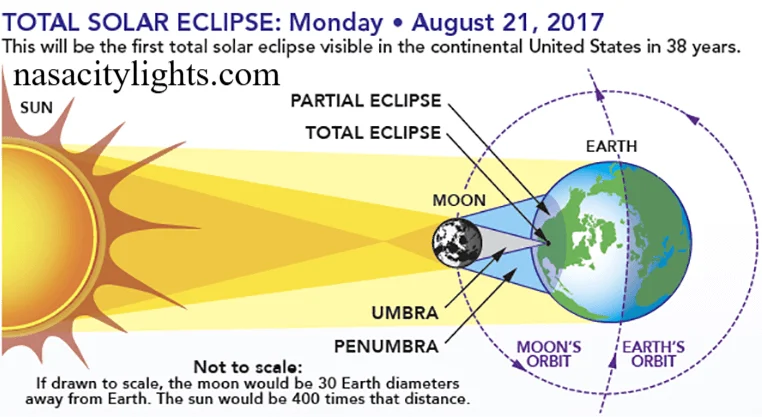
To understand how does NASA predict eclipses, you first need to understand what actually causes an eclipse. A solar eclipse happens when the Moon passes directly between the Sun and Earth. A lunar eclipse happens when Earth passes between the Sun and Moon, casting its shadow on the Moon.
These events are not random. They follow strict orbital patterns that scientists have studied for centuries. Since the Moon orbits Earth and Earth orbits the Sun in predictable paths, astronomers can calculate exactly when these three bodies will align.
This is the heart of the answer to how does NASA predict eclipses. It all comes down to orbital mechanics, which is simply the study of how objects move in space under the pull of gravity.
The Role of Orbital Mechanics and Gravity
Gravity controls everything in space. The Moon does not randomly float around Earth. It follows a fixed orbital path shaped by gravitational forces. Earth also follows a steady path around the Sun.
Because these paths are consistent and measurable, scientists can plug them into mathematical formulas. These formulas describe where the Sun, Earth, and Moon will be at any given moment, even far into the future.
When you ask how does NASA predict eclipses, orbital mechanics is really the foundation. Without understanding gravity and motion, none of these predictions would be possible.
Here is a simple breakdown of what scientists track.
- The Moon’s orbital tilt around Earth
- Earth’s rotation speed and axis tilt
- The elliptical shape of both orbits
- Small gravitational pulls from other planets
Each of these factors slightly affects timing, so NASA includes them all in its calculations.
How Computer Simulations Make It Possible
Decades ago, predicting eclipses required painstaking manual calculations. Today, NASA relies on powerful computer simulations to speed up the process and improve accuracy.
These simulations model the exact positions of the Sun, Earth, and Moon down to fractions of a second. Scientists feed in current orbital data, then let the software calculate future positions years or even centuries ahead.
This is another major part of how does NASA predict eclipses so precisely. Instead of relying only on old observations, modern technology lets scientists run thousands of calculations quickly and catch even tiny variations that could shift eclipse timing.
Solar Eclipses vs Lunar Eclipses: How Prediction Differs
Although both eclipse types follow orbital mechanics, predicting them involves slightly different factors.
Solar Eclipse Prediction
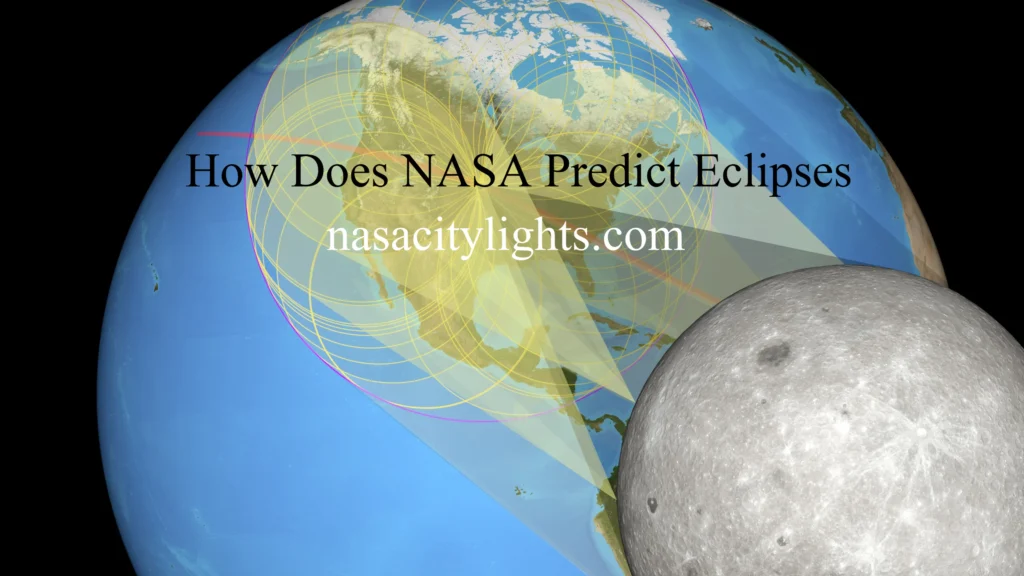
For a solar eclipse, NASA needs to calculate exactly where the Moon’s shadow will fall on Earth’s surface. Since the Moon is much smaller than Earth, its shadow only covers a narrow path. This is why solar eclipses are visible from limited locations.
Lunar Eclipse Prediction
Lunar eclipses are easier to predict in some ways because Earth’s shadow is much larger than the Moon. This means more people can see a lunar eclipse at once, since it is visible from an entire hemisphere rather than a narrow path.
Both predictions rely on the same core question, how does NASA predict eclipses, but the specific shadow calculations differ based on size and distance.
The Data and Tools NASA Uses
NASA does not rely on guesswork. It uses a combination of historical records, telescopes, satellites, and mathematical models refined over hundreds of years.
Some key data sources include the following.
- Centuries of recorded eclipse observations
- Satellite tracking of the Moon’s exact position
- Telescope measurements of solar and lunar movement
- Earth rotation data, including tiny slowdowns over time
By combining old astronomical records with modern satellite data, NASA continuously improves its models. This blend of historical knowledge and current technology is central to how does NASA predict eclipses with such confidence.
Why Eclipse Predictions Are Accurate Decades in Advance
You might wonder how scientists can predict an eclipse happening fifty or even a hundred years from now. The answer is that orbital patterns are extremely stable and repeat in predictable cycles.
One well known cycle is called the Saros cycle. This pattern repeats roughly every eighteen years and helps scientists predict similar eclipses far into the future.
Because of this reliable cycle, combined with precise math, how does NASA predict eclipses becomes less mysterious once you understand that space follows patterns, not randomness.
Why Eclipse Paths Change Slightly Over Time
Even though eclipses follow predictable patterns, their paths are not identical every time. Several small factors cause slight shifts.
- Earth’s rotation gradually slows down
- The Moon’s orbit is not a perfect circle
- Gravitational pulls from other planets add tiny influences
- Earth’s axis tilts slightly over long periods
These small variables explain why an eclipse path in one century looks slightly different from a similar eclipse centuries earlier. NASA accounts for all of this when explaining how does NASA predict eclipses accurately, even with these minor shifts.
How Accurate Are NASA’s Predictions?
NASA’s eclipse predictions are incredibly accurate, often within seconds for timing and just a few kilometers for location. This level of precision comes from decades of refined data and constant updates from satellites and observatories.
If you check historical predictions against what actually happened, you will notice they almost always match perfectly. This accuracy is a major reason people trust NASA’s eclipse calendar for planning travel, research, and public viewing events.
Frequently Asked Questions
1. How does NASA know when an eclipse will happen? NASA uses mathematical models based on the orbits of the Sun, Earth, and Moon. These models allow scientists to calculate exact alignment moments years in advance.
2. How accurate are NASA’s eclipse predictions? NASA’s predictions are extremely accurate, often precise to within seconds and a few kilometers of location, thanks to advanced tracking and orbital data.
3. What data does NASA use to predict eclipses? NASA uses historical eclipse records, satellite tracking, telescope observations, and Earth rotation data to build accurate models.
4. Why do eclipse paths change? Eclipse paths shift slightly due to Earth’s slowing rotation, the Moon’s elliptical orbit, and gravitational effects from other planets.
5. Can NASA predict eclipses hundreds of years into the future? Yes. Because orbital patterns repeat in predictable cycles like the Saros cycle, NASA can forecast eclipses centuries ahead with strong accuracy.
6. Why are solar eclipses visible from fewer places than lunar eclipses? The Moon’s shadow is small compared to Earth, so only a narrow path experiences a solar eclipse, while Earth’s larger shadow covers more area during a lunar eclipse.
7. Does NASA update its eclipse predictions over time? Yes. NASA continuously refines predictions using new satellite data and improved astronomical models to maintain high accuracy.
Conclusion
So, how does NASA predict eclipses so precisely? It all comes down to understanding gravity, orbital motion, and decades of reliable astronomical data. By combining historical records with modern computer simulations, NASA can tell us exactly when the Sun, Earth, and Moon will align to create these breathtaking events.
The next time you witness a solar or lunar eclipse, you will know it was not luck or chance. It was the result of careful science and precise calculations built over centuries. If you found this explanation helpful, share it with someone who loves space, or explore more about the next eclipse visible in your area.
nasacitylights.com
Author Name: Hamid Ali
Email: johanharwen314@gmail.com
About the Author: Hamid Ali is a passionate content writer who loves exploring space, science, and technology topics. He enjoys breaking down complex scientific concepts into simple, easy to understand articles that readers actually enjoy.